
Lecture 2 min.
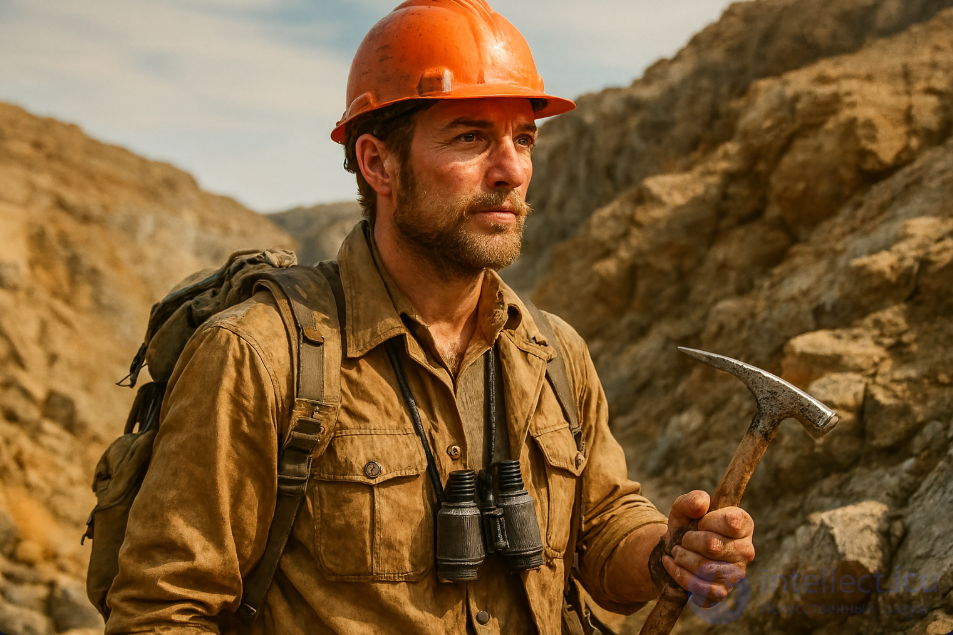
A geologist is a specialist who studies the structure of the Earth's crust, minerals, rocks, groundwater, and the processes that shape the planet. Their work covers mineral exploration, the compilation of geological maps, assessing the safety of sites for construction, and analyzing environmental changes.
Good vision and hearing (working with instruments, maps, and samples).
Endurance and a strong musculoskeletal system (expeditions, work in mountains and mines).
No chronic respiratory diseases (conditions are often dusty).
Resistance to temperature swings and varying climate conditions.
High stress tolerance (expeditions, isolation, extreme conditions).
Attentiveness and an analytical mindset.
Patience and persistence for desk-based data processing.
Teamwork and communication skills (expeditions and projects).
A bachelor's or specialist degree in geology, geophysics, hydrogeology, or engineering geology.
A master's degree for scientific and research work.
Additional skills: working with GPS, drones, drilling equipment, and geodata processing software.
| Country | Income range (USD) |
|---|---|
| United States | 4,500 – 7,000 |
| China | 1,200 – 2,500 |
| Russia | 800 – 1,500 |
| Ukraine | 500 – 900 |
| India | 400 – 700 |
| South Africa | 1,200 – 2,000 |
| Egypt | 600 – 1,000 |
| Israel | 3,000 – 5,000 |
Silicosis and other dust-related lung diseases (work in mines and quarries).
Musculoskeletal disorders (prolonged strain, expeditions).
Skin and eye conditions (contact with chemical reagents, ultraviolet exposure).
Psycho-emotional exhaustion (long expeditions, isolation).
The geology profession arose at the intersection of humanity's practical needs and the scientific study of nature.
Even in ancient times, people who did not call themselves geologists searched for stone, clay, metals, and salts. Mining flint, copper, gold, and iron required understanding where and in which rocks they could be found.
Antiquity
In Ancient Greece, philosophers such as Aristotle and Theophrastus tried to explain the origin of minerals, mountains, and earthquakes. Their works became the first steps toward a scientific understanding of geological processes.
The Middle Ages
During this period, knowledge of the Earth's interior developed slowly, but practical mining was actively conducted. An important role was played by the scholar Abu Rayhan al-Biruni, who described minerals and rocks with scientific precision.
The early modern period (17th–18th centuries)
It was during this time that geology began to form as an independent science.
The following appeared:
the first geological maps,
the systematization of rocks,
an understanding of the Earth's layered structure.
The 19th century — the «golden age of geology»
The rapid growth of industry and transportation sharply increased demand for mineral resources. Geology became the foundation of:
mining,
the oil industry,
the construction of railroads and cities.
The 20th century
Geology became closely linked with physics, chemistry, and mathematics. New fields emerged:
geophysics,
geochemistry,
plate tectonics,
space geology.
Considered the founder of Russian geology. He was one of the first to propose ideas about:
the organic origin of mineral resources,
the gradual formation of the Earth's crust.
The father of modern geology. He formulated the principle of uniformitarianism:
«The present is the key to understanding the past».
Developed Hutton's ideas and had an enormous influence on the natural sciences, including on Charles Darwin.
Creator of the theory of the biosphere and noosphere. He showed that life is one of the most powerful geological forces on Earth.
Author of the theory of continental drift, which became the foundation of modern plate tectonics.
Today, a geologist is not just someone with a hammer in the mountains. They are a specialist who:
analyzes satellite data,
works with 3D models of the subsurface,
takes part in the search for oil, gas, metals, and rare earth elements,
assesses geological risks (landslides, earthquakes),
works in environmental and engineering geology.
AI is already being actively used in geology:
analysis of large volumes of geodata,
recognition of structures in satellite imagery,
predicting mineral deposits,
modeling processes within the Earth's interior.
No, the profession will not disappear, but it will undergo significant transformation.
AI:
speeds up calculations and analysis,
reduces routine work,
helps identify patterns.
But AI cannot fully replace:
fieldwork,
scientific intuition,
integrated thinking,
responsibility for decisions with environmental and social consequences.
This is a specialist who:
combines knowledge of geology, programming, and data analysis,
knows how to work with AI as a tool,
makes strategic decisions.
Geophysicist
Hydrogeologist
Engineering geologist
Geochemist
Paleontologist
Environmental geologist
Conclusion: The geology profession combines the romance of expeditions with serious risks. It requires robust health, a resilient psyche, and specialized education. Salaries vary greatly depending on the country and sector (research, mining, consulting). Related professions make it possible to expand career opportunities in adjacent fields. The geology profession has come a long way, from the primitive search for stone to a high-tech science connected to space and artificial intelligence.
With the development of AI, the geologist is becoming not a less but a more important specialist, since it is the human being who sets the goals, interprets the results, and bears responsibility for the future use of the Earth's resources.

Comments