
Lecture
A ship's captain — is the highest-ranking official on any vessel, whether it be a cargo, passenger, fishing, or naval ship. He bears full responsibility for the safety of the crew, passengers, cargo, and the ship itself. The captain manages navigation, makes decisions in emergency situations, oversees the ship's technical condition, and ensures compliance with international maritime standards
A captain is an official who heads a ship's crew and is responsible for its actions on board.
Captain — a maritime term denoting the official who heads the crew of a civilian vessel and bears responsibility for its actions; under normal circumstances, holding a ship-navigation education and possessing the maritime rank of captain (navigator) is considered necessary and mandatory — a representative of the shipowner and cargo owners with respect to debts and claims arising from the needs of the ship, cargo, and voyage, in the absence of other representatives (for example, he is granted the right to sell part of the cargo or the ship's property in order to purchase, at a foreign port, the fuel necessary to complete the voyage).
The captain also bears responsibility for operating the ship; his duties include ensuring the safety of navigation, maintaining order aboard the floating unit entrusted to his command, and preventing any harm to people and cargo. The captain's orders within the limits of his authority are binding on all persons aboard the ship; he has the right to isolate any person whose actions threaten the safety of the ship and people, and to conduct an inquiry in the event of a crime committed on board, he oversees the hiring and dismissal of crew members, applies measures of reward and penalty, performs notarial functions aboard the ship (in cases of birth, death, drawing up of wills, etc.), organizes rescue operations upon receiving a distress signal from another vessel, leads the struggle for the survivability of the ship (his own), and if necessary leaves it last, taking with him the ship's, engine, and radiotelegraph logs, voyage charts, documents, and valuables. A ship's captain retains his rights even after the loss of the ship, up until the crew's return to their homeland. He takes all necessary measures to prevent the seizure of the ship by enemies in wartime, and by pirates — in peacetime. The interactions of the ship's captain with pilots are governed by a special regulation. In naval practice, his authority, rights, and duties are regulated by the ship's charter of the navy.
In the dredging fleet, the ship's captain is called a bagermeister.
In civil aviation, the captain is the term for the commander of an aircraft.
The law grants the captain of a seagoing vessel very broad powers, extending to the use of force, for example, to suppress a mutiny, or to defend against an attack by pirates. In many cases, a person, even one senior in rank or position, does not have the right to give orders bypassing the captain. In other words, the captain has the absolute right to make decisions related to the safety of the ship, cargo, and crew, unrestricted by any considerations of subordination.
Flag states that do not fall under the definition of a flag of convenience require that the ship's captain hold the citizenship of the country whose flag the ship carries.
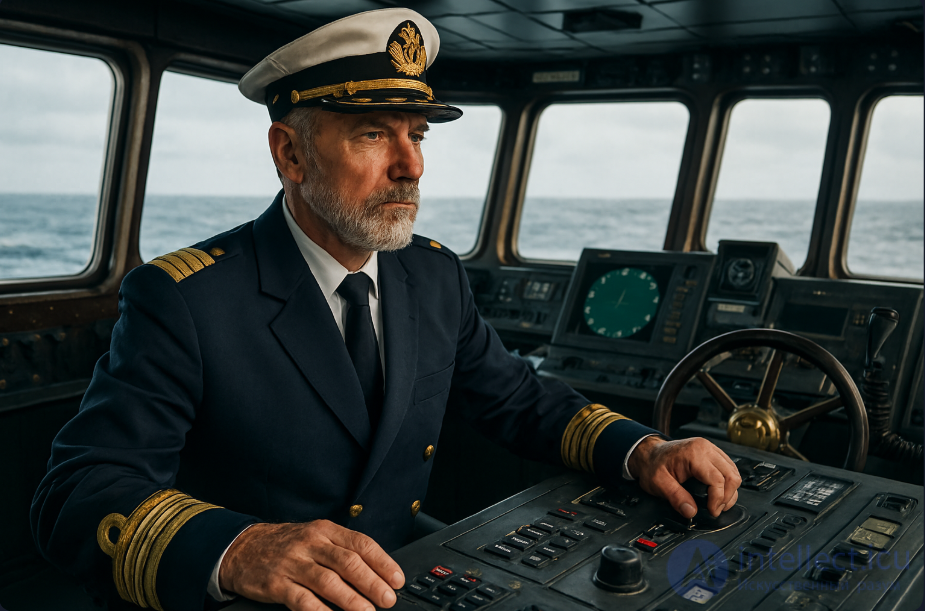
The history of seafaring and shipping spans nearly 5,000 years. Even in prehistoric times, people actively attempted to travel by water. With the development of foreign and domestic trade, a need arose to establish connections between distant countries and cities located vast distances apart. Only very wealthy people could afford to own a personal ship.
Many merchants chartered a vessel to transport goods across rivers, seas, and oceans. The most important person aboard the ship was the captain. He chose the most favorable route and coordinated the actions of the crew throughout the entire journey.
The profession of ship's captain is full of surprises and, to a certain extent, involves risk to life and health. In the open sea, one often has to confront the raging elements. At the same time, the cargo must be delivered to its final destination on time. The presence of a pilot aboard the ship does not relieve the captain of responsibility for what happens on the ship.
In foreign countries, this profession is among the highly paid ones. At the same time, in a number of countries only ocean-going captains can count on good earnings. Wages vary depending on the type of vessel. Captains of river ferries and small vessels have a more modest income.
Being an exclusively male profession, this occupation has the following advantages:
The disadvantages are
A ship's captain is a leader who directs the actions of all crew members. He has the right to isolate any person whose actions threaten the safety of the ship or crew. In the event of a crime committed on board, the captain conducts an inquiry.
His duties also include:
None of the mates has the right to make changes to the course and speed set by the captain. Exceptions are emergency situations that threaten the ship's continued safe movement.
In the event of an evacuation, the captain is the last to leave the vessel, taking with him the ship's, engine, and telegraph logs.
To be admitted to work as a captain, one must pass an in-depth medical examination, which includes:
Excellent vision and hearing (including color perception)
Absence of chronic diseases, especially cardiovascular and neurological ones
Good physical endurance
The ability to work for extended periods under conditions of rolling seas, confined space, and time-zone changes
Psychological resilience — is a key factor. Required are:
Stress resistance and the ability to make decisions under pressure
Leadership qualities and the ability to manage a team
A high level of responsibility
The ability to adapt and concentrate quickly
Emotional stability during prolonged isolation
A ship's captain – is a person with an iron will who does not lose composure in the most difficult situations. The necessary qualities a captain must possess:
A ship's captain has excellent health and practical thinking; he does not suffer from seasickness or chronic illnesses.
To become a captain, one must work one's way up from seaman to chief mate. Education includes:
Secondary vocational or higher maritime education (maritime academies, colleges)
Certification according to international standards (STCW — the International Convention on Standards of Training, Certification and Watchkeeping for Seafarers)
Possession of maritime experience (usually no less than 5–10 years)
Regular professional development and completion of training in safety, navigation, and ecology
No company whose activities involve passenger and cargo transportation, as well as fishing, can do without a ship's captain.
To obtain a license to operate a vessel, one will need to work as a seaman for at least 1 year. Afterward, one will spend several years working in the position of helmsman.
The profession of ship's captain requires a higher education in the specialty «Management of Water Transport and Hydrographic Support of Navigation» or «Ship Navigation». It is also possible to obtain a secondary education in the specialty «Operation of Inland Waterways».
A ship's captain is a strong-willed individual. He must be able to find common ground with the crew while remaining a demanding commander. He is obligated to know the existing intricacies of navigation, the structure of the ship, and the particulars of how the technical equipment functions.
The work requires the ability to operate the ship and to handle navigational instruments and charts. The captain must also be competent in the legal nuances associated with preparing the necessary documentation.
| Country | Average monthly salary of a ship's captain |
|---|---|
| USA | $9,000 – $14,000 |
| China | $5,000 – $8,000 |
| Russia | $2,500 – $4,500 |
| Ukraine | $2,000 – $4,000 |
| India | $3,000 – $6,000 |
| South Africa | $4,000 – $7,000 |
| Egypt | $1,500 – $3,000 |
| Israel | $6,000 – $10,000 |
The salary depends on the type of vessel (cargo, passenger, oil tanker), the company, the routes, and the captain's experience.
A captain's work is associated with a number of risks:
Seasickness and chronic fatigue
Sleep and circadian rhythm disturbances
Psycho-emotional burnout
Musculoskeletal problems (due to limited mobility)
Hypertension and cardiovascular diseases
If you are interested in the maritime field, but not necessarily the role of captain, consider:
Navigator
Chief mate
Ship's mechanic
Radio operator
Marine engineer
Yacht skipper
Pilot
Ship safety inspector

Comments