
Lecture
A customs officer is a government official who monitors the movement of goods, transport, and people across the border. Their task is to ensure compliance with the law, prevent smuggling, collect duties, and protect the country's economic security. Customs officers work at checkpoints, airports, railway stations, excise departments, and even in private companies engaged in foreign economic activity.
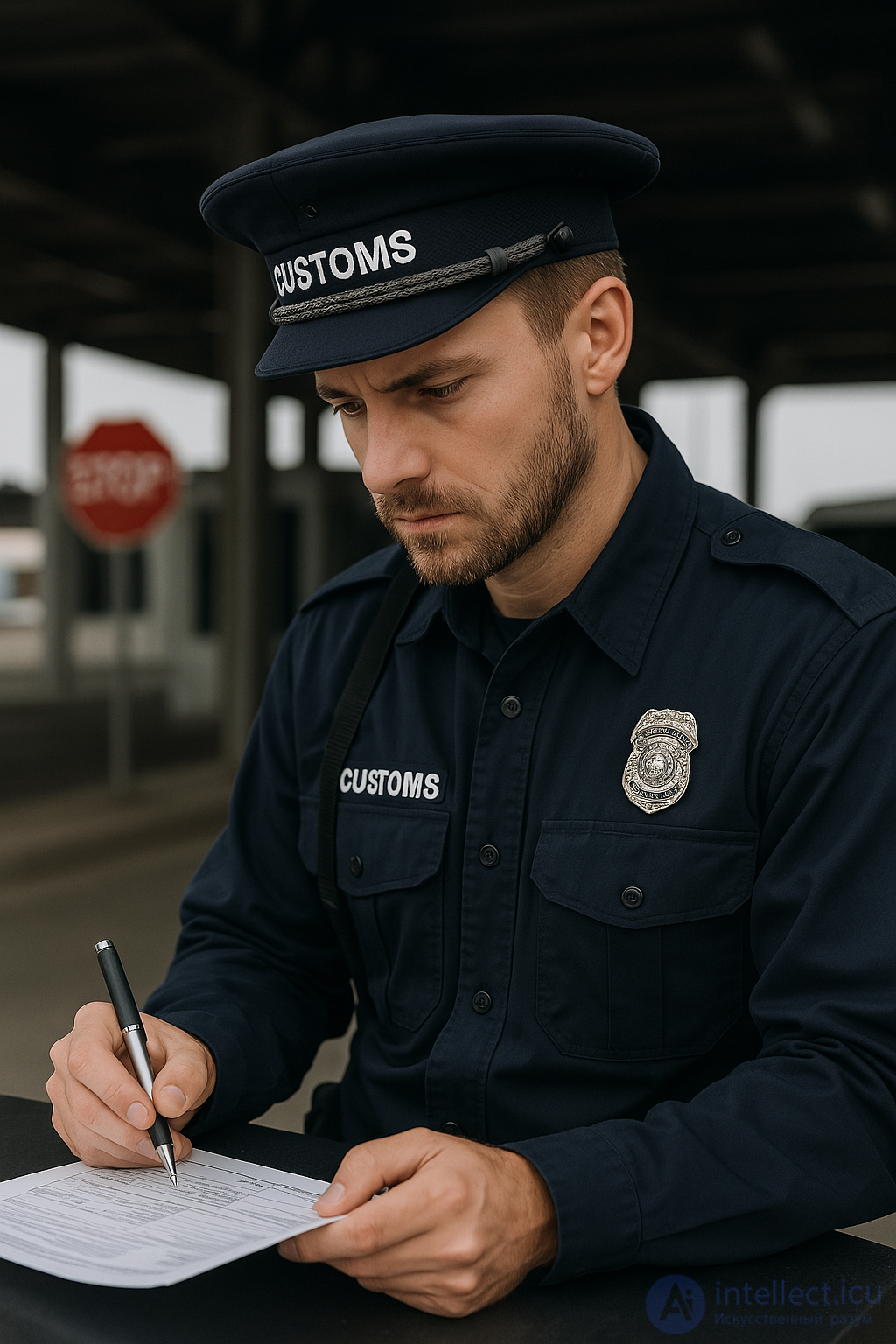
Strict health requirements are set for service in the customs authorities:
absence of chronic diseases that impede physical activity (for example, tuberculosis, pancreatitis, musculoskeletal disorders);
good vision and hearing;
resistance to stress and shift schedules;
passing a medical examination under Federal Customs Service Order No. 2460.
The work requires high concentration and resilience:
attention to detail;
stress resistance;
well-developed intuition and observation skills;
the ability to make decisions quickly;
communication skills — it is important to be able to defuse conflicts and conduct dialogue with representatives of different cultures.
To become a customs officer, specialized education is required:
a bachelor's or specialist's degree in «Customs Affairs», «Law», or «Economics»;
training is possible at universities such as the Russian Customs Academy (RTA), IMES, as well as at colleges and professional development courses;
mandatory knowledge of foreign languages and EAEU legislation.
Salary depends on the country, region, and level of position. Approximate figures:
| Country | Average customs officer salary (per month) |
|---|---|
| USA | $4,000–$6,000 |
| Germany | $3,000–$4,000 |
| France | $2,500–$3,500 |
| Russia | $500–$1,200 |
| Ukraine | $400–$800 |
| Japan | $3,000–$4,500 |
In countries with a high standard of living (Switzerland, USA, Norway), salaries can exceed $6,000 per month.
Customs officers are exposed to a number of risks:
chronic stress and emotional burnout;
respiratory diseases (when working with chemicals, contraband);
sleep disorders and cardiovascular problems;
vibration disease (when working with machinery);
skin diseases (when in contact with toxic substances).
Ancient roots: The first forms of customs control existed as far back as Ancient Egypt, Greece, and Rome, where duties were levied on the movement of goods between regions.
The Middle Ages: In Europe, customs fees became an important source of income for feudal lords and kingdoms. The first customs posts, regulations, and trade barriers appeared.
18th–19th centuries: In the era of the formation of nation-states and industrialization, customs became an instrument of economic policy — protecting the domestic market and regulating imports and exports.
After the world wars:
The 20th century, especially after the First and Second World Wars, became a turning point. The world faced:
Mass migrations and flows of refugees
The growth of smuggling of weapons, currency, and strategic resources
Tighter borders and increased control over the movement of people and goods
The active development of customs services as elements of national security began.
Differences in the level of development of countries and in ideological systems (for example, East–West during the Cold War) strengthened the role of customs officers as "border guards of the economic front."
The Soviet period: In the USSR, customs performed not only an economic function but also an ideological one — controlling the import of prohibited literature, equipment, and currency.
The present day: Today, a customs officer is a specialist who works with digital systems, international agreements, logistics, and security. Customs services are integrated into global networks for data exchange and the fight against transnational crime.
Although the customs officer profession rarely becomes public, there are known cases where employees displayed heroism or became experts:
Alexander Belsky — an honored employee of the Russian customs service who contributed to the development of customs legislation.
Vladimir Malinovsky — an expert in the field of customs law, author of textbooks and teaching aids.
International examples — employees who uncovered major smuggling schemes or took part in anti-corruption investigations often remain in the shadows, but their contribution to security is enormous.
Troy A. Miller — Commissioner of CBP, heads the largest border and customs structure in the USA, responsible for border security, combating smuggling, and immigration control.
Pete R. Flores — Deputy Commissioner, oversees operational areas, including control at borders, airports, and ports.
Although rank-and-file CBP employees rarely become public figures, some receive recognition for uncovering major smuggling schemes, saving the lives of migrants, or participating in international operations.
In Ukraine, the fame of customs officers is more often associated with reforms or investigations:
Yulia Marushevska — former head of the Odessa customs office, became a symbol of anti-corruption reforms in 2015–2016 after being appointed by Mikheil Saakashvili. She actively advocated for transparency and digitalization.
The profession will not disappear, but it will change radically:
Automation: AI is already used to analyze declarations, identify suspicious cargo, and recognize faces and license plates.
Risks: Routine tasks (checking documents, sorting cargo) will be fully automated.
New roles:
Risk and violations analyst
Cybersecurity specialist in the customs sphere
Operator of intelligent control systems
The human factor: Decisions about detention, inspection, and diplomatic nuances will remain with people.
Thus, the customs officer of the future is a highly qualified specialist who works in tandem with AI, not one replaced by it.
If you are interested in the customs field, consider related areas:
Customs declarant — processing export-import documents;
Foreign economic activity inspector — monitoring foreign economic activity;
Customs operations auditor — checking compliance with the law;
Customs clearance specialist — processing transport and cargo;
Customs risk management specialist — analyzing and preventing violations.

Comments