
Lecture
A pilot is a specialist who operates an aircraft (airplane, helicopter, glider, etc.) during flight. They are responsible for safety, navigation, the technical condition of the machine, and interaction with ground services. In civil aviation the term «pilot» is used more often, while in the military the term «airman» (lyotchik) is used.
The distinction between «lyotchik» (airman) and «pilot» is subtle but interesting, especially in Russian. Here is how they differ by context, style, and usage:
| Term | Core meaning | Context of use |
|---|---|---|
| Lyotchik (airman) | A person who operates an aircraft | More traditional, military, Russian-language |
| Pilot | The same, but with an emphasis on the profession | International, civil, modern |
«Lyotchik» (airman) — more often associated with military aviation, heroism, history (fighter pilot, cosmonaut pilot).
«Pilot» — a more neutral and universal word, especially in the context of civil aviation (airline pilot, drone pilot).
| Type of pilot | Description |
|---|---|
| Civil | Operates passenger, cargo, and private aircraft |
| Military | Pilots combat aircraft: fighters, bombers, reconnaissance planes |
| Test pilot | Tests new or upgraded aircraft models |
| Instructor pilot | Trains cadets and students in piloting |
| Cosmonaut pilot | Carries out space missions |
| Agricultural aviation pilot | Works in the agrarian sector: spraying fertilizers, pesticides |
| Helicopter pilot | Operates helicopters in civil, rescue, or military missions |
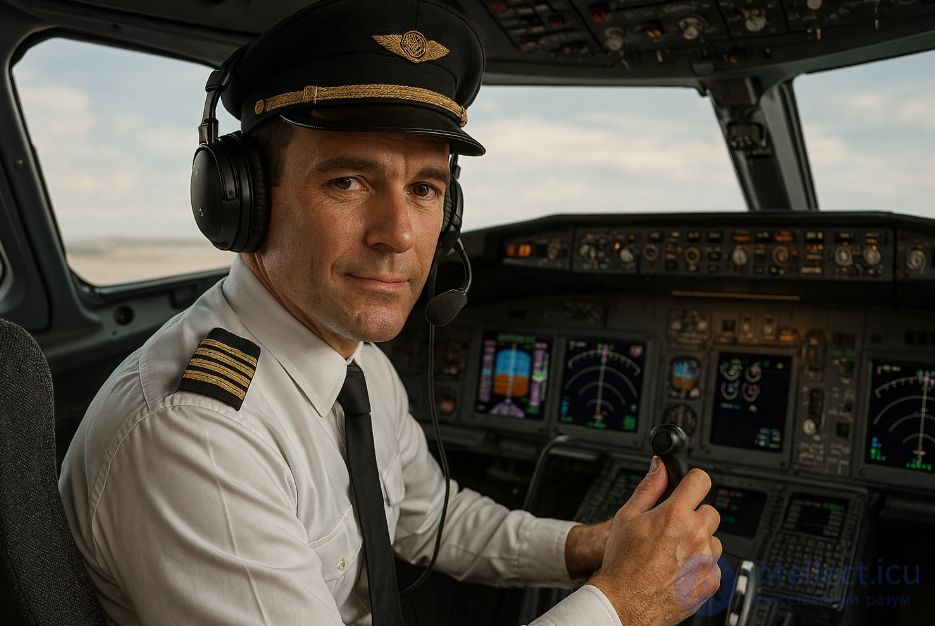
Preparation for flight: checking the equipment, planning the route
Operating the aircraft: takeoff, flight, landing
Navigation and communication with air traffic controllers
Responding to emergency situations
Interacting with the crew
Keeping documentation and records
Professional development and compliance with safety standards
Excellent vision (often without correction)
Healthy cardiovascular system
No chronic illnesses
Good coordination and vestibular system
Stress resilience
Quick reactions and analytical thinking
Ability to make decisions under conditions of uncertainty
High level of concentration
Secondary specialized or higher education in the following fields:
Flight operation of aviation complexes
Aircraft control systems
Operation of aircraft and air traffic management
Pilot license (PPL, CPL, ATPL — depending on the level)
Regular training and recertification
| Country | Average annual salary |
|---|---|
| USA | $120,000 – $160,000 |
| Canada | $90,000 – $130,000 |
| Germany | $80,000 – $110,000 |
| UAE | $100,000 – $150,000 |
| Russia | $20,000 – $40,000 |
| India | $15,000 – $30,000 |
| Australia | $100,000 – $140,000 |
| China | $90,000 – $120,000 |
| Iran | $6,000 - $30,000 |
| South Africa | $36,000 - $84,000 |
Salary depends on the type of aviation, experience, company, and region.
Hearing impairment (due to noise)
Varicose veins and thrombosis (prolonged sitting)
Spinal problems
Fatigue and jet lag syndrome
Psycho-emotional burnout
Navigator
Air traffic controller
Aircraft technician
Aviation equipment engineer
Unmanned aerial vehicle operator
Cosmonaut
Aviation simulator instructor

Comments