
Lecture
In an era of rapid change and intense competition, the concepts of «professional» and «professionalism» take on special value. To be a professional means not merely to possess knowledge, but also to be able to apply it with precision, ethics, and responsibility. Professionalism is not only a level of qualification, but also a style of thinking, behavior, and attitude toward one's work. In this article, we will examine which qualities shape a true professional and why they matter in any field of activity.
A professional is a person who has made a certain occupation (activity) their profession; a person who has become a high-class specialist in some field of activity; a specialist well prepared for work in a certain sphere, possessing skills, qualifications, and, when necessary, clearance to carry out duties within their specialty.
A professional is usually a member of a community of qualified specialists who possess skills in a particular field (a profession). Such communities are engaged in the preparation and training of their members beyond primary (university) education; they also develop codes of conduct (the Hippocratic Oath) and industry standards, and they have the right to issue permits (licenses) to engage in professional activity and to oversee the conduct of their members.
The term professional is often applied to highly qualified specialists in the creative professions — medicine, law, architecture, construction — who often hold the independent status of a sole proprietor. Professionals usually earn money by using their skills and abilities; their activity is their profession.
Professionalism is a special quality of people who systematically, effectively, and reliably carry out complex (professional) activity under the most diverse conditions. Here, professional activity is understood as complex activity that presents itself to a person as a constituted way of performing something, having a normatively established character. Professional activity is objectively complex, and therefore it is difficult to master and requires a long period of theoretical and practical training. In the normal case, this activity becomes a profession and implies material remuneration.
It derives from the Latin profess — to swear, to promise, to confirm: qualified specialists possess a reputation that must be constantly «confirmed,» and they «swear» and «promise» to use their knowledge and skills to accomplish the work.
Professionalism embodies the degree to which a person has mastered the special psychological structure of their professional activity. This structure corresponds to socially recognized standards and objective requirements. Professional experience acts as a key characteristic of the individual in the role of professional and manifests itself both in activity and in communication. The concept of professionalism includes not only achieving good results in one's work, but also the internal incentives, values, and meaning that a person attaches to their professional activity. Professionalism, considered as a characteristic of personality, represents a set of stable traits that ensure a certain level of quality in professional activity, including effectiveness, reliability, and quality, under various circumstances. Professional skill includes competence, but is not limited to it, also encompassing responsibility. Professionalism also includes a professional worldview, attitudes toward oneself, one's activity, one's profession, and the surrounding world, as well as the motivation that drives professional development. In other words, professionalism is the union of competence and responsibility.
The formation of a professional usually rests upon general mental development, is carried out against its background, and comes after it. The professional within a person is younger than the personality and the individual. Thus, in the beginning (in early and preschool age) general human abilities are laid down (the capacity for cognition, for thinking, for communication, for initial forms of labor); then, on their basis (more often in school age) special abilities arise (in the humanities, technical fields, etc.); later (usually in youth) general professional abilities begin to take shape (relating to different types of profession); in adulthood, special professional abilities are formed (as the person specializes in a profession).
The psychological formation of a professional means the appearance of new qualities in a person's psyche that were previously absent in the person or existed in a different form (for example, a number of professional abilities grow out of general human qualities), as well as the emergence in the person of new types of professional activity and professional communication that did not exist before. This means that the formation of a professional is an "increment" to a person's psyche, its enrichment. A particular case of a professional's development is regress: the loss or deformation of old qualities, the appearance of new negative traits, the disintegration, interruption, or cessation of professional activity, which means qualitative, albeit negative, changes in a person's psyche. A person who possesses an active, mature personality strives to resist negative processes, developing methods of compensation, new creative strategies, and mastering for this purpose new mental qualities and modes of activity, which once again advances mental development.
The basic characteristics of a professional, formulated by Harvard University professor Howard Gardner and by Lee Shulman, president of the Carnegie Foundation for the Advancement of Teaching:
A number of features are distinguished that set a professional apart from a non-professional: an understanding of the essential foundations of professional activity, a capacity for reflection, the ability to forecast the processes and phenomena within the zone of professional vision, a comprehensive grasp of the subject, and the ability to model a system of professional activity. A professional is characterized by: a high speed of performing professional actions with the inclusion of intuitive processes; novelty and originality of activity against a backdrop of rejecting stereotypes, and the removal of psychological barriers and defense mechanisms; the continuity and inexhaustibility of creative processes; the unconscious regulation (automatism) of professional activity .
As the most important system-forming factor of a person as a professional, E. F. Zeer singles out personal orientation, which includes the following components: motives, value orientations, professional stance, and professional self-determination. The author showed that at different stages in the formation of a professional these components have different psychological content, conditioned by the nature of the leading activity and the level of professional development of the personality .
The work of a professional is not reduced to what is visible to an outside observer; from the standpoint of cognition, the professional person (as the bearer of a specific quality called professionalism) should be regarded as a certain multilevel system that has not only external functions but also complex, diverse internal functions — in particular, mental ones. According to E. A. Klimov, professionalism appears not simply as a certain high level of knowledge, skills, and results manifested in a given field of activity, but as a certain systemic organization of the consciousness and psyche of the professional person .
Proceeding from the principles of the science of the human being (as formulated by B. G. Ananyev), a professional is a person as a whole: as an individual (the biological essence of the professional person), as a personality (their social essence), as a subject of activity, and as an individuality (the uniqueness of this particular person)[ . In the process of a person's professionalization (the formation of professionalism), changes affect all of their levels, and to a greater extent professional development occurs at the mental and psychophysiological level. The individuality inherent in a professional takes shape on the basis of the interconnection between the features of the person as a professional personality and as a subject of professional activity, which are conditioned by the natural properties of the person as an individual. At the same time, the very formation of the professional person occurs in the course of professional activity and under its influence .
A professional is characterized by high productivity and effectiveness of labor, and the professional steadily demonstrates these indicators in the most diverse situations and conditions of activity, including those that objectively make it difficult to achieve a result .
The process of becoming a professional passes through several stages. Mastery is the highest level of command of the various aspects of an activity.
In Ozhegov's Explanatory Dictionary, the word «master» has the meaning « a specialist who has attained a high level of artistry in their craft». One of the definitions that Dahl's Explanatory Dictionary gives to a master is: «especially knowledgeable or skilled in one's craft» In this sense, a master is a professional who has attained a high level of professionalism in a certain profession . The stage of professional mastery is characterized by a creative and innovative level of performing professional activity. The driving factor of further professional development of the personality becomes the need for self-realization and self-fulfillment .
Expertise: A professional possesses deep knowledge and skills in their field. They constantly improve their knowledge and keep up with new trends and technologies in order to stay ahead.
Responsibility: A professional understands the importance of their work and is ready to take responsibility for it. They perform their duties accurately and on time, and do not leave tasks unfinished.
Efficiency: A professional is able to achieve high results with minimal resources. They know how to plan their work, optimize processes, and attain maximum productivity.
Communication: The ability to communicate well with colleagues, clients, and partners plays an important role. A professional expresses their thoughts clearly and precisely, listens to others, and resolves conflicts effectively.
Adaptability: In today's world, a readiness for change is required. A professional adapts to new conditions, learns quickly, and adjusts to different situations.
Initiative: A professional does not limit themselves to performing their direct duties, but looks for ways to improve processes, proposes new ideas, and contributes to the development of their field.
Honesty and ethics: Professional conduct is based on high moral principles. Honesty, reliability, and adherence to ethical standards play an important role in building long-term relationships with clients and colleagues.
Problem-solving ability: A professional is able to analyze complex situations, identify the causes of problems, and find effective ways to solve them.
Leadership: Depending on the field, a professional may also possess leadership qualities. They inspire and motivate others, help colleagues develop, and create an atmosphere of a cohesive team.
Professional development: A professional strives for constant development and self-improvement. They seek opportunities for learning, professional growth, and expanding their skills.
Together, these characteristics help create a positive impression of a professional and contribute to achieving outstanding results in their field of work.
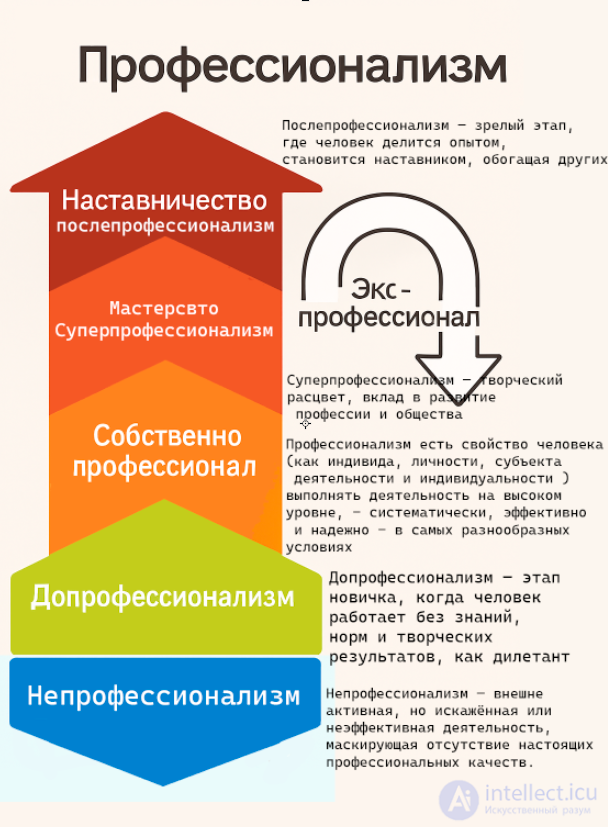
Pre-professionalism. Here a person carries out certain work and types of labor without possessing the professional qualities named above. In other words, the person works, but as a novice, a dilettante, having not yet mastered the norms and rules of the profession, much less achieving high and creative results in their labor. Every person usually passes through this stage in their working life, but some people (passive, unhealthy ones) may linger here for a long time.
Professionalism. This level encompasses the greater part of the lives of those belonging to the active portion of the population. Here a person consecutively masters the qualities of a professional. Thus, the person assimilates the norms and rules of the profession and at first performs work according to a template, according to instructions, in the course of executive labor; then acquires a specialty and a qualification and carries out qualified labor.
Super-professionalism (the highest professionalism). This level characterizes professional activity in its full flower («acme»), in its high achievements and creative successes. The main feature of this level is the «person's going beyond the bounds of the profession,» that is, the creative enrichment of it through one's own personal contribution. It is precisely this level of an individual's professionalism that most significantly affects the progress of society.
Non-professionalism (pseudo-professionalism). This level does not coincide with pre-professionalism, where a person lacks the necessary professional knowledge and skills. At the level of pseudo-professionalism, a person outwardly carries out fairly active labor, but at the same time certain deformations are observed in their formation as a professional: either the person performs ineffective activity that does not conform to norms (allowing «defects»); or carries out outwardly bustling labor to mask an absence of professionalism; or fixates their whole life on work, unjustifiably reducing all of their personal space to the professional and thereby distorting their professional and personal development; or the person proceeds from mistaken, defective spiritual and moral guidelines, pursuing, for example, goals of narrow personal individual success to the detriment of other people. All of this, in one way or another, characterizes the absence of professionalism.
Post-professionalism. Everyone who lives to retirement age passes through this level, and each experiences it with a different degree of dignity. At this level a person may turn out to be simply a «professional of the past» (an ex-professional), or may remain a welcome consultant, adviser, mentor, and expert, generously and yet unobtrusively sharing their professional experience — the experience of achievements as well as of mistakes, failures, and setbacks — in order to help the younger generation avoid these mistakes. This level can give a person the opportunity to discover new facets of professionalism, consisting in helping and spiritually enriching other people. Such is the general path of ascent from one level of professionalism to another, characteristic of most people on the whole.
Super divided the entire professional path into five stages. Above all, the author was interested in the individual's discovery of their inclinations and abilities and the search for a suitable profession that actualizes the professional "self-concept."
1. THE GROWTH STAGE (from birth to 14 years). In childhood the "self-concept" begins to develop. In their games, children play out various roles, then try themselves in different activities, finding out what they like and what they are good at. Certain interests emerge in them that may influence their future professional career.
2. THE EXPLORATION STAGE (from 15 to 24 years). Young men and women try to understand and define their needs, interests, abilities, values, and possibilities. Based on the results of such self-analysis, they weigh possible options for a professional career. By the end of this stage, young people usually select a suitable profession and begin to master it.
3. THE STAGE OF CONSOLIDATING A CAREER (from 25 to 44 years). Now workers try to secure a firm position in the activity they have chosen. In the first years of their working life they may still change their place of work or specialty, but in the second half of this stage there is a tendency to preserve the chosen line of occupation. In a person's working biography these years often turn out to be the most creative.
4. THE STAGE OF MAINTAINING WHAT HAS BEEN ACHIEVED (from 45 to 64 years). Workers try to retain the position at their workplace or in their service that they attained at the previous stage.
5. THE DECLINE STAGE (after 65 years). The physical and mental powers of the now-elderly workers begin to wane. The nature of the work changes so that it can correspond to the person's diminished capabilities. Ultimately, labor activity ceases.
An analysis of the data in the literature, carried out by V. A. Bodrov, makes it possible to define the main prerequisites of professional development in the form of the following propositions.
1. All people differ individually in their psychological properties and qualities.
2. The success of professionalization is determined by the degree of correspondence between the individual psychological features of the personality and the requirements of the profession.
3. Every person corresponds to the requirements of a number of professions.
4. The degree of correlation between individual features and professional requirements determines the level of interest in the profession, satisfaction within it, the striving for professional improvement, and so on.
5. Professionalization is realized throughout the entire professional path of the personality's development.
6. The professional development of the personality, of its operational and psychological qualities and structures, occurs unevenly and at different times.
7. The determining factor in the professional development of the personality is the nature of the leading activity and its change.
8. The attitude toward the profession, its mastery, and labor activity are determined and corrected by professional, psychological, physiological, and other factors that define the features of a person's life and labor activity.
Professionalism is not a title, but a daily practice. It manifests itself in the ability to solve tasks, to interact with people, to observe ethical norms, and to develop continuously. A true professional is a person who not only knows their craft, but also inspires others through their approach, the quality of their work, and their sense of responsibility. In a world where trust and competence are valued ever more highly, professionalism becomes an indispensable element of success — both personal and collective.

Comments