
Lecture
A neonatologist is a doctor who stands guard over the lives of newborns. This profession requires high qualifications, emotional resilience, and readiness to work under stressful conditions. Below is a detailed article following your outline.
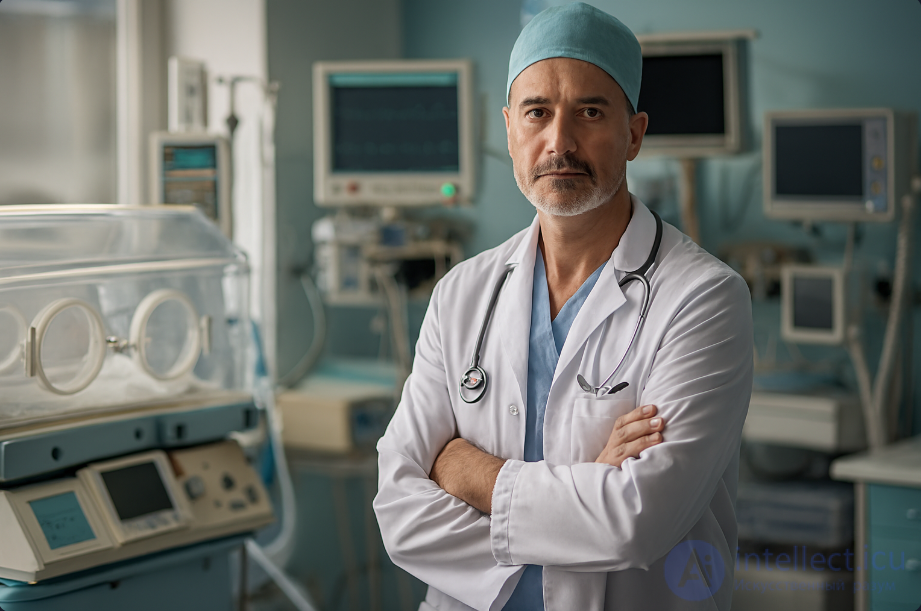
A neonatologist is a doctor who specializes in medical care for newborn children, especially those born prematurely, with low birth weight, congenital pathologies, or in critical condition. They work in intensive care units, perinatal centers, and maternity hospitals, ensuring the infant's adaptation to extrauterine life.
Assessing the newborn's condition immediately after birth (using the Apgar score, visual examination, analysis of breathing, heartbeat, and reflexes)
Performing resuscitation measures if the child is born in critical condition
Prescribing and monitoring treatment for pathologies: asphyxia, infections, congenital defects, prematurity, hypoxia, and others
Monitoring vital functions: breathing, heartbeat, temperature, oxygen level
Working with medical equipment: incubators, ventilators, phototherapy, infusion systems
Maintaining medical records: case histories, examination protocols, prescriptions
Advising parents on child care, breastfeeding, and disease prevention
Interacting with other specialists: pediatricians, obstetricians, surgeons, geneticists
Participating in consultations for complex cases
Ensuring infection safety and compliance with sanitary standards
Training junior staff and participating in professional development
In-depth knowledge of pediatrics, obstetrics, and resuscitation science
Command of newborn resuscitation methods and monitoring of vital functions
Ability to work with life-support equipment (incubators, ventilators)
Knowledge of pharmacology, including the specifics of dosages for infants
Skills in diagnosing congenital pathologies, infections, asphyxia, and sepsis
Emotional resilience: dealing with critical cases and death
Speed of decision-making under stress
Communication skills: interacting with parents and colleagues
Compassion and empathy: supporting families in difficult situations
Ability to maintain concentration during long shifts and night duty
Higher medical education in the specialty «Pediatrics» or «General Medicine»
Completion of a residency or internship in the field of «Neonatology»
Professional retraining is possible for doctors of other specialties
Regular professional development, participation in conferences and seminars
Command of ethical standards and the deontology of medical practice
| Country | Average monthly salary of a neonatologist |
|---|---|
| USA | $12,000–18,000 |
| China | $2,000–4,000 |
| Russia | $800–1,500 |
| Ukraine | $500–1,000 |
| India | $1,000–2,500 |
| South Africa | $2,500–4,000 |
| Egypt | $700–1,200 |
| Israel | $6,000–9,000 |
Income depends on experience, region, type of institution (public or private), and the number of shifts on duty.
Chronic stress and emotional burnout
Sleep disorders due to shift schedules
Musculoskeletal problems (prolonged standing, overexertion)
Infection risks from contact with biological materials
Decreased immunity due to constant strain
Neonatology (from Greek νέος — «new», Latin natus — «birth», λόγος — «study») is a branch of medicine that studies the health of newborns, especially those born prematurely or with pathologies. It emerged from pediatrics and obstetrics in the late 19th and early 20th centuries.
In the 19th century, premature babies were considered doomed.
In the early 20th century, Martin Couney, an American doctor, popularized the use of incubators, demonstrating them at exhibitions to draw attention to the problem.
After World War II, the first intensive care units for newborns appeared.
From the 1960s onward, there was rapid technological development: ventilators, monitoring, phototherapy, ultrasound.
Here are several figures who played an important role in the development of neonatology:
| Name | Contribution |
|---|---|
| Martin Couney | Popularizer of incubators, saved thousands of premature babies in the early 20th century. |
| Virginia Apgar | Developed the Apgar score in 1952 — a system for assessing a newborn's condition in the first minutes of life. |
| Mildred Stahlman | Founded the first neonatal intensive care unit in the USA in 1961. |
| Alexander Baranov (Russia) | Academician who contributed to the development of pediatrics and neonatology in the Russian Federation. |
Artificial intelligence is already being actively introduced into neonatology, but it does not replace the doctor — it becomes an assistant:
Diagnostics: AI analyzes ultrasounds, CT scans, and ECGs of newborns, detecting pathologies faster and more accurately.
Forecasting: algorithms assess the risks of complications and outcomes in cases of prematurity.
Monitoring: automatic control of vital signs in intensive care.
Robotic systems: assistance with medication dosing and ventilator management.
However:
Empathy, decision-making in complex situations, and communication with parents remain exclusively human tasks.
Ethical questions, especially in critical cases, require the doctor's involvement.
The profession will not disappear, but it will change: the neonatologist of the future is a doctor who knows how to work with AI, interpret data, and make decisions as part of a team with technology.
Pediatrician — a doctor for children from birth to adolescence
Obstetrician-gynecologist — manages pregnancy and childbirth
Neonatal resuscitation specialist — a narrow specialist in newborn resuscitation
Neonatal ward nurse — provides care and monitoring
Geneticist — participates in the diagnosis of congenital diseases
Perinatal psychologist — works with parents and staff

Comments