
Lecture
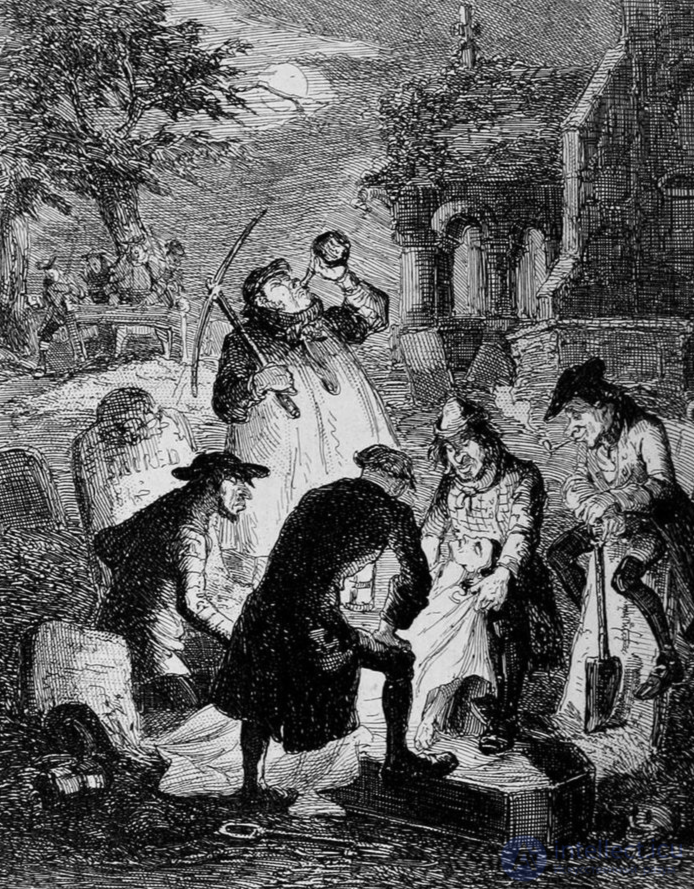
In Britain during the 18th–19th centuries, Resurrection Men were people who illegally dug up recently buried bodies and sold them to medical schools for anatomical research and the training of future physicians. The emergence of this occupation was driven by an acute shortage of corpses for the study of anatomy. Legally, medical institutions could obtain only the bodies of executed criminals, but their number was insufficient for the growing number of medical students.
The activity of resurrection men became especially widespread in England and Scotland in the late 18th and early 19th centuries. The profession was considered criminal and provoked public outrage, yet it brought a high income. Some groups of resurrection men later moved from exhumation to murder for the sale of bodies; the most famous example was the crimes of William Burke and William Hare in Edinburgh.
After the passage of the Anatomy Act 1832 in Britain, the activity of resurrection men gradually disappeared, since medical institutions gained legal sources of anatomical material.
Since the work required heavy physical labour, a successful resurrection man had to possess:
In effect, this activity was closer to the professions of a digger, a loader, or a gravedigger.
Engaging in such activity required:
Many historians note that resurrection men often came from the criminal milieu—former labourers, sailors, or people without a steady income.
No formal education for resurrection men existed.
The core skills were acquired through practice:
In effect, the profession was an illegal craft passed down within criminal gangs.
It is important to understand that the profession of resurrection man does not exist today as a legal activity. Therefore it is impossible to estimate modern salaries.
If we consider the historical period of the early 19th century, then in England a single fresh body could fetch a sum equivalent to several months' wages of a skilled worker. This made the activity extremely profitable.
In the early 19th century, English and Scottish medical schools paid between 7 and 10 pounds sterling for a fresh corpse. In winter the price was higher, since the body kept better.
For comparison:
If we convert not through inflation but through the purchasing power of labour, then the income from a single body can be compared to a modern worker's wages for 3–4 months.
This corresponds approximately to:
| Country (2026) | Income equivalent per corpse |
|---|---|
| United Kingdom | 8,000–15,000 USD |
| United States | 10,000–20,000 USD |
| Germany | 8,000–14,000 USD |
| France | 7,000–13,000 USD |
Thus, a group of two or three resurrection men who obtained several bodies a month could earn significantly more than a skilled craftsman, sailor, or miner of the time. It was precisely this high profitability that made the trade so widespread in the late 18th and early 19th centuries.
The reasons were simple:
The closest legal professions are:
The average monthly incomes of such specialists in US dollars:
| Country | Average income per month, USD |
|---|---|
| United States | 18,000–30,000 |
| China | 2,000–6,000 |
| Russia | 1,000–3,500 |
| Ukraine | 500–1,500 |
| India | 800–3,000 |
| South Africa | 2,000–5,000 |
| Egypt | 400–1,500 |
| Israel | 8,000–18,000 |
The figures are approximate and depend on qualifications, region, and place of work.
The historical resurrection men were characteristically prone to:
William Burke and William Hare became the most notorious «resurrection men» in history—they did not confine themselves to plundering graves but began murdering people to sell their bodies to anatomists in Edinburgh in 1828. Their crimes shocked society and led to the passage of the «Anatomy Act 1832», which legalized the use of the bodies of the dead for science.
The story of Burke and Hare
Who they were: William Burke (1792–1829) and William Hare (c. 1792–1870) were Irish immigrants living in Edinburgh.
The start of the crimes: They sold their first body after a lodger died in Hare's house. Having received money from the anatomist Robert Knox, they decided to continue.
Method: Instead of digging up graves, they began murdering people using a method of suffocation («burking») so as to leave no marks of violence.
Number of victims: Over ten months they killed 16 people, including women and children.
Exposure: Their final victim, Margaret Docherty, was discovered by other lodgers, which led to their arrest.
Trial and aftermath
The trial: Hare was offered immunity in exchange for his testimony. Burke was found guilty and executed in January 1829.
After the execution: His body was dissected, and his skeleton is still kept in the anatomical museum of the University of Edinburgh.
Legislative changes: The public shock at these events accelerated the passage of the Anatomy Act 1832, which permitted the use of the bodies of the dead in hospitals and workhouses for medical research.
Impact on culture
Literature: The story of Burke and Hare inspired numerous works, from newspaper articles to novels.
Film and theatre: Their crimes were adapted many times, often in a gothic or black-comedy vein.
Language: The term «burking» entered the English language to denote suffocation without marks of violence.
Comparison with other «resurrection men»
| Burke and Hare | Ordinary resurrection men |
|---|---|
| Killed people for their bodies | Dug up fresh graves |
| 16 victims in 10 months | Dozens of cases of body theft |
| Worked directly with the anatomist Knox | Sold bodies through intermediaries |
| Caused a public scandal | Were a «shadow» problem of society |
Historical:
Modern:
The profession of the resurrection man is one of the most unusual and grim phenomena in the history of medicine. Despite the illegal nature of the activity, it was precisely thanks to the demand for bodies for anatomical research that the medicine of the 18th–19th centuries received a significant impetus for development. After the passage of the British Anatomy Act of 1832 and the emergence of legal mechanisms for transferring bodies for scientific purposes, the need for resurrection men disappeared. Today this profession is of purely historical interest as an example of how the advance of science can give rise to unusual and controversial kinds of activity.

Comments