
Lecture
A perfumer is a specialist who creates fragrances for perfumery, cosmetics, household chemicals, and even the food industry. Perfumers are called the «nose», because their key instrument is a highly developed sense of smell and the ability to distinguish hundreds of scent nuances.
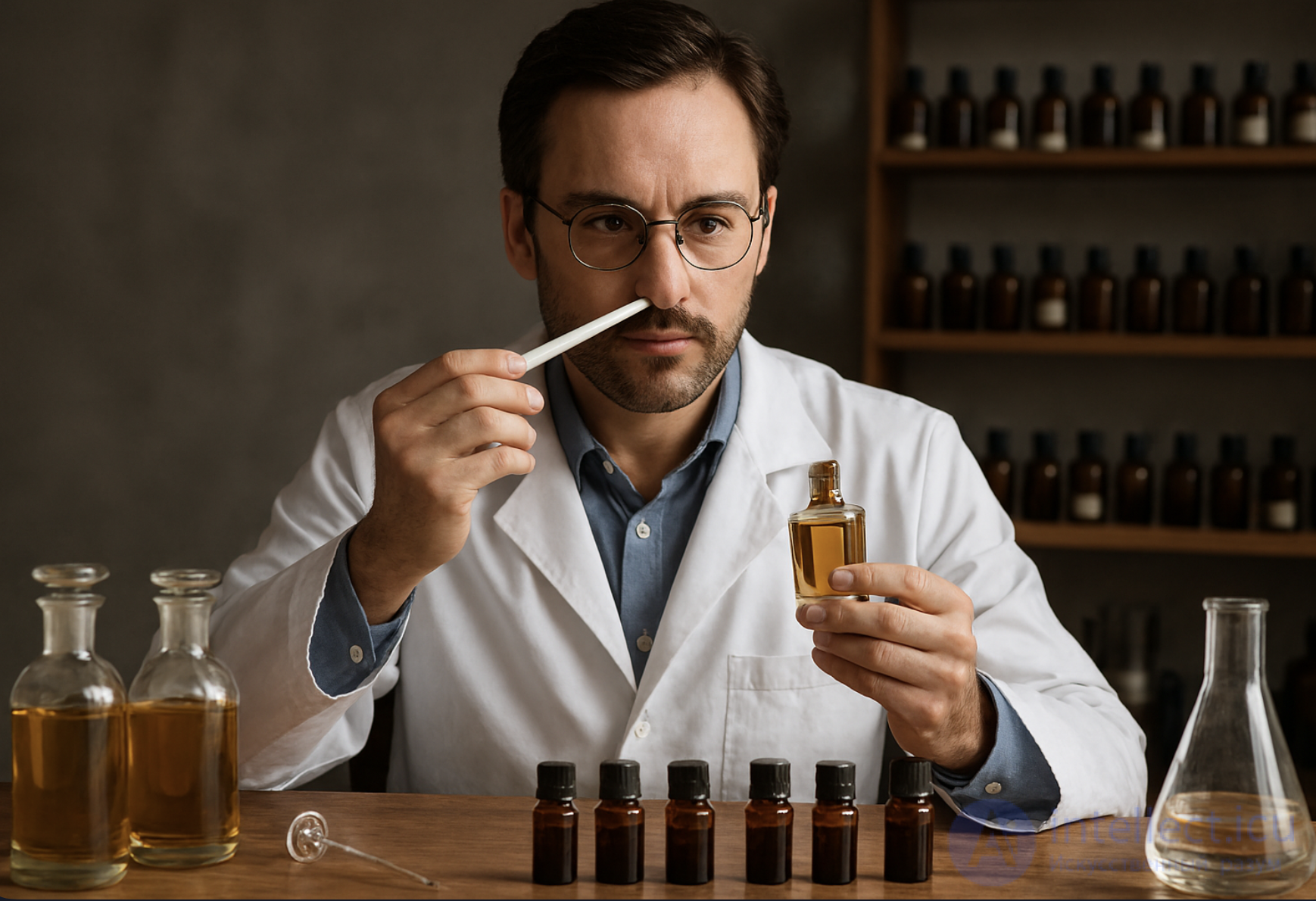
no chronic respiratory diseases: the job involves constant contact with volatile substances.
normal functioning of the sense of smell: even a slight loss of sensitivity makes the profession impossible.
resistance to allergies: many ingredients can trigger reactions, so the absence of severe allergies is important.
high concentration: the work requires prolonged analysis of scents.
creativity and artistic thinking: creating a fragrance is an art.
emotional stability: scents affect mood, so keeping one's balance is important.
a basic education in chemistry or biology: most perfumers hold a bachelor's degree.
specialized perfumery schools: such as ISIPCA in France.
lengthy practice and internships: training can take 5–7 years.
| Country | Average Income | Range |
|---|---|---|
| USA | $70,745 | $38,000 – $130,000 |
| China | ~$25,000 | $15,000 – $40,000 |
| Russia | ~$12,000 | $8,000 – $20,000 |
| Ukraine | ~$10,000 | $6,000 – $15,000 |
| India | ~$9,000 | $5,000 – $12,000 |
| South Africa | ~$18,000 | $12,000 – $25,000 |
| Egypt | ~$8,000 | $5,000 – $12,000 |
| Israel | ~$30,000 | $20,000 – $45,000 |
allergic dermatitis: contact with essential oils.
bronchial illness: from inhaling chemical vapors.
potential carcinogenic risks: when working with synthetic components
The perfumer's profession is one of the oldest in human history. Its origins reach back into deep antiquity and are closely tied to religious rites, medicine, and social status.
The first aromatic blends were created more than 4,000–5,000 years ago in Ancient Egypt, Mesopotamia, and India. Aromatics were used:
in religious ceremonies,
in mummification,
in medicine and cosmetics.
In Egypt there were special priest-aromatists, who were effectively the first perfumers. In Mesopotamia, Tapputi (2nd millennium BC) is known — the first documented female perfumer and chemist in history.
In Ancient Greece and Rome, perfumery became part of everyday life for the elite. Fragrances were made from oils, resins, flowers, and spices. Perfumers were regarded as craftsmen and traders of luxury goods.
In Europe, interest in fragrances declined, but in the East — in the Arab world — the profession continued to develop actively.
Arab scholars (notably Avicenna) improved distillation, which made it possible to obtain essential oils and floral waters. Perfumery became closely linked with alchemy and pharmacy.
France becomes the center of the art of perfumery. The city of Grasse turns into the world capital of perfumery.
Perfumers begin working at royal courts, creating individual fragrances for the nobility.
The development of organic chemistry leads to the appearance of synthetic aromatic molecules, which radically changes the profession. The perfumer turns from a craftsman into an artist and chemist at the same time.
Large perfume houses and a mass-production industry emerge.
Tapputi — the first known perfumer in history.
Avicenna — introduced the distillation of rose water and essential oils.
Ernest Beaux — creator of Chanel No. 5.
Edmond Roudnitska — a philosopher of perfumery, author of Dior Eau Sauvage.
Jacques Guerlain — a representative of the Guerlain dynasty.
Jean-Claude Ellena — minimalism and intellectual perfumery (Hermès).
Francis Kurkdjian — author of Baccarat Rouge 540.
Calice Becker, Alberto Morillas, Dominique Ropion — key figures of the modern industry
AI is actively used in perfumery for:
analyzing consumer preferences,
There are systems that can generate aromatic compositions by combining molecules with specified characteristics.
No, the profession will not disappear, but it will change substantially.
Scent is emotion, memory, culture, not just chemistry.
Human intuition, associations, and artistic vision are still beyond the reach of AI.
The perfumer works with abstract ideas: mood, history, the image of a person or a brand.
The perfumer of the future:
will become a curator and author of concepts,
will work in tandem with AI as a tool,
will focus on creativity rather than trial-and-error with formulas,
will become a more interdisciplinary specialist (art + chemistry + technology).
forecasting trends,
selecting formulas and ingredients,
creating fragrances based on large datasets.
aromatherapist: working with essential oils for health.
cosmetics technologist: developing formulas for creams and other products.
flavorist: creating flavor compounds for the food industry.
fragrance marketer: promoting perfume brands

Comments