
Lecture
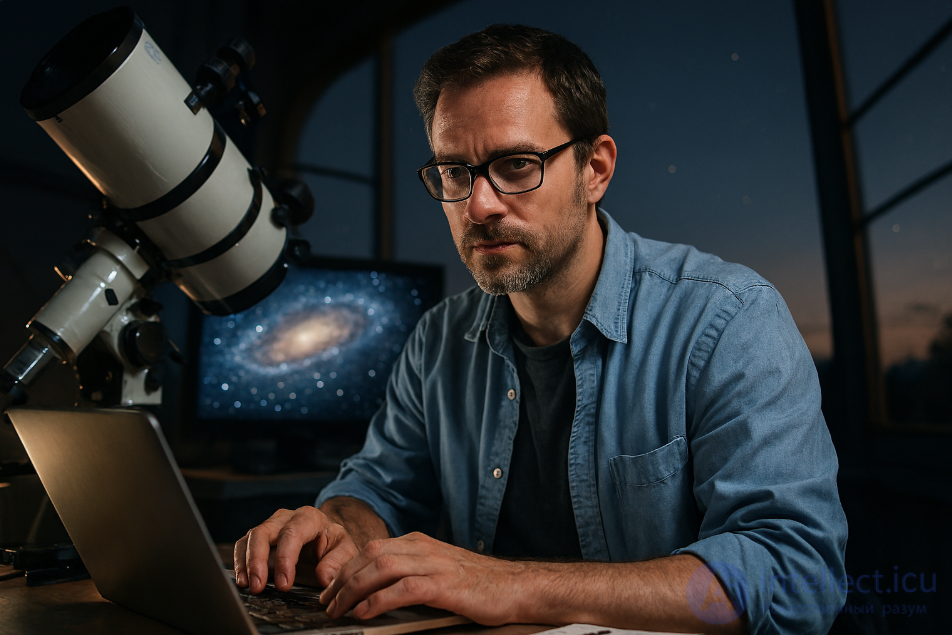
An astrophysicist is a profession of the future, uniting science, technology, and the philosophy of the cosmos. It is one of the most intellectually rich and prestigious scientific specialties, requiring advanced training and personal resilience. An astrophysicist is a scientist who studies the physical and chemical properties of cosmic objects: stars, planets, galaxies, interstellar matter, and the Universe itself. The work includes both theoretical research and the practical processing of data from telescopes, satellites, and detectors.
Good eyesight and the ability to work with optical instruments.
A healthy nervous system and the absence of chronic illnesses that interfere with prolonged mental work.
Tolerance for night shifts and working on an altered schedule (observations are often carried out at night).
High concentration and analytical thinking.
The ability to work with large data sets and abstract models.
Patience and stress resistance: research results may take years to appear.
An inclination toward systems thinking and scientific curiosity.
Foundational education: a bachelor's degree in physics, astronomy, or applied mathematics.
A master's degree and doctoral studies in astrophysics or related fields.
Command of modern programming languages (Python, C++) for data analysis.
Experience working with telescopes, satellite systems, and simulation software.
| Country | Average monthly income (USD) |
|---|---|
| USA | 6,000–10,000 |
| China | 1,500–3,000 |
| Russia | 800–1,500 |
| Ukraine | 600–1,200 |
| India | 400–800 |
| South Africa | 1,200–2,500 |
| Egypt | 500–900 |
| Israel | 3,000–5,000 |
In developed countries, salaries are higher thanks to the funding of science and space programs; in developing countries, they are closer to the average national income level.
Although astrophysicists are not exposed to the physical risks typical of industry, they do encounter:
Vision impairment (from working with instruments and screens).
Psycho-emotional burnout due to prolonged research.
Disruptions of sleep and biorhythms (nighttime observations).
Osteochondrosis and spinal problems from sedentary work.
Astrophysics as an independent science took shape relatively recently — in the late 19th and early 20th centuries, although its roots go back to ancient astronomy. Ancient civilizations observed the sky but could not explain the physical nature of cosmic objects.
As long as humans regarded the celestial bodies as «divine fires», the profession of astrophysicist simply did not exist — there were observational astronomers, astrologers, and mathematicians.
Everything changed in the 19th century with the development of spectroscopy. Scientists realized that the composition of stars could be determined from the spectrum of light.
In the 1860s, Gustav Kirchhoff and Robert Bunsen proved that stars are made of the same chemical elements as the Earth. From that moment it became clear that the cosmos obeys the same physical laws — and so astrophysics was formed.
In the 20th century, the profession acquired fundamental status thanks to the discovery of:
the expansion of the Universe (Hubble)
nuclear reactions in stars (Gamow, Bethe)
the cosmic microwave background
neutron stars, quasars, and black holes
radio telescopes and later orbital observatories
Astrophysics became a deeply theoretical and, at the same time, experimental science, relying on big data, complex mathematical models, and computer simulations.
An American astrophysicist who proved the existence of galaxies beyond the Milky Way and discovered the law of the Universe's expansion. His work became the foundation of modern cosmology.
A theoretical astrophysicist who developed the theory of the quantum evaporation of black holes and made an enormous contribution to understanding the nature of space-time.
He discovered the mass limit at which a white dwarf collapses into a neutron star. A Nobel Prize laureate.
A popularizer of science and a researcher in planetary science; he participated in creating the first interplanetary missions.
One of the first scientists to prove the existence of dark matter through the rotation curves of galaxies.
A Catholic priest and, at the same time, an astrophysicist, who proposed the idea of the "primeval atom" — the forerunner of the Big Bang theory.
Soviet physicists who greatly advanced cosmology, the theory of the early Universe, and the physics of black holes.
AI is already changing astrophysics dramatically:
it analyzes vast data sets from telescopes
it searches for exoplanets
it detects rare events (gravitational waves, gamma-ray bursts)
it models cosmological processes
it automates image processing
But will the profession disappear? Practically speaking — no.
routine data analysis
the automatic classification of objects
the building of models and simulations
the forecasting of astronomical phenomena
the initial scientific search for patterns
AI will become a powerful tool, just as computers, CCD sensors, or radio telescopes once did.
the formulation of scientific hypotheses
the interpretation of results and theoretical reflection
strategic scientific planning
the creation of new paradigms
creative thinking and scientific intuition
AI relies on data but does not create a new physical theory «out of nowhere».
New fundamental physics will require human thought — at least in the coming decades.
The profession is transforming into human-machine collaborative work:
astrophysicist-analyst
astrophysicist specializing in big data
astrophysicist-programmer
astrophysicist-modeler of cosmology
researcher of AI algorithms for science
AI will become a «second assistant», like a junior research associate, rather than a replacement.
Astronomer
Cosmologist
Theoretical physicist
Space systems engineer
Data processing specialist (Data Scientist)
Planetary scientist
Space technology specialist
The astrophysicist profession is a path for those ready to devote their lives to studying the Universe. It requires robust health, a stable psyche, a deep education, and a readiness for long-term projects. Despite the differences in salaries across countries, the status of an astrophysicist remains high, and related professions open up broad opportunities in science and technology.
An astrophysicist is a profession with deep historical roots, arising from the union of physics, mathematics, and astronomy.
The distinguished astrophysicists of the 20th and 21st centuries radically changed our understanding of the Universe.
AI will not destroy the profession, but it will make it significantly more technological, analytical, and fast. The human being will remain its center — as a generator of ideas and an interpreter of cosmic phenomena.

Comments