
Lecture
A photographer is a specialist who creates visual images using photographic equipment. They can work in a wide variety of genres: portrait, reportage, advertising, fashion, nature, architecture, documentary, as well as in the scientific and technical fields. The modern photographer is not simply a person with a camera, but an artist, storyteller, marketer, and technologist all in one.
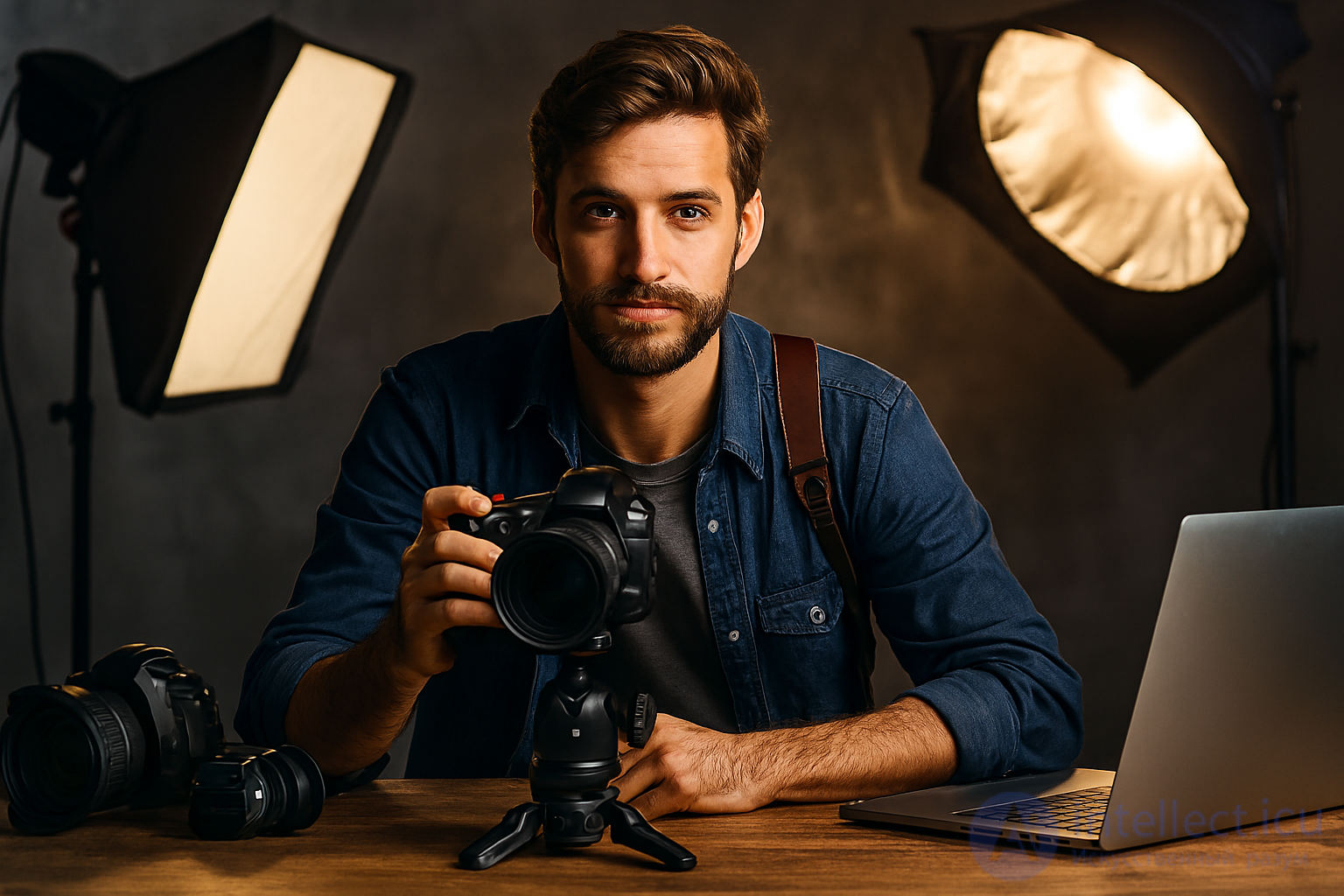
A photographer performs a wide range of job responsibilities aimed at creating high-quality visual materials. They organize and conduct photo shoots in various genres — from portrait and reportage to product and fine-art photography, select equipment and set it up according to the shooting conditions, and choose composition, lighting, and angles that ensure expressiveness and technical image quality. After the shoot, the photographer processes the images using graphic editors, adjusts color, sharpness, and exposure, removes defects, and prepares the materials for publication or delivery to the client. They interact with clients, models, stylists, and other participants in the shooting process, coordinating concepts, deadlines, and the format of the work. The photographer also maintains an image archive, organizes and stores the captured materials, monitors the technical condition of the equipment, updates their portfolio, and develops their professional skills by attending master classes, exhibitions, and training courses. When working on staff, they carry out tasks assigned by the editorial office, agency, or studio, and comply with corporate standards and deadlines.
The history of the photographer profession begins in 1839 — the moment when the Frenchman Louis Jacques Daguerre presented the daguerreotype to the world, the first practically applicable method of fixing an image using light. This year is considered the official birth of photography as a technical and artistic phenomenon.
1839 — the invention of the daguerreotype. Photography is perceived as a scientific achievement rather than an art.
1850s–1880s — the first photo studios appear. Photographers begin working with portraits, documenting everyday life and architecture.
Late 19th century — the development of photojournalism thanks to lighter cameras and the ability to print images in newspapers. The concept of the photographer profession emerges.
1912 — the first professional union of press photographers is founded in Denmark.
1925 — the release of the 35mm Leica camera, which revolutionized reportage and street photography.
1930s–1950s — the flourishing of fine-art and documentary photography. The works of Henri Cartier-Bresson, Robert Capa, and Dorothea Lange become benchmarks.
1970s–1990s — the spread of color photography, automatic cameras, and then digital technologies.
2000s and beyond — the digital revolution, the appearance of smartphones with cameras, the mass accessibility of photography. The profession transforms: the photographer becomes not only a camera operator, but also a retoucher, marketer, and content creator.
Initially, photography was not considered an art — it was perceived as a mechanical recording of reality. However, with the development of artistic approaches, composition, light, and post-processing, photography took its place in the world of visual arts. Today, a photographer is not merely a craftsman, but an author of visual stories, capable of influencing culture, politics, and public opinion.
The future of the photographer profession promises to be not only vibrant, but also multifaceted — the fusion of art, technology, and media creates new forms of visual expression and employment. Here are the key directions in which this profession is moving:
The use of artificial intelligence for automatic processing, retouching, and even image generation.
The application of drones and 360° cameras for shooting from new angles — especially in architecture, tourism, and reportage.
The growing popularity of AR/VR photography — creating visual content for virtual worlds, games, and metaverses.
The photographer becomes a visual strategist: not simply shooting, but creating content that sells, engages, and tells stories.
The ability to work with social media, trends, and algorithms becomes an important skill.
Growing demand for niche photographers: food photographers, e-commerce photographers, medical imaging, scientific photography.
The emergence of new genres: environmental photography, ethical reportage, visual journalism.
More and more photographers work as self-employed, combining shooting, processing, promotion, and teaching.
Online courses, master classes, and NFT photography become sources of income.
The photographer of the future is not only a person with a camera, but also:
A digital artist (working with neural networks, generative graphics)
A media producer (creating visual content for specific goals)
A curator of visual stories (working with archives, exhibitions, publications)
A tech expert (understanding sensors, optics, data processing)
| Direction | Demand forecast |
|---|---|
| AR/VR photography | High growth |
| Drone photography | Steady demand |
| E-commerce and product photography | Mass demand |
| Emotional portrait | Declining, but remains |
| Reportage and documentary | Growth in niche media |
| NFT and digital art | Volatile market |
AI is already being actively used:
Automatic retouching, color correction, noise reduction
Image generation (for example, Midjourney, DALL·E)
Recognition of faces, objects, and scenes
Learning and analysis of composition
What is changing:
Routine tasks are being automated, but creative vision, intuition, and emotional connection remain unique to humans.
Photographers are becoming curators of visual content, rather than simply camera operators.
New roles are emerging: AI photographer, visual editor, generative image designer.
Will the profession disappear?
No. It is transforming. Just as the artist did not disappear with the advent of graphic editors, so too will the photographer remain — but with new tools and tasks.
| Name | Country | Contribution |
|---|---|---|
| Henri Cartier-Bresson | France | Founder of the street photography genre, master of the "decisive moment" |
| Robert Capa | Hungary/USA | Legendary war photojournalist |
| Steve McCurry | USA | Author of the famous portrait "Afghan Girl" |
| Alexander Rodchenko | USSR | Constructivist, experimenter in composition |
| Andreas Gursky | Germany | One of the most expensive photographers of our time, works in the genre of large-scale digital photography |
Although the profession is not considered physically demanding, it requires:
Good eyesight (including color discrimination and focusing)
A healthy musculoskeletal system (especially when shooting with heavy equipment)
Endurance (long shoots, working in difficult weather conditions)
The absence of chronic illnesses that interfere with concentration and mobility
A photographer needs:
Creativity and visual thinking
Patience and attention to detail
Sociability (especially when working with people)
Stress resistance (working at events, deadlines, demanding clients)
The ability to adapt and improvise quickly
Formal education is not always required, but is welcomed:
Secondary or higher education in the field of photography, visual arts, design, or journalism
Professional development courses (retouching, studio lighting, composition, working with clients)
Proficiency in image processing programs: Adobe Photoshop, Lightroom, Capture One
A portfolio — the main indicator of professionalism
| Country | Average photographer salary per month |
|---|---|
| USA | $3,000–5,000 |
| China | $1,000–2,000 |
| Russia | $600–1,200 |
| Ukraine | $400–800 |
| India | $300–700 |
| South Africa | $800–1,500 |
| Egypt | $600–2,000 (in the cruise industry) |
| Israel | $2,000–3,200 |
Note: Salary depends on specialization (wedding, commercial, reportage), region, experience, reputation, and type of employment (freelance or staff).
Photographers are prone to:
Vision impairments (eye strain, fatigue from screens)
Pain in the back, neck, and wrists (from carrying equipment and working at a computer)
Psycho-emotional burnout (especially among freelancers)
Allergic reactions (when shooting in nature or in a studio with chemicals)
Videographer
Retoucher
Graphic designer
Art director
Journalist
Content manager
SMM specialist
Illustrator
Drone operator

Comments