
Lecture
Это окончание невероятной информации про технологическая безработица.
...
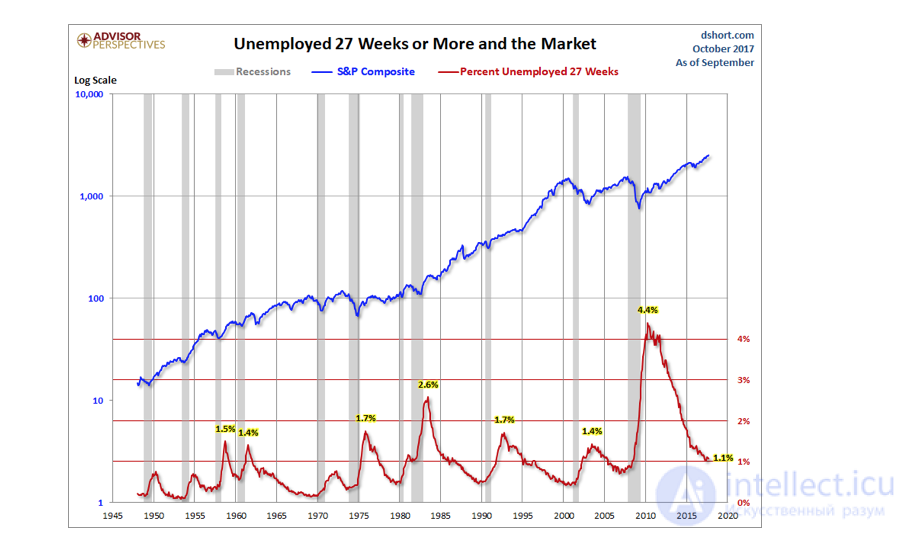
acknowledged that in the future the unemployed will need more time to find work, so for those who lose their jobs in the next wave of economic crisis, the difficult period may drag on.
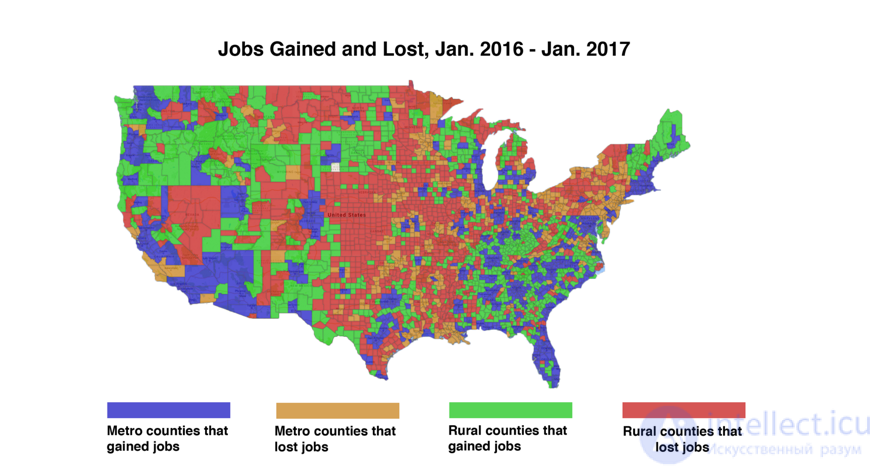
To add even more fuel to the fire, it must be acknowledged that in America robotization has a favourable effect on liberal suburbs, while conservative rural areas suffer from its consequences. According to an analysis by the Daily Yonder, 80% of the jobs created in 2016 were located in 51 suburbs with a population of one million or more. In just one year, the number of jobs in the suburbs increased by 1.2 million. Meanwhile, in rural areas over the same period the number of jobs fell by 90,000.

Today, more than 52 million Americans live in counties experiencing economic hardship. In a report by the Economic Innovation Group (EIG), a research and advocacy organization supported by both parties, a close connection is clearly traced between the number of residents of a locality and their prosperity. Thus, in counties with a population of fewer than 100,000 people, the likelihood of low well-being is 11 times higher than in counties with a population of more than 100,000 people.
Once you understand that automation is contributing to the division of the US population along «red» and «blue» lines, the growing polarization of American politics immediately becomes clear to you. This is perhaps the most dangerous effect of technological unemployment, the erosion of democracy itself, as partisan bias tears the nation apart, like the process of the mitotic division of a cell into two parts.
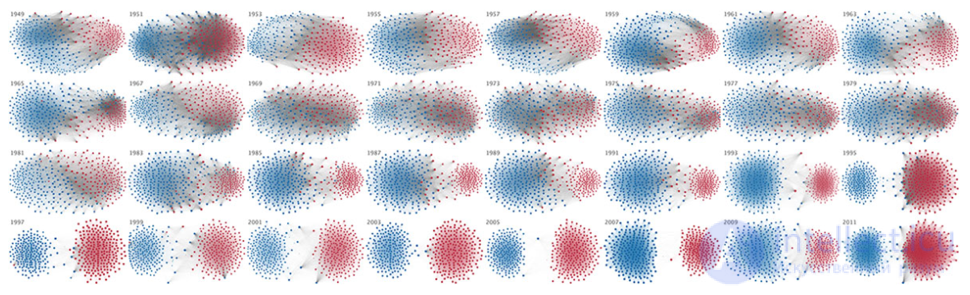
It must be acknowledged that since technology allows enterprises to hire fewer workers, «full employment», in which everyone who wants a job can be employed, can be achieved. The laws of economics require that either everyone works a shorter work week, or, to employ the same number of workers, more enterprises are needed. If the average number of workers at an average enterprise is 10 people, then to provide work for 100 people, 10 enterprises are needed. If technology allows 1 worker to do the work of 10 people, still working a 40-hour work week, then the average number of workers will be reduced to 1. Therefore, the number of enterprises needed to employ 100 people must increase to 100 (note: given population growth, the number of enterprises will exceed 100).
Is this happening? No. This is not happening. The opposite is happening. The number of newly created enterprises is decreasing annually, not increasing.
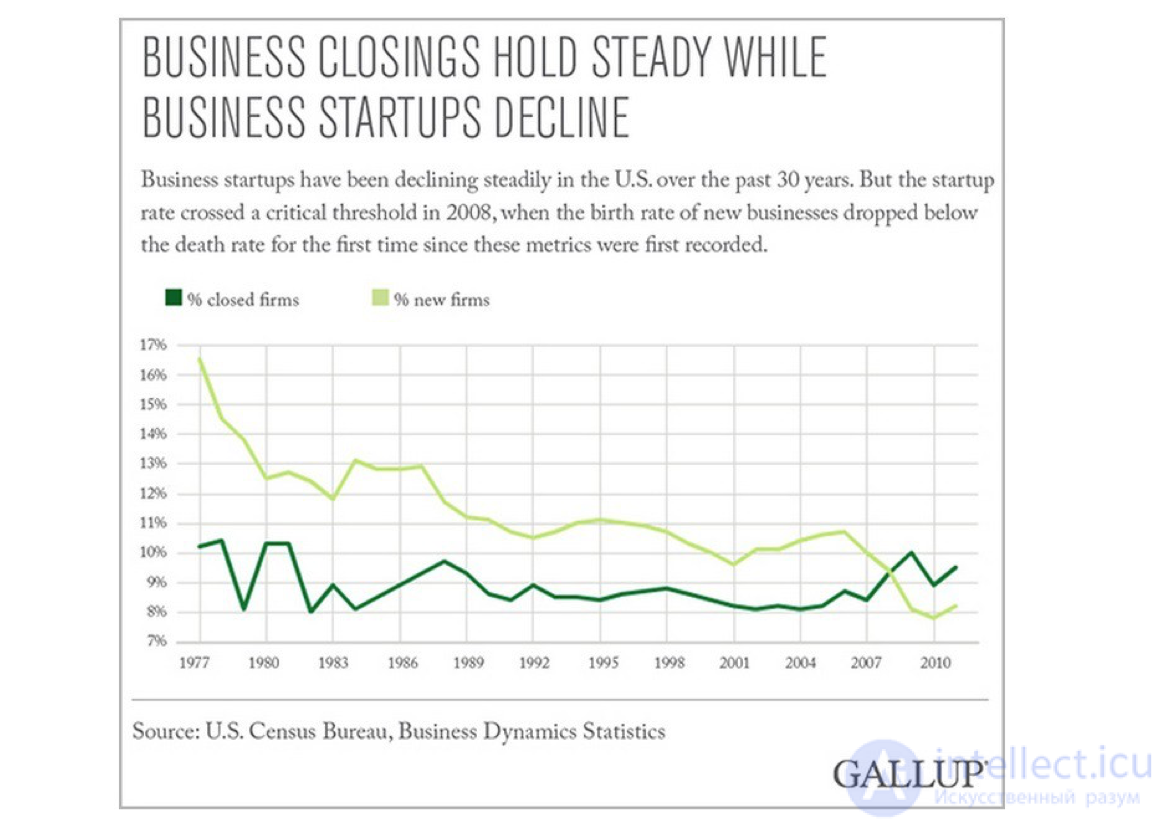
But newly created enterprises increase their value every year. This is exactly what we expect from each new enterprise using the latest technology to produce more at a lower cost.
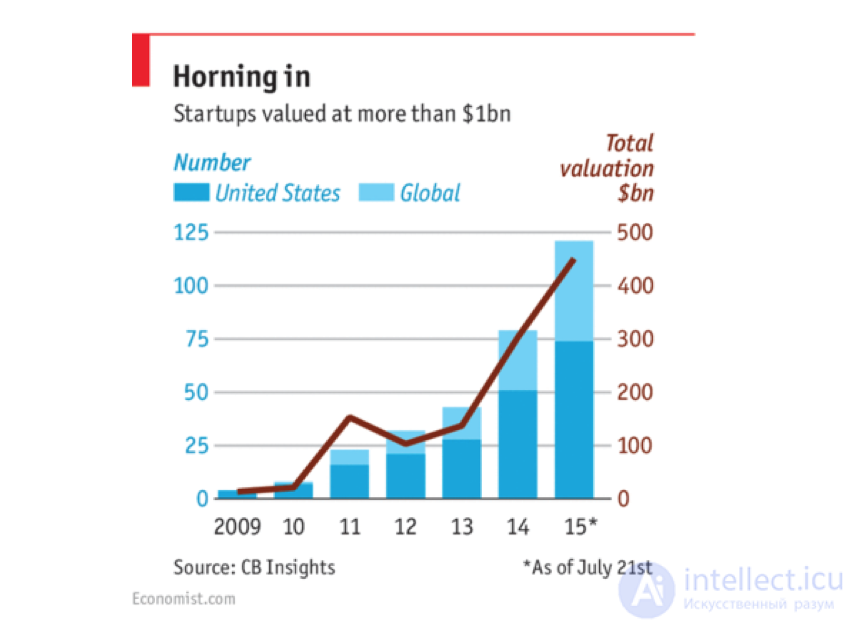
Every year, more and more new enterprises worth more than $1 billion appear. Compare Tesla with Ford Motors of the early 20th century, Instagram with Kodak, or Facebook with all the previously existing newspapers. These companies are worth hundreds of billions of dollars, and their staff is much smaller than that of the most valuable companies of the past.
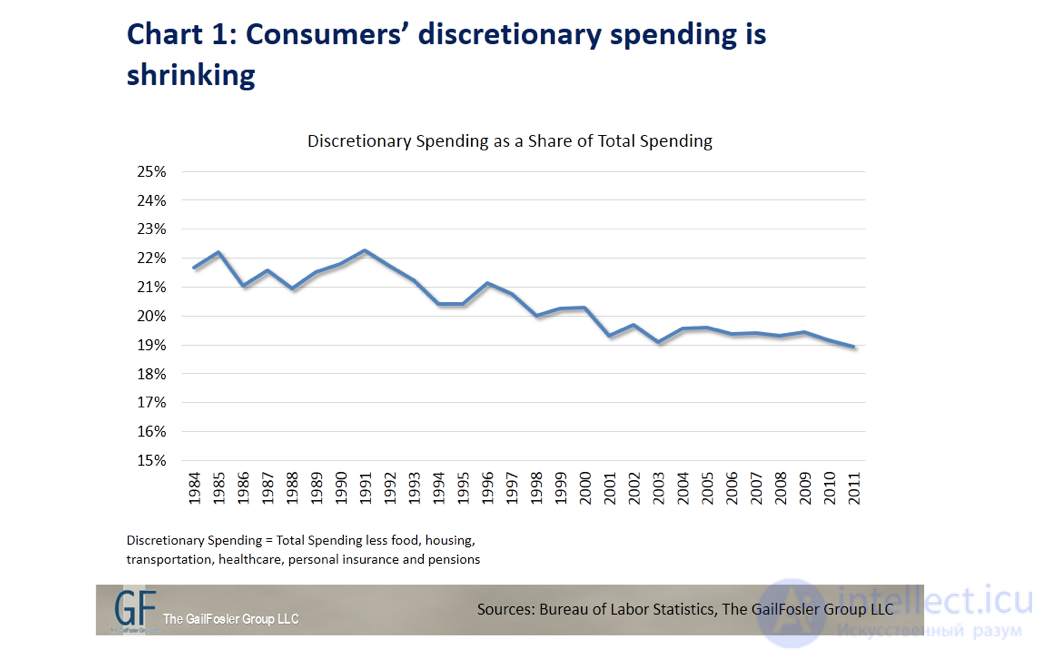
There is also an assumption about the boundlessness of human needs, so no matter how many jobs are cut due to technology, the boundless consumer desires of humans will always contribute to the creation of new jobs. This belief coexists with a steady decline in the share of discretionary spending in total expenditures. This should surprise no one. People cannot spend money they do not have.
Now let me ask a question. Did you know everything I have described here, was none of the above news to you? Now ask yourself, why? Robotization definitely exists and is already having an impact on the economy. So why are we still arguing about this topic? Perhaps the most frightening thing about the graph of the robotization of drilling rigs, along with the other graphs I have included in this article, is the fact that the data presented is not discussed in society. This is becoming similar to the problem of climate change, which we have been arguing about for decades, while the situation only worsens. Likewise, people prefer to dismiss the problem of robotization, even though its impact is becoming ever more significant.

I fear that the problem will continue to be ignored. Why do I think so? We ignored the moment of the robotization of production. Yes, we know that it happened, but we pretended that all the workers simply moved on to new paid work, without critically assessing the nature of this work. Unemployment is not a problem because the unemployment rate is at a record low? Tell that to a person who went from a 40-hour work week with a benefits package and a sense of confidence in the future to three different jobs without a benefits package, where he works 80 hours a week, earning less and constantly fearing losing even that.
Or tell that to people who feel that marriage has become the prerogative only of the wealthy.
Or tell that to people who have tried to commit suicide or self-medicated their depression with opiates, because in their town the town-forming enterprise was closed, destroying the local economy and leaving no means of subsistence.
Technological unemployment is real. In the current situation, only one public discussion will be honest — what is the nature of the new employment. Everything points to a decline in the share of the employed among the economically active population, to a rise in low-skilled jobs, to a shift to alternative labour relations (for example, temporary work and «gig work»), to an increase in the spread of monthly incomes, to a reduction in benefits and compensation, to longer searches for new work, and to what might be called a general uncertainty about tomorrow, since survival, rather than the «American dream», is becoming the main goal for most Americans.
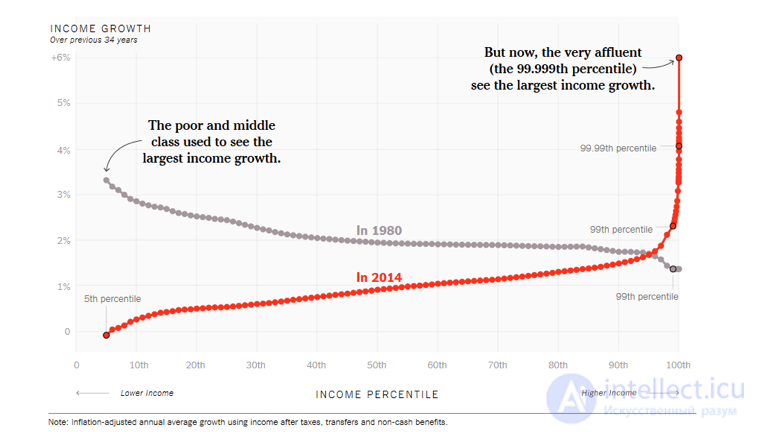
At the same time, some Americans are doing well. Why? Because they own the machines. They have lobbyists. They write the laws. They write the tax code. They have power. They are now the sole beneficiaries of machine labour, producing more and more of the national wealth, whereas this wealth was once distributed among a broader circle of people.
Hundreds of thousands of jobs were simply lost due to the automation of drilling rigs, and no one (except those who lost their jobs and their families) even batted an eye. Over these years, in connection with the use of industrial robots, hundreds of thousands of jobs have been cut.
Hundreds of thousands of jobs were cut this year in the retail sector due to the unstoppable efficiency of Amazon, which is using more than 100,000 robots already. To be fair, Amazon also creates many new jobs, but for every newly created job there are two or more cut, because the company removes the least efficient bricks or uncompetitive links. Any talk of employment will be dishonest unless it is about the creation of networked jobs or the details of their creation.
Premature deindustrialization occurs when developing countries deindustrialize without first becoming rich, as happened with the developed economies. This concept was popularized by Dani Rodrik in 2013, who published several articles showing a growing body of empirical evidence for this phenomenon. Premature deindustrialization heightens concern about technological unemployment in developing countries, since the traditional compensation effects enjoyed by workers in advanced economies, such as the ability to obtain a well-paid job in the service sector after the loss of factory jobs, may not be available. [134] [135] Some commentators, such as Carl Benedikt Frey, argue that with the right responses the negative consequences of further automation for workers in developing countries can be avoided. [
Since around 2017, a new wave of concern about technological unemployment has become noticeable, this time about the impact of artificial intelligence (AI). [137] Commentators, including Calum Chace and Daniel Hulme, have warned that, if left unchecked, AI could cause an «economic singularity», in which the outflow of jobs would be too rapid for people to adapt to them, leading to widespread technological unemployment. Although they also report that, with the right response from business leaders, politicians, and society, the impact of AI could be positive for workers. [138] [139]
Morgan R. Frank et al. warn that there are several obstacles preventing researchers from making accurate predictions of the impact of AI on future labour markets. [140] Marian Krakovsky argued that the jobs most likely to be fully replaced by AI are in middle-class areas, such as professional services. Often the practical solution is to find another job, but workers may not be qualified for high-level work and therefore must move to lower-level work. However, Krakovsky (2018) predicts that AI will mostly follow the path of «complementing people» rather than «copying people». It is assumed that the goal of the people implementing AI is to improve the lives of workers, not to replace them. [141]Research has also shown that artificial intelligence may not only destroy jobs but also create jobs: albeit low-skilled ones, for training artificial intelligence in low-income countries. [142]
Following President Putin's 2017 statement that whichever country first achieves mastery in AI «will become the ruler of the world», various national and supranational governments announced AI strategies. Concerns about not falling behind in the AI arms race were more prominent than concerns that AI could cause unemployment. Some strategies suggest that achieving a leading role in artificial intelligence should help citizens obtain more useful work. Finland has sought to help citizens of other EU countries acquire the skills they need to compete in the post-AI job market, by making the free «Elements of AI» course available in several European languages.
Lights-out manufacturing — robotized shops and enterprises in which all work is performed not by people but by machines
Historically, innovation has sometimes been banned because of fears about its impact on employment. However, since the development of the modern economy, this option has not even been considered a solution, at least for advanced economies. Even commentators who are pessimistic about long-term technological unemployment consistently regard innovation as a general good for society, with J. S. Mill perhaps being the only prominent Western political economist to propose banning the use of technology as a possible solution to the problem of unemployment. [20]
Gandhi's economic theory called for delaying the introduction of labour-saving machines until unemployment had been reduced, but this advice was largely rejected by Nehru, who was to become prime minister after India achieved independence. However, a policy of slowing the introduction of innovation in order to avoid technological unemployment was implemented in the 20th century in China under Mao's administration. [147] [148] [149]
In 1870, the average American worker worked about 75 hours a week. Shortly before the Second World War, the number of working hours per week had fallen to about 42, and there was a similar decline in other advanced economies. According to Wassily Leontief, this was a voluntary increase in technological unemployment. The reduction in working hours helped to distribute the available work and was welcomed by workers, who were happy to cut hours to gain additional leisure, since innovation at the time generally helped to increase their pay rates. [25]
As a possible solution to the problem of unemployment, economists including John R. Commons, Lord Keynes, and Luigi Pasinetti proposed a further reduction in working hours. Nevertheless, when the number of working hours reached about 40 hours a week, workers were less enthusiastic about further reductions, both to prevent loss of income and because many people value work for its own sake. As a rule, 20th-century economists opposed further reductions in unemployment as a solution to the problem of unemployment, arguing that it reflected the general lump of labour fallacy. [150] In 2014, Google co-founder Larry Page proposed a four-day work week, so that as technology continues to displace jobs, more people can find work. [96] [151] [152]
Public works programs have traditionally been used by governments as a way to directly increase employment, although this has often been opposed by some, but not all, conservatives. Jean-Baptiste Say, though usually associated with the market economy, advised that public works could be a solution to the problem of technological unemployment. [153] Some commentators, such as Professor Matthew Forstater, have argued that public works and guaranteed public-sector jobs could be the ideal solution to the problem of technological unemployment, since unlike welfare schemes or a guaranteed income they provide people with the social recognition and meaningful participation that come with work.
For less developed countries, public works may be a simpler solution compared with universal welfare programs. [25] As of 2015, calls for public works in advanced economies have become less frequent even from progressives due to concerns about sovereign debt. A partial exception is infrastructure spending, which has been recommended as a solution to technological unemployment even by economists previously associated with the neoliberal agenda, such as Larry Summers. [156]
Increasing access to quality education, including vocational training for adults and other active labour market policies, is a solution that in principle, at least, is not opposed by either side of the political spectrum and is welcomed even by those who are optimistic about the long-term prospects for technological employment. Improved education paid for by the state is usually especially popular in industry.
Proponents of this policy argue that a higher level of specialized training is a way to benefit from the growing technology industry. The leading technology research university MIT published an open letter to policymakers calling for a «rethinking of education», namely a shift from «rote learning» to STEM disciplines. [157] Similar statements issued by the US President's Council of Advisors on Science and Technology (PCAST) were also used to support this STEM emphasis in the choice of enrolment in higher education. [158] Education reform is also part of the «Industrial Strategy» of the UK government, a plan announcing the country's intention to invest millions in the «Industrial Strategy». The proposal includes creating a retraining program for workers who want to adapt their skills. These proposals combat concerns about automation through policy choices aimed at meeting the emerging needs of society with updated information. Among academic professionals who applaud such moves, the gap between economic security and formal education is often noted [160] - an inequality aggravated by the growing demand for special skills - and the potential of education to reduce it.
However, some scholars have also argued that improved education alone is not enough to solve the problem of technological unemployment, pointing to the recent decline in demand for many intermediate skills and suggesting that not everyone is capable of mastering the most advanced skills. [29] [30] [31] Kim Taipale said that «the era of the bell-curve distribution that supported the growth of a social middle class is over ... Education alone will not make up the difference». [161] And in a 2011 article, Paul Krugman, economics professor and New York Times columnist, argued that better education would be an insufficient solution to the problem of technological unemployment, since it «actually reduces the demand for highly educated workers». [162]
The use of various forms of subsidies has often been accepted as a solution to technological unemployment even by conservatives and those who are optimistic about the long-term impact on jobs. Welfare programs have historically tended to be more durable once established compared with other solutions to the problem of unemployment, such as directly creating jobs through public works. Although Ramsay McCulloch and most other classical economists were the first to create a formal system describing compensation effects, they advocated state assistance for those suffering from technological unemployment, since they understood that the market's adaptation to new technology was not instantaneous and that those displaced by labour-saving technology could not always immediately find alternative work by their own efforts. [20]
Some commentators have argued that traditional forms of social benefits may be inadequate as a response to future problems associated with technological unemployment, and have proposed a basic income as an alternative. [163] Among the people who advocate some form of basic income as a solution to technological unemployment are Martin Ford, [164] Erik Brynjolfsson, [90] Robert Reich, Andrew Yang, Elon Musk, Zoltan Istvan, and Guy Standing. Reich went so far as to say that the introduction of a basic income, perhaps implemented as a negative income tax, is «almost inevitable», [165] while Standing said that he believes a basic income is becoming «politically important». [166] Since late 2015, new basic income pilot programs have been announced in Finland, the Netherlands, and Canada. Recently, a number of technology entrepreneurs have come out in support of a basic income, and the most famous of them was Sam Altman, president of Y Combinator. [167]
Skepticism about a basic income includes both right-wing and left-wing elements, and proposals for its various forms come from all segments of the spectrum. For example, while the best-known proposed forms (with taxation and distribution) are usually considered left-wing ideas that right-wing people try to defend against, other forms have been proposed even by libertarians such as von Hayek and Friedman. Republican President Nixon's 1969 Family Assistance Plan (FAP), which had much in common with a basic income, was passed by the House of Representatives but was defeated in the Senate. [168]
One objection to a basic income is that it may discourage work, but data obtained from experienced pilots in India, Africa, and Canada show that this does not happen and that a basic income encourages entrepreneurship at a low level and more productive collaborative work. Another objection is that sustainable financing is a huge problem. Although new ideas for raising revenue have been proposed, such as Martin Ford's wage recapture tax, the question of how to finance a generous basic income remains contested, and skeptics have dismissed it as a utopia. Even from a progressive point of view, there are concerns that too low a basic income may not help the economically vulnerable, especially if it is financed mainly by cutting other forms of welfare. [166][169] [170] [171]
To better address the funding problems and concerns about state control, one alternative model is that the costs and control would be distributed to the private sector rather than the public sector. Companies throughout the economy would have to hire people, but the description of the job duties would be left to private innovation, and individuals would have to compete to be hired and retained. This would be an analogue of a basic income for the commercial sector, that is, a market form of basic income. This differs from a job guarantee in that the government is not the employer (rather, companies are), and there is no aspect of having employees who «cannot be fired» - a problem that hampers economic dynamism. The economic salvation in this model is not that every person is guaranteed a job, but that there are enough jobs to avoid mass unemployment and that employment is no longer the exclusive privilege of only the smartest or best-trained 20% of the population. Another variant of the market form of basic income was proposed by the Center for Economic and Social Justice (CESJ) as part of a «just third way» (a third way with greater justice) through widely distributed power and freedom. Called the Capital Homestead Act, [172], it resembles the People's Capitalism of James S. Albus [71] [72] in the sense that the creation of money and the ownership of securities are widely and directly distributed among people, rather than flowing through or being concentrated in centralized or elite mechanisms.
Several solutions have been proposed that do not fit easily into the traditional left-right political spectrum. These include expanding ownership of robots and other productive capital assets. Expanding the ownership of technology is advocated by people including James S. Albus, [71] [173] John Lanchester, [174] Richard B. Freeman, [170] and Noah Smith. [175] Jaron Lanier proposed a somewhat similar solution: a mechanism by which ordinary people receive «nanopayments» for the big data they generate through regular surfing and other aspects of their online presence.
The Zeitgeist Movement (TZM), The Venus Project (TVP), and various individuals and organizations propose structural changes toward a form of economy that would emerge after scarcity, in which people are «liberated» from their automatic, monotonous work rather than «losing» their jobs. In the system proposed by TZM, all jobs are either automated or abolished, since they represent no real value to society (for example, conventional advertising), rationalized by more efficient, sustainable, and open processes and collaboration, or performed on the basis of altruism and social significance (see also: Whuffie), as opposed to coercion or monetary gain. The movement also assumes that the free time given to people would allow a revival of creativity, invention, community and social capital, and would reduce stress. [177]
The threat of technological unemployment has sometimes been used by free-market economists as a justification for supply-side reforms to make it easier for employers to hire and fire workers. Conversely, it has also been used as a reason to justify strengthening employee protections. [15] [182]
Economists, including Larry Summers, have reported that a package of measures may be required. He advised undertaking a vigorous collective effort to eliminate the «myriad devices», such as tax havens, banking secrecy, money laundering, and regulatory arbitrage, that allow holders of great wealth to avoid paying taxes and make it difficult to accumulate large fortunes without requiring «large social contributions» in return. Summers proposed stricter enforcement of antitrust laws; reducing «excessive» intellectual property protection; greater encouragement of profit-sharing schemes that could benefit workers and give them a share in the accumulation of wealth; strengthening collective bargaining; improving corporate governance; strengthening financial regulation to eliminate the subsidization of financial activity; weakening restrictions on land use, which could lead to a further rise in the value of estates; better training of young people and retraining of laid-off workers; and increasing public and private investment in the development of infrastructure, such as energy production and transport.
Michael Spence reported that responding to the future impact of technology will require a detailed understanding of the global forces and flows that set technology in motion. Adapting to them «will require changes in mindset, policy, investment (especially in human capital), and quite possibly in models of employment and distribution».
The question is at what point enough people will understand that robotization is a completely real problem that must be dealt with immediately. When millions of jobs in road transport are automated? Or when millions of jobs in retail are automated? How many people need to be laid off before we develop a collective desire to do something? And at what point will we understand that the problem of robotization should not be a problem at all, that we simply want to automate work as much as possible? When will we understand that robotization is a blessing, not a curse? That the benefits of machine labour should extend to all of society, rather than being concentrated in the hands of a comparatively small group of people, especially given that all of the technology arose from taxpayer-funded research and development and represents the technological legacy of our ancestors, who passed their knowledge down to us through the generations. When will the sole beneficiaries of this legacy realize that, despite their interest in cutting jobs, they still need customers?
I hope that this time will come soon. Very soon, because, looking back at our reality, the question arises whether it is not too late to act, whether perhaps we are already too late? As long as we force each other to work for money in order to live, robotization will work against us.
The primary task of our civilization must be to abandon the tying of income to work, which would create economic freedom for everyone. Without an unconditional basic income, the future is very bleak. With an unconditional basic income, growing as productivity grows, as a fair share of an increasingly robotized economy, the future will finally become a favourable place for humanity.
Часть 1 Technological Unemployment, Robotization and Lights-Out Manufacturing
Часть 2 Solutions - Technological Unemployment, Robotization and Lights-Out Manufacturing


Comments