
Lecture
Это окончание невероятной информации про депрессия.
...
modulators of the GABA-A receptor (which require the presence of other α subunit variants, for example zolpidem) do not possess similar activity.
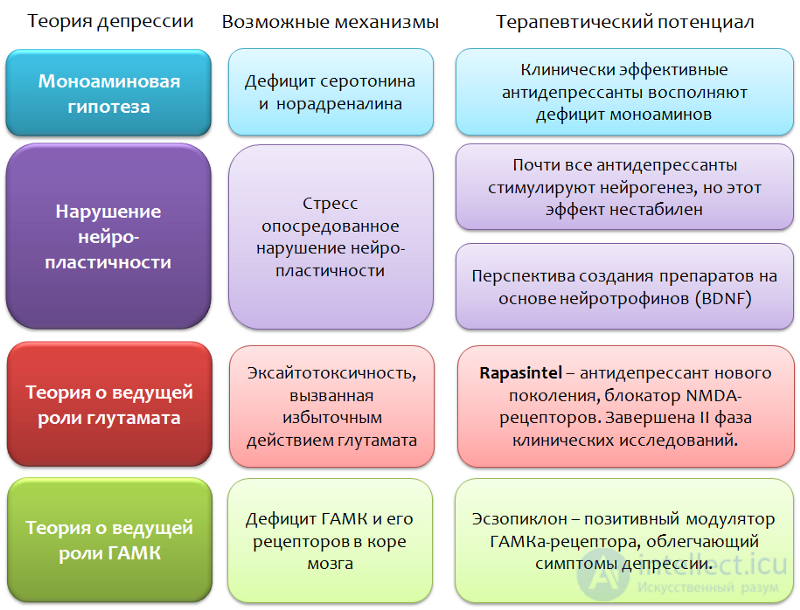 Fig. 36
So, in the diagram presented (Fig. 37) we summarize the data on disruption of neuroplasticity processes and the development of depressive symptomatology.
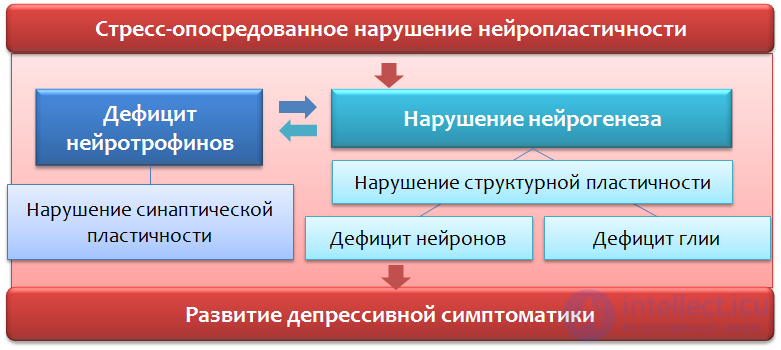 Fig. 37
— Suppression of neuroplasticity processes is not specific to depressive disorders
— In animal models, suppression of stem cell proliferation does not always block the effects of antidepressants
— The resource of neurogenesis may prove to be limited, and excessive stimulation could lead to its depletion.
— The long-term consequences of prolonged «forced» stimulation of neurogenesis remain unknown. Is there a risk of tumor development?
— Disruption of neuroplasticity is not an exhaustive concept for depressive disorders.
Theories regarding the role of the neurotransmitter amino acids — glutamate and GABA — are not exhaustive either. First, the systems in question (the glutamatergic and GABAergic systems) cannot be considered in isolation from other factors, since they are essentially an intermediate link in the pathogenesis of depressive disorders or their individual symptoms. Second, changes in the brain's glutamatergic and GABAergic systems are observed not only in depressive disorders but also in a number of other disorders and conditions (schizophrenia, anxiety disorders, panic attacks, epilepsy, pain sensitivity, Parkinson's disease, Alzheimer's disease).
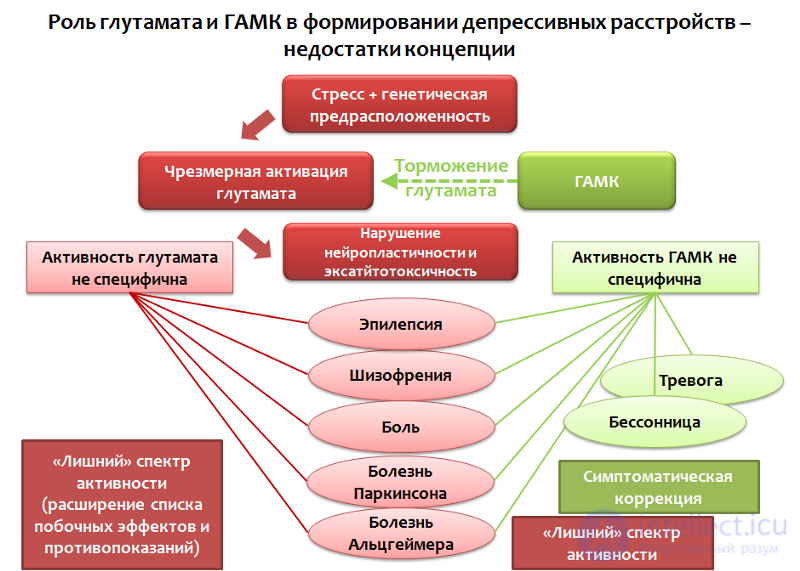 Fig. 38
If we consider pharmacological intervention in the glutamatergic system, it is undoubtedly promising and even innovative, since previously all antidepressants acted exclusively on the brain's monoaminergic system. However, the sheer breadth of glutamate's functions in the CNS may lead to undesirable effects and a number of contraindications. But it is too early to make predictions — the glutamate receptor blocker still has to go through Phase III clinical trials. The drug is being considered not as a replacement for current antidepressants, but as a supplementary therapy (for example, in treatment-resistant forms of depression).
Drugs that act as positive modulators of GABA-A receptors are not currently regarded as standalone antidepressants; they are useful for relieving individual symptoms of depressive disorders.
A promising direction for the development of new effective and safe antidepressants appears to be the study of the mechanisms of stress itself, since it is the stress factor (stressful events) that is regarded as the main triggering stimulus for the formation of depressive disorders.
The search for and creation of an «ideal» antidepressant should be based on two simple principles (according to Franco Borsini):
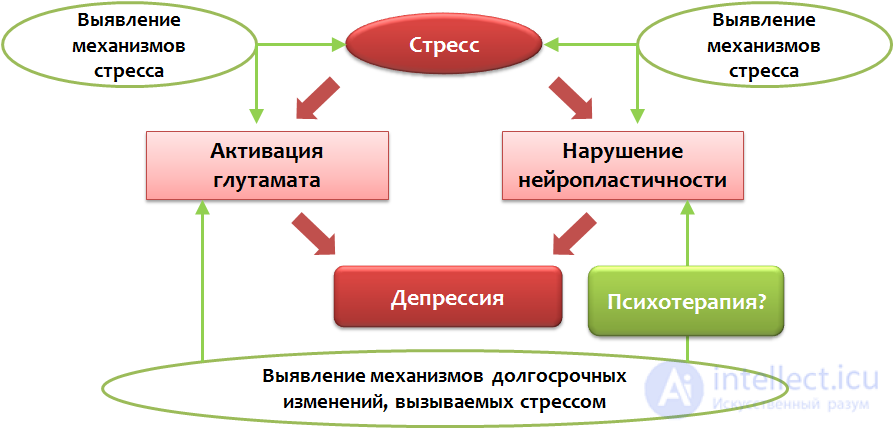 Fig. 39. Borsini F. Models for depression in drug screening and preclinical studies: Future directions // World Journal of Pharmacology. 2012. 1(1). P. 21–29.
Interrupting the mechanisms of stress at early stages would make it possible to prevent all the changes discussed in the context of this article. It is precisely this kind of correction that, in theory, appears to be the most effective not only for preventing the development of depression, but also for reliable protection against relapses and repeated, more severe episodes.
Drug therapy by itself is not the only means of correcting the psychopathology in question. No less importance should be given to communicating with patients and identifying the cause of the illness. In a number of cases, the effectiveness of psychotherapy also has high potential, since it helps find ways to solve the problem rather than fighting the symptoms of the illness, which leaves the problem unresolved and turns the depression into a subchronic or chronic form.
Часть 1 Depression: Causes, Diagnosis, Prevention and Treatment; Depression in Neurology and Neurosurgery, and During Pregnancy, Childbirth,
Часть 2 Depression during pregnancy, childbirth, and menopause - Depression: Causes, Diagnosis,
Часть 3 The «ideal» drug - Depression: Causes, Diagnosis, Prevention and Treatment;

Comments