
Lecture
Obsessive-compulsive neurosis (OCN), also known as obsessive-compulsive disorder (OCD), is a mental illness characterized by the appearance of intrusive, relentless thoughts (obsessions) and/or actions (compulsions), which the patient experiences as uncontrollable and pointless. These intrusive thoughts and actions can cause discomfort and anxiety.
Classification
An obsession is the sudden appearance of a thought or idea not connected at that moment to the content of consciousness, and therefore perceived as alien, emotionally unpleasant, but with the understanding that it is one's own, not imposed from outside.
It develops against a background of clear consciousness, although some affective narrowing is possible. Clarity and «alienness» lead to a critical attitude and prompt a struggle against it, which is what distinguishes it from delusion.

Obsessions in neuroses are accompanied by a painful affective state defined by a sense of helplessness in the face of them. It is often unclear which is more distressing
Obsessional phenomena, being obligatory symptoms of obsessive-compulsive syndrome, are characterized by the appearance in consciousness of certain contents that:
Recognizing the obsessive thoughts as wrong, the patient is «forced» to act as though these thoughts were correct, otherwise anxiety and fear arise.
In 80% of persons with obsessive-phobic disorder, depressive symptoms developed after the onset of obsessive manifestations, and these were secondary in nature.


Obsessional phenomena include
fears. Obsessive fears arise against one's will and contrary to the actual facts of life.
doubts– constant vacillation in decision-making, uncertainty about the correctness of actions performed, repeated, unreassuring rechecking and recalculating;
memories– intrusive recall, most often of unpleasant, compromising events;
contrasting phenomena.A feeling of antipathy– hostility toward a close person that arises contrary to one's will and actual attitude.Blasphemous thoughts – the emergence of cynical, offensive representations toward people for whom the patient feels sincere respect; in religious people – the emergence, at a moment of high emotional intensity (worship), of thoughts about the desecration of a shrine.
Obsessive urges – the appearance, contrary to reason, of urges to perform senseless or even dangerous actions;
compelling representations - the emergence, contrary to the facts of consciousness, of vivid images based on productive imagination.
abstract obsessions–obsessive counting,obsessive recall of forgotten names, obsessive rumination(mental rumination) – involuntary deliberation over trivial alternatives, which makes it impossible or significantly difficult to make trivial but necessary everyday decisions;
obsessive actions– performing unnecessary actions against one's wishes while insight is preserved - touching the face with a hand, biting nails, pulling out hair (trichotillomania), etc.
rituals– complex obsessive actions that are secondary in relation to phobias, having the significance of incantations, protection, and leading to relief, brief freedom from obsessive fear.
Obsessive doubts manifest as agonizing doubts about the correctness or completeness of actions, with a constant urge to check their performance, which nevertheless brings no reassurance. Meanwhile, real events and phenomena attract significantly less of their attention.
Obsessions in the form of «mental rumination» manifest as obsessive doubts and reflections that accompany any actions of the patients. Being fruitless, they are tormenting, since there is no getting rid of them. They force the person to return to the same thoughts again and again, to recount or check completed work an endless number of times, bringing them to a state of exhaustion.
Obsessive memories – the irresistible recurrence of a psychotraumatic event from the past. This is often accompanied by a feeling of shame and remorse.
Compulsive counting often has a protective-ritualistic character: the person counts in order not to fall ill with cancer or AIDS.
Contrasting obsessions – blasphemous, sacrilegious thoughts that contradict a person's true emotional attitudes and moral-ethical values, fear of causing harm to oneself and others, an overwhelming fear of performing dangerous or absurd actions, while obsessive urges are represented only minimally.
This is not an obsessive urge to perform an action, but a fear of the possibility of doing something combined with a vivid mental image of that action.
Obsessions of sexual content (obsessions in the form of forbidden images of deviant sexual acts involving children, members of the same sex, or animals).
Symptoms of obsessive fear of being unable to perform some action are quite common.
This is characteristic of syndromes of deautomatization of autonomic functions, manifesting as disturbances of breathing, swallowing, and urination. For example, an inability to remain in a certain situation because of the possibility of a throat spasm occurring.
Rituals
Obsessive movements or actions serve as rituals. These can be simple actions (tapping, shaking off), as well as complex, strictly sequential ones (a morning routine, arranging objects in a particular order).
Complex rituals often have the character of a «purifying», protective-safeguarding act (washing the hands), carry the significance of an incantation, and are performed to prevent an imagined misfortune (for example, the death of loved ones) or to overcome an obsessive doubt (for example, doubt about the successful outcome of upcoming tasks at work): a series of obsessive actions is performed in a fixed order, movement occurs only along certain routes, only the front carriages are used when traveling on public transport, and so on.
Tics
Tics are isolated, monosymptomatic motor disorders
Tics are complex motor acts that have lost their original meaning.
As J. M. Charcot wrote, tics sometimes give the impression of exaggerated physiological movements. They are a kind of caricature of certain motor acts, of natural gestures.
Compulsive actions
Compulsive actions are performed against one's will, resembling natural gestures and movements that have lost their meaning.
Patients with such habitual, repetitive movements may shake their head, as if checking whether their hat is sitting properly, make a hand movement as if brushing away hair that is in the way, smooth out folds in their clothing, blink their eyes (as if getting rid of a speck of dust), and so on.
Pathological habitual actions: lip biting, nail biting, teeth grinding, spitting, and so on - differ from compulsive actions in the absence of a subjectively distressing sense of persistence and of experiencing them as alien or painful.
Performing a ritual is usually accompanied by a feeling of relief, but only for a short time.
Attempts not to perform rituals lead to a sharp increase in anxiety, low mood, and tension.
But performing the rituals is accompanied by annoyance, a feeling of helplessness, and resentment
Sometimes they even make their family members perform them too.
What brings patients to the clinic is not the fear and the rituals themselves, but the hopelessness of the situation, since all their time is spent performing rituals, leaving almost no time for anything else.
Mysophobia - an obsessive fear of contamination.
This group of obsessions includes not only the fear of contamination (by earth, dust, urine, feces, and other filth), but also phobias of substances entering the body that are harmful and poisonous (asbestos, toxic waste), small objects (glass fragments, needles, specific types of dust), and microorganisms - that is, phobias of extracorporeal threat
Some typical signs of obsessive-compulsive neurosis include:
Obsessive thoughts: These are unwanted and recurring thoughts that may be anxiety-provoking, unpleasant, or even absurd. Patients may feel that they cannot get rid of these thoughts.
Compulsions: These are ritualistic actions or behavioral routines that patients perform in an attempt to relieve the anxiety associated with obsessive thoughts. For example, this may include repeated hand washing, checking doors, counting to a certain number, and so on.
Fears and worry: People with obsessive-compulsive neurosis may experience intense fear and worry because of their obsessive thoughts and compulsive actions.
Interference with daily life: Obsessive thoughts and compulsions can affect daily activities, work, and relationships, which can lead to significant discomfort and disruption of everyday life.
Awareness of meaninglessness: Patients with obsessive-compulsive neurosis usually recognize that their obsessive thoughts and actions have no rational explanation, but they still feel unable to stop
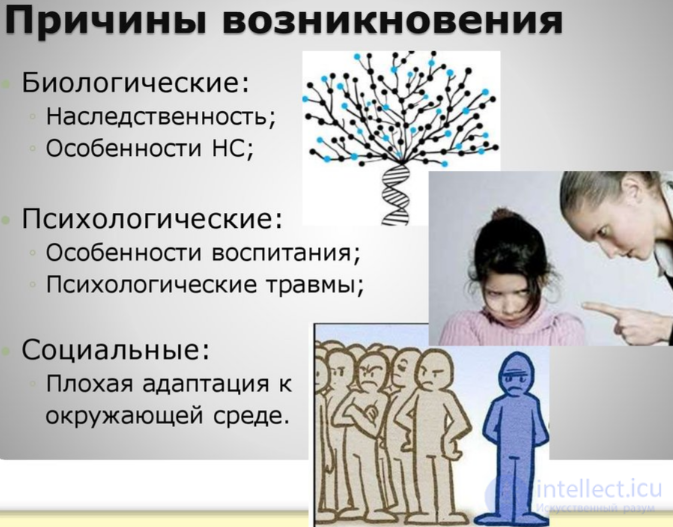
Obsessive-compulsive neurosis, also known as obsessive-compulsive disorder (OCD), is a mental illness characterized by the appearance of obsessive, recurring thoughts (obsessions) and/or actions (compulsions). The causes of OCD can be multiple and include the following factors:
Genetic predisposition: Research shows that there is a genetic component in the development of OCD. If a family member has a history of this disorder, the risk of developing OCD in other family members may be increased.
Biological factors: Certain changes in brain chemistry, such as an imbalance of neurotransmitters (for example, serotonin), may play a role in the emergence of OCD. Medications that correct neurotransmitters can be effective in treating OCD.
Stressors and traumatic events: Psychological trauma, stressful situations, and major life changes can trigger the development of obsessive-compulsive neurosis. Traumatic events or experiences can intensify obsessive thoughts and actions.
Psychological factors: Certain personality traits, such as perfectionism and a tendency toward anxiety, can increase the risk of developing OCD. Also, excessive stress and anxious thoughts can create conditions for the emergence of obsessive states.
Sociocultural factors: Sociocultural and environmental factors, such as pressure from society, expectations, or the influence of certain cultural norms, can also influence the appearance of obsessive states.
Illnesses and medical conditions: Certain medical conditions, such as infections or diseases of the central nervous system, may be associated with the emergence of obsessive states.
It is important to note that the development of OCD is usually not related to a single specific factor, but rather represents a complex interaction of multiple factors. Treatment of OCD may include therapy, medications, and other approaches aimed at managing symptoms and improving the patient's quality of life.


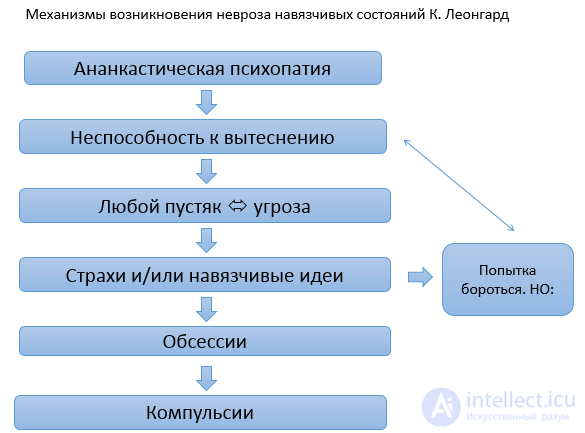
Mechanisms of development of obsessive-compulsive neurosis according to K. Leonhard

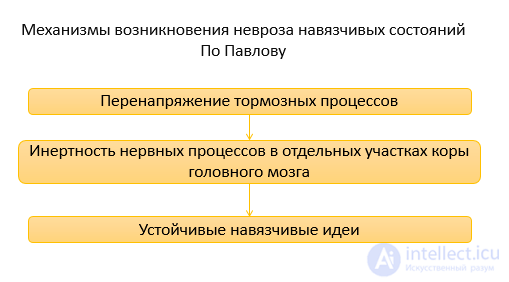
Mechanisms of development of obsessive-compulsive neurosis according to Pavlov
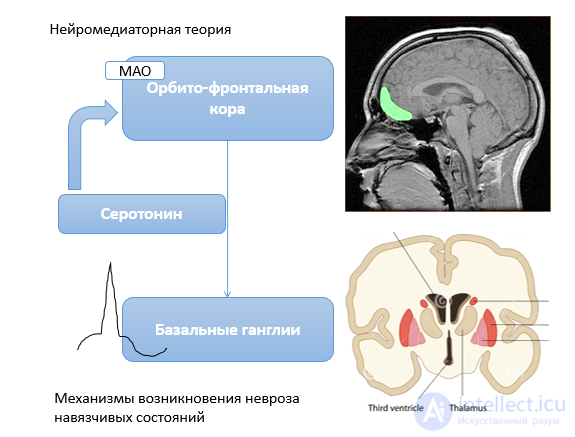
Neurotransmitter theory
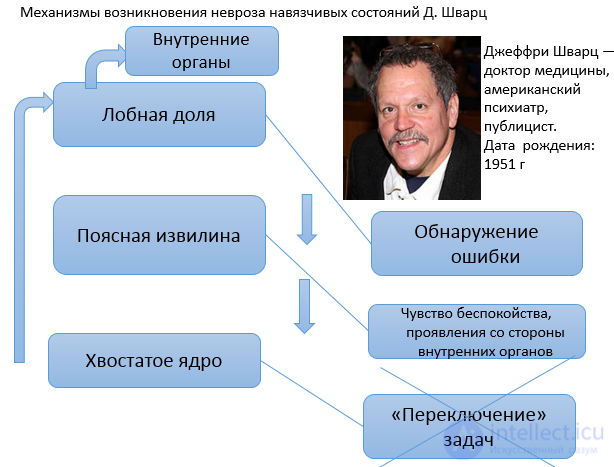
Mechanisms of development of obsessive-compulsive neurosis according to D. Schwartz
Diagnosis (criteria) of obsessive-compulsive neurosis

The causes of the development of OCN can be multiple and include genetic, biological, psychological, and environmental factors. Treatment of OCN may include therapy, medications, and other methods aimed at managing symptoms and improving the patient's quality of life.
Thus:
Characteristics of the disorder: OCN is characterized by the appearance of obsessive, relentless thoughts and actions that cause discomfort and anxiety in the patient.
Obsessive thoughts: Patients experience unwanted and recurring thoughts that may be anxiety-provoking, unpleasant, or absurd.
Compulsions: These are ritual actions or behavioral rites performed in an attempt to relieve the anxiety associated with obsessive thoughts.
Fear and anxiety: Patients may experience intense fear and anxiety because of their obsessive thoughts and compulsive actions.
Interference with daily life: OCN can affect daily activities, work, and relationships, leading to significant inconvenience.
Awareness of meaninglessness: Patients often recognize that their obsessive thoughts and actions have no rational explanation, but they cannot stop.
Causes of development: The causes of OCN can be genetic, biological, psychological, and environmental factors.
Treatment: Treatment of OCN includes therapy, medications, and other methods aimed at managing symptoms and improving patients' quality of life.
OCN is a serious mental disorder, but with appropriate help and treatment, many patients can manage their symptoms and lead a better quality of life. It is important to seek medical help and support if you or someone close to you shows signs of this disorder.

Comments