
Lecture
Any deviation from the established norm can be characterized as pathology.
In medical terminology, pathology usually refers to a disturbance at the biological level of the body's functioning.
In clinical psychology, however, the concept of «pathology» also includes deviations from the norm that have no biological components at all (hence the entirely possible and legitimate use of the terms «pathological personality» or «pathological personality development»).
The Guide to Mental Disorders in Medical Practice, specially prepared by the World Health Organization, presents a fairly extensive list of mental disorders for which not only diagnosis but also certain treatment and preventive actions by primary care specialists are envisaged (Table 1).
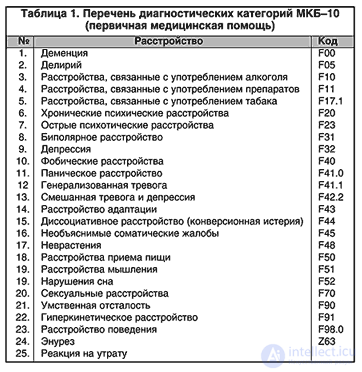
As follows from Table 1, such a widespread mental illness as schizophrenia is not mentioned in this list; more precisely, schizophrenia is included in the insufficiently defined category of «chronic mental disorders» or may be implied under acute psychotic disorders. This is explained by the complexity of diagnosis and, especially, of therapy, which undoubtedly requires the involvement of a psychiatrist. Bipolar (manic-depressive) disorder should also be added here, as it too must remain within the competence of a psychiatric specialist. As for delirium and dementia, these disorders are precisely the ones frequently identified in somatic care settings and require internists to be aware of their manifestations in order to provide timely specialized care, including, if necessary, transfer to a psychiatric hospital. Meanwhile, most of the clinical categories listed here by no means require mandatory transfer to a psychiatric institution. On the contrary, in many cases adequate care can quite well be provided in a general somatic care setting, through either one-time consultations or long-term interaction between internists and psychiatrists.
The use of the word «pathology» emphasizes that the normal state, functioning, or development of the personality is altered as a result of morphofunctional disturbances (i.e., at the level of cerebral, psychophysiological, endocrine, and other biological mechanisms regulating behavior).
With respect to the biological norm, it is possible to establish more or less clear objective boundaries of the acceptable range of variation in a person's level of functioning, within which the body is not threatened by death from structural and functional changes.
With respect to establishing a psychological norm, no clear objective boundaries can be set, since here an arbitrary evaluative, normative approach dominates.
Establishing the boundaries that characterize the norm turns out to be closely tied to theoretical conceptions of the nature of personality, in which some idealized notion of the human being as a social entity is modeled.
The original meaning of the ancient Greek word pathos, from which the term «pathology» derives, is suffering. Consequently, pathology can be understood as referring only to those deviations from the norm in which a person experiences emotional discomfort.
For example, for specific manifestations of sexual preferences requiring clinical-psychological intervention, the terms «ego-dystonic» and «ego-syntonic» are now used.
However, in the area of mental, personality, and behavioral deviations from the norm, a person often experiences no subjective discomfort or feeling of suffering whatsoever.
The use of the word «pathology» also presupposes the existence of a single leading cause of the deviation from the norm. However, one and the same mental state may have not just one but several, sometimes opposing, causes of not only biological but also social origin.
For example, depression can be caused by neurochemical disturbances (decreased activity of biogenic amines – serotonin, norepinephrine, dopamine), by neurohormonal changes caused by hyperactivity of the «hypothalamus-pituitary-adrenal» system (increased cortisol release). But depression can just as likely be caused by life circumstances (not only current living conditions but also cultural, era-related, political, and other factors), as well as by motivationally driven features of cognitive information processing (interpretation of events).
because of the way the word «pathology» is used (the obligatory presence in a person deviating from the norm of suffering, of feeling unwell; the assumption that a single leading cause is at work; a pronounced evaluative component), many scholars advocate for its exclusion from the vocabulary of psychiatrists and clinical psychologists, proposing instead the use of the term «disorder», limiting the use of the word «pathology» to the biological level of disturbances alone.
Disorder means the absence or disturbance of a person's previously usual state. Use of the term «disorder» does not imply that any given deviation from the norm necessarily has an unambiguous cause-and-effect relationship. Disorders may be caused by the interaction of a number of factors at the biological, psychological, and social levels, and in each specific case one factor or another may prove to be the leading one at the onset, development, or outcome of the disturbance.
The definition of a mental disorder rests on three basic criteria
individual types of reactions that exceed the statistically established frequency of their occurrence in most people in a given situation over a certain period of time (for example, if five of nine signs of depression are observed in a person for two weeks or more, only then is the condition recognized as a disorder);
states that prevent a person from adequately achieving the goals they have set for themselves and thereby cause them harm (so-called «dysfunctional states»);
types of behavior from which the individual themselves suffers and sustains physical harm, or which cause suffering and physical harm to the people around them.
Pathology – a persistent change, the result of a pathological process or a defect, a developmental deviation. This condition is a pathological formation not prone to any substantial transformation, resistant to therapy, and stable. (intellectual disability, psychopathy, defect states in schizophrenia, traumatic brain injuries).
Psychosis – a severe disturbance of the psyche characterized by inadequate reactions, impaired reflection of the surrounding world, the disappearance of critical awareness of one's own actions, an inability to comprehend what is happening, and an inability to control oneself, one's actions, and mental manifestations.
Psychosis may manifest as disturbance of consciousness and/or gross personality changes, disintegration of mental activity.
Criteria by which a mental disorder is identified as psychotic:
— a fundamental, radical distortion of the picture of the real world in the patient's consciousness. This is caused by deep depression, delusions, hallucinations, and other profound disturbances of mental activity;
— severe behavioral disturbances, associated with the patient's inability to reckon with the demands of reality and the healthy tendencies of their own personality;
— the patient's failure to understand the fact of their own mental disorder, or in other words, the absence of a critical attitude toward the illness — anosognosia.
In jurisprudence, mental disorder is defined as a more precise term introduced into the Criminal Code of the Russian Federation in place of the outdated concept of mental illness; it includes temporary mental disorder, chronic mental disorder (illness), dementia, as well as other morbid states (Article 21 of the Criminal Code of the Russian Federation). The presence of a mental disorder is a medical criterion which, together with the legal criterion (inability to understand the significance of one's actions or to control them), determines a person's state of legal insanity
By chronic mental disorder, jurisprudence understands a long-lasting disturbance of the psyche that may nevertheless proceed in an episodic manner (that is, with improvement or worsening of the mental state), but leaves behind a persistent mental defect. Such mental illnesses include: schizophrenia, epilepsy, progressive paralysis, paranoia, bipolar disorder, and other mental disorders
By temporary mental disorder, jurisprudence understands mental illnesses that are relatively short-lived and end in recovery. These include: pathological intoxication (delirium tremens), reactive symptomatic states, that is, disturbances of the psyche caused by severe emotional shocks and experiences

Psychiatry and psychopathology draw on ICD-10 and understand the term as the clinically defined group of symptoms or behavioral signs listed therein, which usually cause suffering and impede personal functioning[12].
One can distinguish: organic mental disorders (that is, caused by organic disturbances), personality disorders, behavioral disorders, emotional (affective) disorders, disorders related to (caused by) the use of psychoactive substances, post-traumatic stress disorder, and others. Some of these groups may overlap.
In pathopsychology (a branch of clinical psychology), when classifying mental disorders — the primary consideration is how the course (structure) of the mental processes themselves is disrupted, along with specific components of brain activity, its links and factors, the loss of which is the cause of the symptomatology observed clinically[13].
The primary method of differential diagnosis in pathopsychology is the pathopsychological experiment, in whose diagnostic conclusions the pathopsychologist can operate with a set of pathopsychological register syndromes.
Psychology as a whole uses this term to describe any state of the psyche that differs from a healthy one. Accordingly, the criteria for the presence of a mental disorder in this broad sense are the inverse of the criteria for mental health, that is, any of the following:
WHO specialists identify the main signs of a mental or behavioral disorder as «disturbances of thinking, mood, or behavior that go beyond existing cultural beliefs and norms» , that is — psychological discomfort, deviation from the usual capacity to perform work or study, and «increased risk of death, suffering, or impairment of functioning»[14].
Patients with mental disorders may exhibit various physical, emotional, cognitive, behavioral, and perceptual symptoms . For example:
During diagnosis, the presence or absence of a somatic illness in the patient is checked first[14]. Indirect signs such as the absence of pathology in internal organs, or a difference between the clinical picture of the illness and the manifestation of somatic diseases, suggest the possible presence of a mental disorder in the patient[14].
Special diagnostic tests are used for screening and preliminary diagnosis of various mental disorders[18].
The use of the term mental disorder should not be excessively broad[19]. According to ICD-10, «isolated social deviations or conflicts without personal dysfunction should not be included among mental disorders» [19].
Individuals suffering from mental and behavioral disorders are observed at psychoneurological dispensaries.
The causes of many mental disorders are not fully understood . Specialists speak of the influence of a combination of biological, psychological, and social factors (ranging from heredity to stressful events) on the emergence of mental disorders .
Resilience to mental disorders depends on an individual's physical characteristics and their overall mental development[20]. Different people react differently to emotional suffering and problems: while some recover easily from setbacks, others develop psychological disturbances[20].
Therapy for mental disorders is carried out using psychotherapeutic, medicinal, or other somatic methods.
Psychotherapy includes various psychological methods that help with both mental and physical problems, for example through conversations or exercises[21]. The main goals of using psychotherapy are to alleviate the suffering experienced by a person in the form of fears, depression, obsessive thoughts, sexual problems, etc., and to help get rid of unfavorable character traits and behavioral patterns[22]. High effectiveness across a wide variety of mental disorders, confirmed by numerous studies, is characteristic of cognitive psychotherapy[23].
Psychotherapy can be conducted individually as well as with groups and families, and includes, among others, the following methods[24]:
Somatic treatment, in particular the use of medication, is used by psychiatrists to influence the well-being and behavior of people with mental disorders, and to ease their suffering[25]. The use of modern psychotropic drugs began after two French psychiatrists applied chlorpromazine to treat mentally ill patients in the early 1950s[25]. After this, various antipsychotic drugs and drugs from other classes of psychopharmacological compounds began to appear[26].
Somatic forms of treatment are used for most complex mental disorders, although their mechanism of action is not fully understood[27]. Moreover, the use of medications often only eliminates the symptoms of a mental illness rather than its cause, so, for example, severe psychotic symptoms may return after discontinuing the medication[28].
Mental disorders, even in severe form, can in principle be cured . Often the difficulty lies in the fact that people tend to deny having a mental illness out of fear of it, or because of the misunderstanding of the nature of the illness that exists in society .

Comments