
Lecture
Deviant human behavior can be defined as a system of actions or individual actions that contradict the norms accepted in society and are manifested as an imbalance of mental processes, maladaptation, disruption of the process of self-actualization, or evasion of moral and aesthetic control over one's own behavior.
The basis for assessing deviant human behavior is an analysis of the person's interactions with reality. Behavior is considered deviant when deviations are observed from at least one of the social norms (legal norms, moral norms, aesthetic norms).
Depending on the ways of interacting with reality and the violation of particular societal norms, deviant behavior is divided into five types.
Deviant behavior is considered to be any behavior, regardless of degree of expression, orientation, or motives, that deviates from the criteria of a particular social norm.
In this case, the criteria are determined by norms of compliance with legal instructions and regulations (norms of law-abidingness), moral and ethical prescriptions (so-called universal human values), and etiquette.
I. Delinquent behavior — deviant behavior which, in its extreme manifestations, constitutes a criminally punishable act (a variety of a person's criminal behavior).
The differences between delinquent and criminal behavior lie in the severity of the offenses and the degree of their antisocial character. Offenses are divided into:
K.K. Platonov identified the following personality types of offenders:
Delinquent behavior may manifest itself, for example, in mischief and a desire for entertainment. Out of curiosity and to fit in with peers, a teenager may throw heavy objects (or food) off a balcony at passersby, deriving satisfaction from the accuracy of hitting the «target». As a prank, a person may call an airport dispatch office and report a supposedly planted bomb on a plane. In order to draw attention to themselves («on a dare»), a young person may attempt to climb a television tower or steal a notebook from a teacher's bag.
II. Addictive behavior — is one of the forms of deviant behavior involving the formation of a striving to escape from reality by artificially altering one's psychological state through the use of certain substances or through the constant fixation of attention on certain types of activity, aimed at developing and sustaining intense emotions (Ts.P. Korolenko, T.A. Donskikh).
The main motive of individuals prone to addictive forms of behavior is the active alteration of their unsatisfying psychological state, which they most often perceive as «grey», «boring», «monotonous», «apathetic».
The following psychological characteristics of persons with addictive forms of behavior have been identified (B. Segal):
According to the existing criteria, the main characteristic of an individual prone to addictive forms of behavior is a mismatch of psychological stability between ordinary situations and crises.
Normally, mentally healthy people, as a rule, easily («automatically») adapt to the demands of everyday life and cope with crisis situations less easily. Unlike people with various addictions, they tend to avoid crises and disturbing, unconventional events.
The addictive personality exhibits a phenomenon of "thirst for thrills" (V.A. Petrovsky), characterized by an urge toward risk stemming from experience in overcoming danger.
According to E. Berne, a person has six kinds of hunger:
Within the framework of the addictive behavior type, each of the listed forms of hunger becomes intensified. The person fails to satisfy this feeling of hunger in real life and strives to relieve discomfort and dissatisfaction with reality by stimulating one or another type of activity. He attempts to achieve a heightened level of sensory stimulation (giving priority to intense stimuli, loud sounds, sharp smells, bright images), recognition through extraordinary acts (including sexual ones), and filling his time with events.
Thus, the core feature of addictive personality behavior is a striving to escape from reality, a fear of ordinary, "boring" life filled with obligations and regulations, a tendency to seek extreme emotional experiences even at the cost of serious risk, and an inability to be responsible for anything.
In addictive behavior, escape from reality takes the form of a kind of "flight," in which, instead of harmonious interaction with all aspects of reality, activation occurs in a single direction. In doing so, the person concentrates on a narrowly focused sphere of activity (often disharmonious and destructive to the personality), ignoring everything else. According to N. Peseschkian's concept, there are four types of "flight" from reality:
"flight into the body," in which traditional life activity aimed at family, career growth, or hobbies is replaced, the hierarchy of everyday life values shifts, and reorientation occurs toward activity aimed solely at one's own physical or mental improvement.
"flight into work," characterized by a disharmonious fixation on work matters, to which the person begins to devote a disproportionate amount of time compared to other areas of life, becoming a workaholic.
"flight into contacts or solitude" in which communication either becomes the sole desired way of satisfying needs, replacing all others, or the number of contacts is reduced to a minimum.
"flight into fantasy" a tendency toward reflection and grand plans in the absence of any desire to actually put anything into practice, to perform any action, or to display any real activity. Within this kind of escape from reality, interest arises in pseudo-philosophical quests, religious fanaticism, and life in a world of illusions and fantasies.
III. The pathocharacterological type of deviant behavior refers to behavior conditioned by pathological changes in character formed during upbringing.
These include: 1. Personality disorders (psychopathies), both overt and pronounced character accentuations. Disharmony of character traits leads to a change in the entire structure of a person's mental activity.
- with emotionally unstable personality disorder (excitable psychopathy), the most common motive for behavior is the striving to fulfill an inadequately inflated level of aspirations, a tendency toward dominance and control, stubbornness, touchiness, intolerance of opposition, a tendency to work oneself into a rage, and a search for pretexts to discharge affective tension.
with histrionic personality disorder (hysterical psychopathy), the motives for deviant behavior are typically qualities such as egocentrism, a thirst for recognition, and inflated self-esteem.
2. Neurotic personality development — pathological forms of behavior and response formed in the process of neurogenesis on the basis of neurotic symptoms and syndromes. Deviations manifest as neurotic obsessions and rituals that pervade a person's entire life activity. For example, a person with obsessive rituals may, for long periods and to the detriment of their own plans, perform stereotyped actions (opening and closing doors, letting a certain number of approaching trolleybuses pass by at a stop), the purpose of which is to relieve a state of emotional tension and anxiety.
3. Behavior in the form of behavior based on symbolism and superstitious rituals. In such cases, a person's actions depend on their mythological and mystical perception of reality. The choice of actions is based on a symbolic interpretation of external events. A person, for example, may refuse to carry out some necessary act (getting married, taking an exam, or even going outside) because of an "unfavorable alignment of the heavenly bodies" or other pseudoscientific interpretations of reality and superstitions.
IV. The psychopathological type of deviant behavior is based on psychopathological symptoms and syndromes that are manifestations of various mental illnesses. As a rule, the motives behind a mentally ill person's behavior remain unclear until the underlying signs of the mental disorder are identified.
A patient may display deviant behavior due to perceptual disturbances — hallucinations or illusions (for example, plugging their ears or listening to something, searching for a nonexistent object, talking to themselves), disturbances of thinking (voicing, defending, and trying to achieve goals based on a delusional interpretation of reality, actively limiting their contact with the outside world because of obsessive ideas and fears), performing absurd yet understandable acts or remaining inactive for months, making stereotyped, bizarre movements, or freezing for long periods in a fixed, unchanging posture because of disturbances in volitional activity.
V. A variant of the pathocharacterological, psychopathological, and addictive types of deviant behavior is self-destructive (autodestructive) behavior.
(Autodestructive) behavior is a system of a person's actions directed not toward development and personal growth, nor toward harmonious interaction with reality, but toward the destruction of the personality.
Aggression is directed at oneself (autoaggression), inward at the person, while reality is perceived as something oppositional, one that does not allow for a full life and the satisfaction of basic needs.
Autodestruction manifests itself in the form of suicidal behavior, drug abuse and alcoholism, and certain other varieties of deviation.
VI. A special type of deviant behavior is considered to be deviations caused by a person's hyper-abilities (K.K. Platonov).
A person whose abilities significantly and substantially exceed average abilities (manifestations of giftedness, talent, or genius in one of the person's activities) is regarded as going beyond the ordinary, normal range.
Deviation in the direction of giftedness in one area is often accompanied by deviations in everyday life. Such a person is often found to be poorly adapted to «mundane, down-to-earth» life. They are unable to correctly understand and evaluate the actions and behavior of other people, and turn out to be naive, dependent, and unprepared for the difficulties of daily life.
If delinquent behavior is characterized by confrontation in interaction with reality, addictive behavior — by escape from reality, and pathocharacterological and psychopathological behavior — by painful opposition, then behavior associated with hyper-abilities is characterized by — ignoring reality. Outwardly, in everyday life, the actions of such a person may appear eccentric. For example, they may not know how to use household appliances or perform ordinary everyday tasks. Their entire interest is concentrated on activities related to their extraordinary abilities (musical, mathematical, artistic, or other).
Deviant (aberrant) behavior has the following clinical forms:
Each of the clinical forms may be caused by any type of deviant behavior, and sometimes the motive for choosing one form or another involves several varieties of deviant behavior simultaneously.
Aggressive behavior — behavior directed at another person, a group of people, or oneself, characterized by initiative and purposefulness. The goal of aggression is to cause harm or damage, and the specific means of achieving that goal is the use of force or the threat of its use.
Aggression refers to physical or verbal behavior aimed at causing harm to someone.
The following types of aggressive actions exist (Buss, Durkee):
The features that qualify a given action as aggressive include the following main characteristics:
Aggressive behavior is described by three groups of factors:
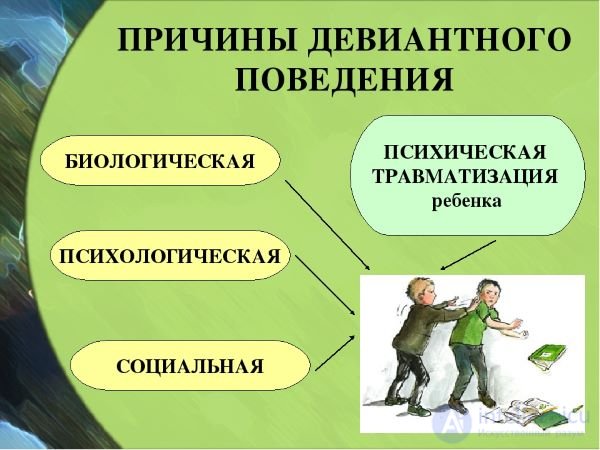
As a rule, studies devoted to the problem of aggressive behavior identify three groups of causes influencing aggression: biological, social, and psychological.
Biological factors: heredity burdened with mental illness, alcohol abuse, use of drugs and psychotropic substances, a history of severe or repeated traumatic brain injuries, as well as infections and intoxications.
Social factors: education received, presence and nature of work performed, marital status, association with antisocial groups, and others.
Psychological factors: the prominence within the personality structure of traits such as egocentrism, emotional instability, impulsivity, anxiety, as well as a tendency toward dysphoria and emotions of rage and anger.
One of the central roles in the organization of aggressive behavior is played by the characteristics of the motivational sphere, as well as by the individual's level of socialization together with the degree of internalization of the moral-ethical and legal norms that regulate behavior.
Among the types of aggressive behavior, a distinction is made between physical and verbal aggression (verbal — threats, insults, criticism).
Whereas childhood (Heckhausen) is characterized by the use of physical aggression (children aged 3 to 10 display approximately 9 acts of physical aggression per hour), in adults it becomes socialized, acquiring socially acceptable forms and turning into verbal aggression.
The most socialized forms of verbal aggression include irony, humor, and satire. Aggressive behavior can also be angry, motivated by the emotion of anger, or instrumental, when, within the framework of a broader activity, the aggressive act serves as an instrument used to achieve some other goal. Examples of instrumental aggression include blackmail and hostage-taking.
Aggression is divided, in a number of studies, into concealed (dreams, fantasies, imagined scenes of revenge, scenes of violence, dreams) and overt, which, in turn, is divided into direct (expressed directly and addressed to the person who provoked the aggression), indirect (when harm is caused not openly but indirectly — anonymous letters or gossip instead of the desired physical reprisal against the offender), and displaced (with a change of the object of aggression: instead of striking the offender, one might kick a chair, a cat, a dog, a child, or slam a door). Indirect and displaced aggression are, as a rule, observed in cases where the person who provoked the aggressive actions is protected by high social status, power, or physical strength.
Ammon distinguishes three types of aggression:
constructive (open, direct expression of aggression in a socially acceptable form or with a socially positive outcome),
destructive (open, direct expression of aggression in a socially unacceptable form or with a socially negative outcome),
deficient (associated with a deficit in the corresponding behavioral skills and, as a result, with insufficient discharge of aggressive impulses). The deficient form of aggression is considered characteristic of patients suffering from psychosomatic disorders.
By direction, aggression is divided into extrapunitive (externally blaming, or hetero-aggression) and intrapunitive, or auto-aggression.
Auto-aggressive actions include:
self-mutilation,
self-cutting — physical auto-aggression,
self-criticism,
self-blame — verbal auto-aggression.
The most severe, brutal form of physical auto-aggression is suicide.
Auto-aggressive behavior, unlike aggressive behavior, is aimed at causing harm to the person themselves rather than to their environment (although there is an infantile variety of auto-aggression combined with a desire to exert a harmful effect on the immediate environment in this unconventional way).
The dominant type of auto-aggression is physical aggression, in the form of verbal self-deprecating and self-blaming behavior, manifested in presenting oneself to others in an unfavorable light, self-insult and calling oneself abusive names, comparing oneself to a «base, worthless, insignificant» creature.
Auto-aggressive behavior manifests itself in two forms: suicide (suicidal behavior) and self-harm (parasuicidal behavior). Their differences lie in the ultimate goal (death or self-mutilation) and the probability of achieving it.
Suicidal behavior is understood as a person's deliberate striving toward death. It may be caused by the formation of an intrapersonal conflict under the influence of external situational factors, or in connection with the emergence of psychopathological disorders that give rise to a striving to take one's own life without any real influence of external situational factors.
Suicidal behavior — is a manifestation of suicidal activity, i.e. the presence of suicidal thoughts and intentions, their expression, threats of carrying them out, and suicide attempts.
There are various points of view on the causes of suicidal behavior:
- suicides are regarded as one of the expressions of social distress and reflect psychological tension in society;
- suicides are linked to a morbid condition of the people who commit them.
1. The well-known specialist in suicidal behavior Durkheim /1878/ once identified three distinct types of suicidal behavior depending on the characteristics of the individual's contacts with their social environment:
«Anomic,» associated with crisis situations in life and personal tragedies, most often found in mentally healthy people as a personality's reaction to insurmountable life difficulties and frustrating events.
This type of behavior should be regarded as a mode of psychological response chosen by a person depending on the value and significance of the event that has occurred.
The anomic type of suicidal behavior is also possible in cases where life confronts a person with a worldview- or morality-based problem of choosing one course of action or another that they are unable to resolve, and they choose to end their life. A person may be placed in a position of choosing between committing an immoral act or action that is repugnant to them on aesthetic grounds, and taking their own life. The resolution of this problem depends on the individual's personal qualities, the situation, and also their mental state at a given period of time.
2) «Altruistic,» committed for the good of other people. The altruistic, type of suicidal behavior likewise stems from the individual's personality structure, when the good of people, society, and the state is placed by them above their own good and even their own life.
This type is found in people oriented toward lofty ideas, living for public interests, and not viewing their own life apart from the people and society around them.
Altruistic suicides are committed both by mentally healthy people who are aware of the real meaning of what is happening, and by mentally ill individuals who find themselves, for example, in a state of religious ecstasy or who end their life for delusional motives of the «common good.»
3) «Egoistic,» caused by a conflict that forms in connection with the unacceptability, for a given individual, of the social requirements and norms of behavior imposed on the person by society.
Egoistic type of suicidal behavior arises as a response to excessive demands placed by others on the individual's behavior. For such a person, realistic norms and coercion to choose a corresponding type of behavior begin to be perceived as a threat to autonomy. He decides to part with life because his existence is inappropriate under the pressure and control exerted by both loved ones and society as a whole.
In this case, suicidal behavior is not a reaction to a critical situation, but a stance toward the surrounding world. It is often found in individuals with pathological character (accentuations and personality disorders) who feel loneliness, alienation, misunderstanding, and their own uselessness.
2. The creator of the theory of psychoanalysis, S. Freud, held a different point of view, linking suicides to a manifestation of the "death instinct," which he contrasted with libido - the sexual energy that is the instinct of life.
In cases where the balance between libido and the "death instinct" is disturbed, the latter may prove stronger and express itself in aggression directed either at oneself or at other people.
3. A follower of Freud Menninger /1938/ believed that suicide includes "three wishes": to die; to kill; to be killed. The author believed that a genuine, non-demonstrative suicide attempt must necessarily contain these three ingredients. If any one of them is absent, the attempt is not serious: it is calculated for external effect and is connected with a desire to intimidate someone, to blackmail, to thereby obtain some dividends.
There is a certain classification of suicides:
Cold suicide - this is when a person truly wants to die, that is, does not want to live;
Suicide that is a certain kind of game, that is, the person is fully confident that they will be saved, they simply want to draw attention to themselves;
Suicide as a way of escaping problems.
- in the individual form, a significant role is played by the individual psychological characteristics of the person and the parameters of the situation.
- within group and mass suicides, the dominant factor becomes the pressure of the environment and situation, while the individual traits and qualities of the person recede into the background.
Targeted or non-targeted pressure from those around an individual contributes to the individual choosing suicidal behavior on the principle of imitation, of conforming to the demands of the reference group.
The choice of method of suicide depends on social, cultural-historical, religious, aesthetic, situational factors and the individual psychological characteristics of the person.
It is believed that the choice of method of suicide is determined to a greater extent by the person's aesthetic notions.
According to L.Z. Tregubov and Yu.R. Vagin, there are three main aesthetic parameters for choosing the method of suicidal actions:
1. All other things being equal, a person seeks to choose the method of suicide that most corresponds to their notions of honor and beauty; and to the acceptability and permissibility of one or another method of suicide in a given social environment.
2. All other things being equal, a person seeks to choose the method that, in their opinion, leads to the least disfigurement of the body.
3. All other things being equal, a person always considers what aesthetic feelings the sight of their body will evoke in those around them.
Alongside aesthetic criteria in choosing a method of auto-aggression, what is often significant is the painfulness or painlessness of the intended action.
A person with parasuicidal intentions may seek to avoid an intense pain stimulus, whereas for an individual with a genuine intention to end their life by suicide, the nature of the pain may not be significant.
Some individuals with auto-aggressive behavior (more often those with psychiatric anomalies) have a tendency toward experiencing pain and the associated strong emotional experiences, while the outcome of the auto-aggression is not significant for them.
A similar pattern is observed in autoaggressive behavior within the addictive type of deviant behavior.
Parasuicidal attempts are usually made with the aim of bringing oneself out of a state of numbness, joylessness, and emotional flatness by experiencing acute affective-shock sensations.
For this purpose, various risky and life-threatening actions are used: strangulation to the point of the first signs of an altered state of consciousness; walking along the edge of a cliff or precipice, on a balcony ledge, windowsill, or bridge railing; playing «Russian roulette» with a pistol loaded with live and blank cartridges as a «test of fate»; cauterizing or cutting the skin and other painful actions; demonstrating to others one's determination to commit a suicidal act, driven by sadomasochistic urges and deriving satisfaction from bringing those around into a state of frenzy.
A special group of autoaggressive behavior is made up of the mentally ill, whose choice of behavior is determined by the psychopathological features of their existing disorders.
The following psychopathological syndromes are considered the most dangerous in terms of suicidal and parasuicidal behavior:
depressive, hypochondriacal, dysmorphomanic, verbal hallucinosis, paranoiac, and paranoid.

Comments