
Lecture
The field of «major psychiatry» deals with psychoses, in the origin of which individual biological factors play a special role. «Minor psychiatry» refers to borderline conditions, neuroses, personality disorders, addictive states, and the like.
Neuroses belong to what is known as "minor psychiatry," which studies illnesses outside of a psychotic state. These illnesses are characterized not only by low intensity but also by short duration. They fall under the definition of "borderline states." The concept of "borderline states" includes pre-nosological neurotic disorders, clinically established neurosis-like reactions and states, psychopathies, neurosis-like and psychopathy-like disturbances in somatic illnesses, and other conditions occurring at the neurotic level.
Borderline mental disorders may arise acutely or develop gradually; their duration can range from a brief reaction to a prolonged state or a chronic course. Most patients recover as a result of treatment or, in the case of reactions, even without it. However, in 20-40% of patients the course of the illness may become remitting or recurrent in nature, substantially reducing the patient's level of social functioning, yet never leading to disability.
The statistical average norm is the level of a person's psychosocial development that corresponds to the average qualitative and quantitative indicators obtained from examining a representative group of the population of the same age, sex, culture, and so on.
The functional norm is an individual norm of development. Any deviation can be considered a deviation only in comparison with each person's individual developmental trend.
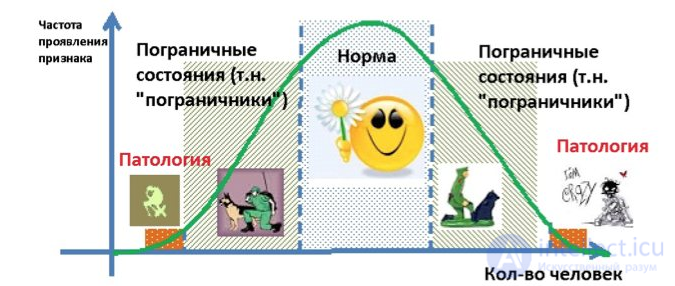

The group of social deviations is related to the rules of behavior or activity of people or social groups. A distinctive feature of social norms for children is that they act as a factor of upbringing, in the course of which social norms and values are assimilated, entry into the social environment takes place, and social roles and social experience are acquired. In this case, one of the important functions of upbringing is its regulatory function, whose task is to manage and organize the circumstances that influence children's consciousness and behavior while ensuring the desired educational effect. Speaking of social deviations, between the normal type of behavior and deviant behavior (lack of willpower, hyperactivity, anger, fear, markedly increased suggestibility, etc.) lies an immeasurable number of transitional stages from norm to deviation. As a result, it is not possible to draw a clear line between the natural expression of a child's character and deviations in it. Therefore, the therapeutic aspect of a teacher's work is aimed not so much at rehabilitating children in whom certain deviations have been identified, but rather at preventing deviations and forestalling violations of particular norms and rules.
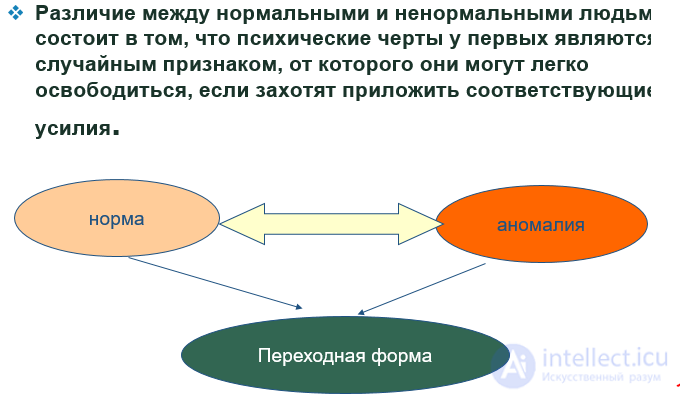
There is no clear understanding of the phenomenology of borderline mental disorders, and the symptoms characteristic of them can often seem vague, bizarre, indeterminate, and practically resistant to objectification. In this regard, coherent concepts of the origin of neurotic experiences have been proposed only by psychoanalysts. Freud held three theories of anxiety. According to the first, anxiety is a manifestation of repressed libido; the second regarded it as a repeated re-experiencing of birth; the third, which can be considered the final psychoanalytic theory of anxiety, posits the existence of two types of anxiety - primary and signal anxiety. Signal anxiety represents a sentinel defense mechanism that warns the "ego" of an impending threat to its equilibrium, while primary anxiety is the emotion accompanying the disintegration of the "ego." Primary anxiety signals a failure of defense and manifests in nightmares.
+Biological theories of the etiopathogenesis of neurotic disorders are based on the identification of biological markers of brain mechanisms that correlate with the corresponding symptomatology. Despite the separation of anxiety and depressive disorders into distinct diagnostic categories in current classifications, the high prevalence of cases with combined manifestation of anxiety and depression symptoms has provided grounds for reviving the concept of a single symptomatic continuum for these disorders. Genetic and neurobiological evidence has been obtained showing that the link between anxiety and depressive disorders is realized not only at the clinical level but also at the pathophysiological level. A so-called neurotic factor has been identified, encompassing feelings of inferiority and rejection, demoralization, shyness, and general affective distress.
Borderline mental disorders also have a serious genetic basis: in patients with agoraphobia, up to 20% of relatives suffer from similar disorders, and cases of generalized anxiety disorder are characterized by concordance in 50% of monozygotic and 15% of dizygotic twins.

Comments