
Lecture
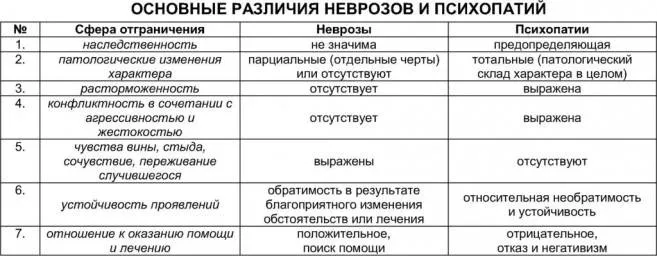
The differential diagnosis of psychopathy versus neuroses is based on the fact that, unlike psychopathies, neuroses arise after psychic trauma, i.e., they have a beginning and an end to their course. Most often it is necessary to distinguish psychasthenic psychopathy from obsessive-compulsive neurosis. In doing so, the clinical picture of neurosis involves awareness of the illness and the partial (circumscribed) nature of the neurotic disturbances. In contrast, the clinical picture of psychopathy is characterized by a greater massiveness of disturbances. Neurosis is characterized by reversibility of the condition, whereas psychopathic character traits remain with the patient throughout life. In neurotic disorders, insight (critical self-awareness) is preserved. Hysterical neurosis differs from hysteroid psychopathy in the absence of pronounced social maladjustment and in the preservation of the social-ethical level.
+Neuroses are a group of functional neuropsychic disorders that include emotional-affective and somatovegetative disturbances caused by psychogenic factors. Psychopathies (PP) are an anomaly of the personality and of emotional-volitional response that exists throughout the whole of life, is not amenable to treatment, determines the person's entire psychic makeup, and therefore interferes with adjusting and adapting to environmental conditions. What they have in common: psychogenicity; the psychological mechanism that triggers both conditions; the clinical picture. The difference: any psychopath feels that he has problems, but considers himself a neurotic. PP has biological mechanisms underlying this disharmony; it is not necessarily triggered as a result of external psychotrauma. A neurotic becomes such as a result of breakdowns in adaptation. Criteria for PP: totality — it leaves its imprint on the whole of activity and life; relative stability; social maladjustment. There exist 2 states: decompensation (does not fit into the environment, pronounced clinical picture) and compensation (fits into the environment, relatively adaptive). Life consists of a series of decompensations (if a person has lived half a life and decompensation occurred once, then this is not PP). The intensity of the psychogenic influence must be small — i.e., the cause is minimal, while the response is disproportionate — a weak stimulus produces an extremely strong response; for neurosis — a powerful cause produces an adequate response. Affective charge — responding in an inadequate manner lies in its nature — a conflict arises out of nothing. In PP — reduced insight and understanding of one's own behavior and state; in neurosis — critical self-awareness is constantly present and causes anxiety. The psychopath is not capable of critical thinking as a result of an affective narrowing of consciousness. A psychopathic personality has always been that way, whereas the neurotic was not previously like this — a breakdown, a qualitative change, takes place. There are only 3 neuroses in total, while there are about 20 PPs. The neurotic himself can say from what moment his problems began. He was like everyone else, then he changed. The psychopath is always one and the same, only manifesting to a greater or lesser degree. Neurosis: psychogenic; functional; powerful cause — adequate response; PP: biological, organic, minimal cause — powerful response.

Comments