
Lecture
Questions for consideration:
| Depressive syndrome. | Triad: pathologically lowered mood (dysthymia), slowing of the associative process, and motor retardation. The severity of these disturbances varies. The range of hypothymia extends from mild dejection and sadness to profound anguish, in which patients experience a sense of heaviness, pain in the chest, hopelessness, and worthlessness of existence. Everything is perceived in gloomy tones – the past, present, and future. The anguish is sometimes experienced not only as psychological pain but also as an oppressive physical sensation in the region of the heart, in the chest – «precordial anguish». Slowing of the associative process manifests as impoverishment of thinking – thoughts are few, they flow slowly, and are fixated on unpleasant events: illness, ideas of self-blame. No pleasant events can change the direction of these thoughts. Answers to questions are monosyllabic and involve long pauses. Motor retardation manifests as slowed movements and speech; speech is quiet and slow, facial expression is mournful, movements are slowed and monotonous. Patients may remain in one position for long periods. In some cases, the retardation reaches complete immobility (depressive stupor). Depressive patients, experiencing an agonizing, oppressive state, hopeless anguish, and a sense of futility of existence, express suicidal thoughts. Sometimes motor retardation is replaced by a fit of agitation, an outburst of anguish (melancholic raptus). The patient suddenly jumps up, beats their head against the wall, scratches their own face, and displays auto-aggression. If the patient can be restrained, the fit subsides and retardation sets in again. Sleep is significantly disturbed, with difficulty falling asleep, shallow sleep, hypersensitivity to stimuli, and anxious dreams of a gloomy, frightening nature. Also quite typical is the so-called «early awakening» phenomenon, in which the patient wakes at 2–3 a.m. and cannot fall back asleep. Instead of experiencing anguish, depression can produce a state of «emotional numbness». Loved ones evoke no feelings whatsoever. This syndrome may be accompanied by pronounced vegetative-somatic disturbances: tachycardia, blood pressure fluctuations, gastrointestinal disorders, loss of appetite, and weight loss. |
Affective syndromes develop in manic-depressive psychosis, schizophrenia, organic brain lesions, infectious diseases, and intoxications.
Several variants of depressive syndrome are distinguished.
| Melancholic (simple) depression | Depressed mood, slowed flow of thoughts, and motor retardation. Instincts and drives are disturbed. Anxiety and fear are not characteristic of melancholic depression. It is noted in endogenous illnesses. |
| Anxious (agitated) depression | Characterized by pronounced anxiety, fear, and expectation of an inevitable misfortune or tragedy for oneself and one's relatives. Patients are motorically disinhibited and cannot find peace. If motor agitation reaches its maximum, patients rush about the ward, moan loudly, and inflict injuries on themselves (agitated depression with high suicide risk). It occurs in vascular and involutional psychoses. |
| Hypochondriacal depression | Hypochondriacal ideas about the presence of incurable serious illnesses or irreversible pathological processes in the internal organs, up to and including their complete absence (nihilistic delusion). |
| Anesthetic depression | Patients begin to complain of a feeling of loss of love for their closest people (parents, children, siblings). In the patients' view, all feelings are lost, leaving only a feeling of the loss of feelings (a sense of feelinglessness – anaesthesia psychica dolorosa). Patients are listless, indifferent, voice no complaints, and do not engage in contact. Their only wish is to be left alone. |
| Apathetic depression | A significant weakening of all drives and desires (listlessness, indifference toward oneself and others, engaging in no activity, spending days in bed, indifference to food due to a sharp decline in the appetitive instinct). It is noted in endogenous illnesses |
| Masked depression | Various vegetative and somatic symptoms (more pronounced in the morning, less in the evening). The anguish is not outwardly expressed; patients present complaints of cardiovascular disturbances, various pain sensations in the gastrointestinal tract, and so on. These complaints mask the depressive symptomatology. It is known that in depression there are always certain somatic manifestations as its consequence. In masked depression, cause and consequence coincide. Only the prescription of antidepressants promotes the reduction of such «somatic pathology». It occurs in affective and psychosomatic disorders. |
| Delusional depression | «Cotard's syndrome». Depression with the presence of nihilistic delusions asserting the absence of one or more organs, or delusions of negative exceptionality asserting that the patient is a terrible and irredeemable criminal, doomed to live and suffer eternally. |
Manic syndrome
Mania (from Greek mania - madness, exaltation, passion)
Epidemiology. Manic episodes are rarely observed in childhood and are more common in adolescents. However, precise epidemiological data
are lacking. Manic episodes most often turn out to be a phase of bipolar affective disorder. The manic triad: pathologically elevated mood (euphoria), acceleration of associative processes, and psychomotor disinhibition. The severity of these disturbances varies: acceleration of associative activity ranges from slight facilitation to a «flight of ideas»; increased activity can reach the point of chaotic agitation. This syndrome is characterized by distractibility, due to which patients cannot bring a task they have started to completion. Conversation with such a patient is unproductive because of constant distraction by external events or emerging associations, which are quite superficial. Patients usually do not present complaints; they experience an emotional uplift and a surge of physical energy. Women, regardless of age, are convinced of their attractiveness and believe that everyone is in love with them. Patients embellish their appearance in every way, compose poems and music, sing, and draw. Their sense of self-worth is elevated, and they consider themselves capable of many great deeds. Patients display speech agitation, talking a great deal, quickly and loudly. After a few days the voice becomes hoarse. In some cases they cannot fully express a thought because of distractibility, leaving sentences unfinished or shouting out individual words. The acceleration of associative activity also manifests in writing - unfinished sentences or the writing of only individual words. Appetite is increased; patients eat greedily and chew their food poorly. Sexual drive is heightened, they readily enter into relationships, and get married. Occurs in manic-depressive psychosis, schizophrenia, and intoxications.
Variants of the manic syndrome:
| Joyous mania | Classic manic syndrome |
| Irritable mania | Irascibility, irritability, aggressiveness, tendency toward conflict |
| Manic-paranoid variant | Manic syndrome with delusional ideas of reference and persecution. |
| Delusional variant | Delusions of grandeur, of one's own exceptional merit. Delusional ideas are more often related to the patient's professional activity. |
| Oneiroid mania | At the height of the syndrome, disturbances of consciousness of the oneiroid type appear, with fantastical hallucinatory experiences. |
A mental personality disorder manifesting as affective states: manic and depressive, as well as mixed states, 42 in which the patient shows signs of depression and mania simultaneously, for example, sadness combined with agitation and restlessness, or euphoria combined with psychomotor retardation. These states periodically alternate with one another in the form of phases, either directly or through symptom-free intervals, with little or no decline in mental functioning even after a large number of phases and regardless of the duration of the illness. Prevalence ranges from 0.4 to 3.23% of the population. In the Republic of Belarus – 1-2%. The etiology of the disease is unclear. There are two main theories: hereditary and autointoxication (disturbances of endocrine balance, disturbances of water-electrolyte balance). The onset of bipolar disorder occurs at a young age – 20-30 years. The disorder may be limited to only one phase over the course of a lifetime, may manifest only as manic or only as depressive phases, or as an alternation of the two with regular or irregular succession. The duration of phases ranges from several weeks to 1.5-2 years (on average 3-7 months), and the duration of symptom-free intervals is 3-7 years; the symptom-free interval may be entirely absent. Atypicality of the phases may manifest as disproportionate severity of the core (affective, motor, ideational) disturbances, incomplete development of stages within a single phase, and the inclusion within the phase's psychological structure of obsessive, senestopathic, hypochondriacal, hallucinatory, and catatonic disturbances.
Bipolar affective disorder (BAD) Depression is a general medical problem. Over the course of their lives, 20% of the entire world's population will experience depression requiring psychotherapeutic or pharmacological treatment. Depressive states tend toward a protracted course (terminologically, one begins speaking of depression when the state lasts longer than 6 months). Compared with other conditions, depression carries the greatest risk of suicide, and these are suicides with a high lethality rate. Depressions have a polygenic nature. Depression is a universal psychic reaction to endogenous or exogenous causes. Somatic illnesses, organic brain lesions, unpleasant life situations, heredity. In 90% of cases, patients with depression turn to general practitioners, so every physician should have an understanding of this condition. BAD is an illness with a periodic course, in which manic and depressive states alternate.
Depressive phase (stage)
Triad of symptoms
1. Pathologically lowered mood (hypothymia) lasting more than 2
weeks. It can be differentiated from «ordinary sadness» by the following
features:
Anhedonia – loss of the ability to experience positive emotions or
blunting of positive emotions («even orgasm isn't what it used to be…»).
Vitalization of affect – the emotional state is expressed in
specific physical sensations. Example – the sensation of a «stone on one's soul».
Patients themselves emphasize the qualitative difference between hypothymia and
«everyday sadness».
2. Pathologically slowed type of thinking (ideational
retardation).
Subjective experiences: complaints of difficulty finding words when
forming phrases in conversational speech. Patients describe their
state as «an empty head», «sluggish, viscous thoughts».
Objectively: a decrease in speech output per unit of time
(a long pause before answering, answering the first question only after the second one has been asked).
Speech is monosyllabic, sparse; the person's position in conversation is passive – answers may
be limited to the phrases «Yes» and «No».
3. Motor retardation. Three degrees of severity are distinguished:
Mild degree – loss of skill in performing habitual movements,
clumsiness.
Pronounced degree – stooping, drooping posture, shuffling gait.
Extreme degree – depressive stupor.
The appearance of a patient with depression is characterized by the phenomenon
of «hurricane aging»: if you saw the patient before the onset of the depressive phase
of bipolar disorder, they will seem to you to have aged several years. The reasons for such
a change in appearance are: a mournful facial expression, disturbance of the tone and turgor of the facial
tissues. After emerging from the depressive phase, the patient «grows young» again.
In addition to the three core symptoms, there are a number of other signs
of the depressive phase of bipolar disorder.
1. Depressive thoughts (obsessive, overvalued, or delusional).
Ideas of one's own worthlessness («my life has been wasted»), not
determined by the situation, persistent, and not amenable to reasoning.
Ideas of hopelessness and lack of prospects.
Ideas of self-blame, self-abasement. These may be delusional
in nature, for example: «I am eating food that African children need». Formally, such ideas may
be based on real events: «If I hadn't grudged Vasya a pencil in second grade,
he wouldn't have become disillusioned with people and taken to drink», and so on.
2. Suicidal. These suicides are distinguished by their brutality and are aimed
precisely at death, not at psychologically manipulating those around them. Usually
patients jump from upper-floor windows, hang themselves, or bite through their own tongue
without making a sound. Only in bipolar disorder and schizophrenia do
extended suicides occur – killing one's loved ones along with oneself. A possible
motive: «If I am worthless, how can I bring worthy children into the world?».
3. Disturbance of vital functions.
A reduction in total sleep duration to 4 hours per day or
less, early awakenings. Given that the depressive state is
most pronounced precisely in the mornings, and relatives are still asleep, it is in the early
morning hours that most suicides occur.
Increased appetite.
4. Somatovegetative forms.
Protopopov's triad (sympathicotonia): increased heart rate, constipation,
pupil dilation. Blood pressure is somewhat above normal (if
the patient suffers from hypertension, blood pressure may instead decrease).
Complaints of pain in the region of the heart, in the joints and
muscles.
Disturbance of the function of the exocrine glands (dry mouth, «dry crying») and
the endocrine glands.
Manic phase (stage)
There is also a triad of symptoms.
1. Hyperthymia – a pathologically elevated mood, often
contagious (a hyperthymic person can stir even a patient in the depressive phase
of bipolar disorder). The ability to react adequately is impaired: on hearing of
the death of a loved one, such a person may react with a calm smile or
not even pay attention to it at all.
2. Pathologically accelerated pace of thinking. Speech resembles a patter, phrases break off in the middle, speech «can't keep up with the thoughts».
A formal ability for versification appears: the patient rhymes
lines, though these verses are not distinguished by high artistic value.
3. Motor agitation.
Other symptoms.
1. Ideas of overvaluation of one's own personality (delusions of grandeur, intrusiveness).
2. Behavior can be characterized as «gypsy-like».
3. The need for sleep is sharply reduced, while the patient feels no discomfort from this.
4. Increased appetite without weight gain.
5. A sharp increase in libido (hypersexuality), oriented toward
«quantity» rather than «quality». In case of isolation in a psychiatric
hospital, this libido finds its outlet in obscene
verse.
«Lucid interval»
This is the name given to the period between the manic and depressive stages
of bipolar disorder. Unlike remission in schizophrenia, the lucid interval
is characterized by the complete absence of residual symptoms.
Etiology and pathogenesis of bipolar disorder. For the bipolar variant of bipolar disorder (alternation of
manic and depressive stages), a hereditary role has been established (according to
various data, the disease is linked to the X chromosome or to autosome pair 17).
The pathogenesis consists in a disturbance of the metabolism of the biogenic amines serotonin and
noradrenaline. A disturbance in the «hypothalamus – pituitary – adrenal
cortex» system leads to hypercortisolemia with impairment of negative
feedback.
Chronic (affective) mood disorders.
Cyclothymia.
This is a reduced form of bipolar disorder, in which the patient, without
connection to external events, experiences a constant alternation of periods of slightly
lowered and slightly elevated mood, neither of which meets the
diagnostic criteria for hypomania or a mild depressive episode.
The duration of the affective cycles is short, sometimes the mood shifts
within a matter of hours or days. Prevalence is about 1%, onset at age 20-25,
course is prolonged, and in a third of patients bipolar disorder develops. Despite the mildness
of the affective fluctuations, the patient's life and relationship with
the outside world are significantly complicated. Mood swings push the person toward seeking thrills,
changing their place of residence and occupation, and they often resort to alcohol and other psychoactive substances.
It is often not regarded as a pathology but as a personality trait.
Dysthymia.
This is a state of chronic subdepression lasting for years,
the severity of which does not meet the criteria for a mild depressive episode.
It represents an innate tendency toward a persistently lowered mood.
The minimum duration of symptoms is at least 2 years. Prevalence is
3-4%, it begins at age 20-30 and lasts indefinitely. The severity
of the depression fluctuates, but most of the time patients experience sluggishness,
fatigue, loss of the ability to enjoy life, self-doubt, and
lowered self-esteem. Typical complaints include unfair and callous treatment
by their loved ones, an inability to assert their own interests and stand up for them, difficulties in
relationships with others, and pessimism. They can be dangerous in terms of suicide. Over the years,
20% develop major depressive disorder, and 5% develop bipolar disorder.
A depressive episode is a state characterized by pronounced depression and low mood that differ significantly from a person’s usual level of functioning. Depressive episodes are a key symptom of depressive disorders such as major depressive disorder (according to its most recent name – "depression") and dysthymic disorder (according to its most recent name – "chronic depression").
Characteristic features of a depressive episode include:
Depressive episodes can vary in duration and intensity. Typically, diagnosing major depressive disorder requires the depressive episode to be present for most of the day for at least two weeks.
Depressive episodes can be caused by various factors, including genetic predisposition, stress, trauma, chemical imbalances in the brain, and other psychosocial factors.
Treatment of a depressive episode includes psychotherapy, medication, or a combination of both methods. It is important to seek help from qualified specialists if you or someone close to you has symptoms of a depressive episode, in order to receive support and effective treatment.
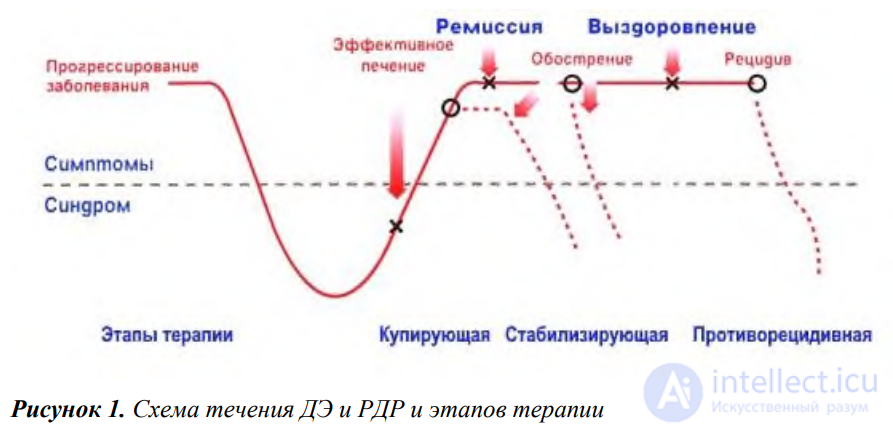
depressive episode - DE, RDD – recurrent depressive disorder
Recurrent depressive disorder (or recurrent depression) refers to a form of major depressive disorder characterized by repeated episodes of depression over the course of a person’s life. Diagnosing recurrent depressive disorder requires that the person have had two or more episodes of depression, separated by periods of normal mood.
Characteristic features of recurrent depressive disorder are similar to those of major depressive disorder and include:
Recurrent depressive disorder can significantly affect a person’s quality of life, limiting their ability to work, communicate with others, and enjoy life.
Treatment of recurrent depressive disorder usually includes psychotherapy and medication. Treatment may also include relapse-prevention methods that help prevent repeated episodes of depression. Early consultation with a specialist and regular treatment can significantly improve the prognosis and reduce the frequency and intensity of depressive episodes in a person with recurrent depressive disorder.
Chronic affective disorders are a group of mental disorders characterized by the prolonged and stable presence of affective symptoms, such as depression or mania, over an extended period of time. They differ from recurrent disorders, which have an episodic character, in that chronic affective disorders are characterized by longer-lasting and more constant symptoms.
The two most common forms of chronic affective disorders include:
Dysthymic disorder (chronic depression): Characterized by a prolonged period (at least 2 years) of low mood, apathy, loss of interest, and reduced energy and self-esteem. People with dysthymic disorder usually do not experience symptoms as severe as those of major depressive disorder, but their low mood lasts much longer.
Cyclothymic disorder: This is a milder form of bipolar disorder, characterized by periods of mood changes that are less pronounced than the manic and depressive episodes of bipolar disorder. Cyclothymic disorder can manifest as periods of euphoria and excitement (hypomania) as well as periods of depression, but to a lesser degree than in classic bipolar disorder.
Chronic affective disorders can significantly affect a person's quality of life and their ability to function in daily life. Treatment includes psychotherapy and, in some cases, medication to manage symptoms and maintain mood stability.
It is important to seek help from qualified specialists for diagnosis and to determine the best treatment plan for a specific case of chronic affective disorders.

Comments