
Lecture
In the genesis of psychogenic disorders, a special place is occupied by psychological conflict (external or internal), the pathogenicity of which is determined by the patient's inability to resolve it.
External conflict is defined by the clash between the disturbed relationships of the personality and the demands of the environment.
Internal (intrapersonal) conflict is defined by the existence of contradictory desires, tendencies, motives, and positions of the personality.
The following conflict situations are possible:
1. The need to choose between equally desired goals;
2. a forced choice between equally undesired goals;
3. the choice of a goal that has both desirable and undesirable aspects.
Psychological conflict, as understood by V.N. Myasishchev, reflects the clash of contradictory relationships of the personality, which is unable to find a productive solution to its difficulties.
As a rule, this concerns significant, dominant relationships of the personality.
Experimental psychological studies have shown that in recent decades a wide spectrum of intrapersonal conflicts has emerged.
Each individual patient exhibited from 2 to 8 intrapsychic problems.
There is a tendency toward polymorphism of neurotic conflicts, which clinically corresponds to a blurring of the boundaries between the individual forms of neurosis.
Personality traits influenced the shaping of the clinical picture, the formation of secondary symptoms, and the emotional coloring of the symptomatology.
The system of relationships and attitudes determined the significance for the personality of particular external events or objects, which were transformed under the influence of psychological defense mechanisms.
Changes in the ratio of intrapsychic and social factors influenced the frequency and features of neurotic symptomatology.
The tendency toward a prolonged chronic course was determined by socioeconomic conditions (the complication of living conditions creates fertile ground for the formation of additional neurotic problems and the persistence of previous ones).
•Since the leading role in the formation of neurotic conflict belongs to the subjective positions of the personality, the reasons for changes in neurotic conflict depended on the conditions of the formation and development of the personality, its interests, needs, and values, which manifested themselves only in interaction with the real, concrete living conditions of each historical period.
•Changes in the socio-political conditions in the country, as well as the economic and cultural characteristics of society, influence changes in the personality traits of patients with neuroses. The formation and dynamics of personality traits depended on them.
In neurosis departments in the provinces:
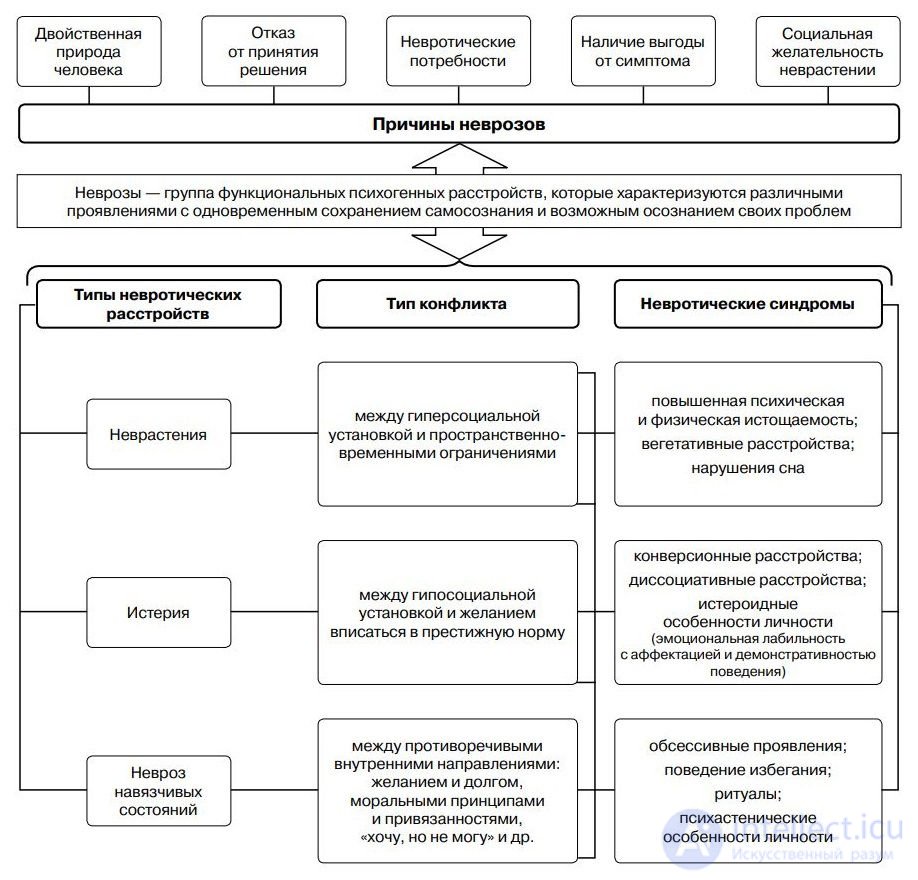
V.N. Myasishchev attached great importance to the main types of pathogenic personality conflicts.
He describes conflicts of the hysterical, obsessive-psychasthenic, and neurasthenic types.
Hysterical conflict is determined above all by excessively inflated claims of the personality, combined with an underestimation or complete disregard of objective real conditions or the demands of others.
It is distinguished by an excess of demands placed on others over demands placed on oneself, and by the absence of a critical attitude toward one's own behavior.
In such individuals, the ability to inhibit desires that contradict social requirements and norms is weakened.
Obsessive-psychasthenic type of neurotic conflict is caused above all by contradictory internal tendencies and needs of one's own, by the struggle between desire and duty, between moral principles and personal attachments.
In this case, even if one of them becomes dominant, but continues to meet resistance from the other, favorable conditions are created for a sharp increase in nervous-psychic tension and the emergence of obsessive-compulsive neurosis.
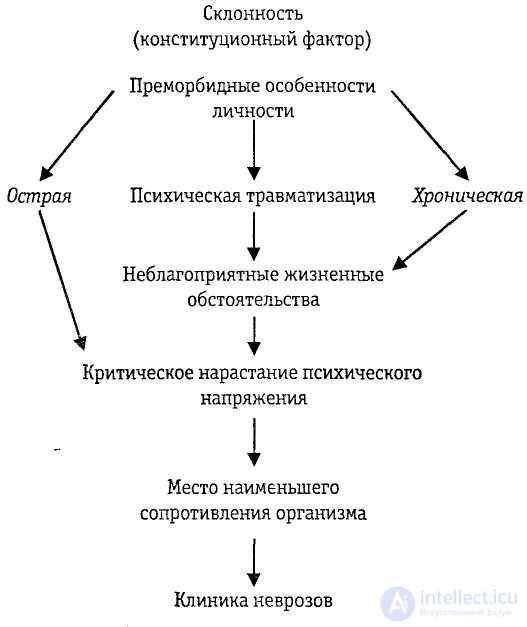
Of particular importance is the presentation of contradictory demands to the personality, which contributes to the formation of a sense of one's own inferiority, contradictory life relationships, and leads to a detachment from life, the emergence of unrealistic attitudes far removed from reality.
Neurasthenic type of conflict represents a contradiction between the capabilities of the personality, on the one hand, and its aspirations and inflated demands on itself, on the other.
The indicated types of neurotic conflicts correspond to a certain degree with the three main forms of neurosis - hysteria, obsessive-compulsive neurosis, and neurasthenia.

Comments