
Lecture
Pathomorphosis (from Ancient Greek πάθος — suffering, and μορφή — kind, form), sometimes Nosomorphosis — a change in the features of a particular disease — the so-called nosological form, as well as a change in morbidity and causes of mortality under the influence of various effects and external factors (biological, social).
Neurosis, psychoneurosis, neurotic disorder (New Latin neurosis from Ancient Greek νεῦρον «nerve») — an obsolete name for a group of neuropsychiatric disorders arising as a result of acute and chronic psychological trauma and characterized by the absence of qualitative changes in mental activity The clinical picture of such disorders is characterized by asthenic, obsessive, or hysterical manifestations, as well as a temporary decline in mental and physical working capacity .
The psychogenic factor in all cases is conflict (external or internal), the action of circumstances causing psychological trauma, stress, or prolonged overstrain of the emotional and intellectual spheres of the psyche .
The concept of «neurosis» was introduced into medicine in 1776 by the Scottish physician William Cullen. The content of the term has been repeatedly revised, and there is still no single generally accepted definition of it. It should also be borne in mind that in medicine and biology the term «neurosis» may be applied to different functional disorders of higher nervous activity.
Mental disorders were traditionally differentiated into neuroses and psychoses. Unlike psychotic disorders, in neuroses people retain critical awareness of their disorder and are able to control their actions .
The term «neurosis» is no longer used by the professional psychiatric community in the United States of America . In the American Diagnostic and Statistical Manual of Mental Disorders, the «neuroses» section was abolished starting with the third edition, DSM-III, in 1980. For example, depressive neurosis was replaced with dysthymic disorder, obsessive-compulsive neurosis with obsessive-compulsive disorder, hypochondriacal neurosis with hypochondriasis, and so on[ Starting with the tenth revision of the International Classification of Diseases (ICD-10), the traditional differentiation between neuroses and psychoses is likewise no longer applied. Nevertheless, the term «neurotic» is used in the name of the section (group) of mental disorders «Neurotic, stress-related and somatoform disorders» (codes F40—F48)
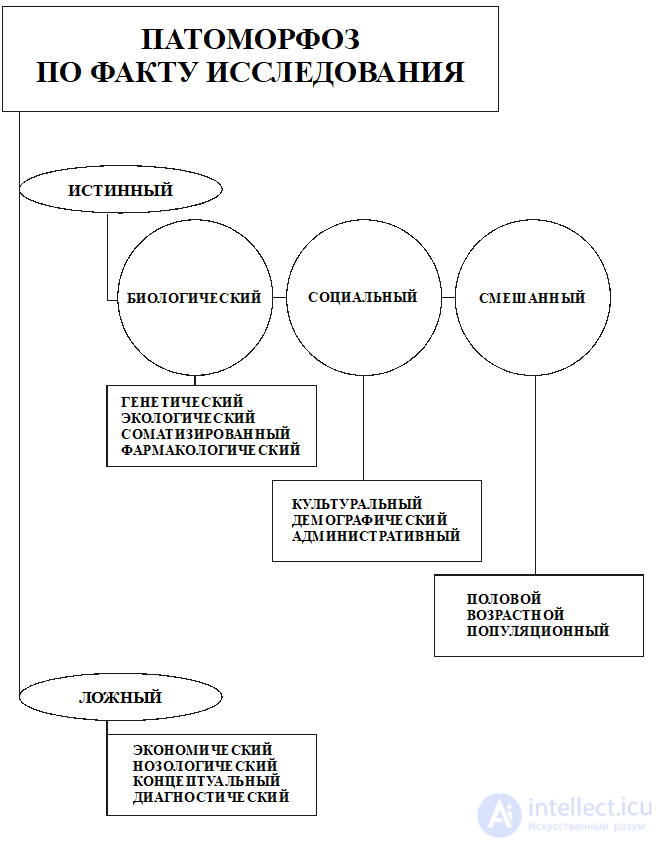
A stable and substantial change in the picture of a particular disease (its external manifestations and the underlying pathological processes) that has occurred under the influence of environmental factors.
False pathomorphosis of neuroses — a change not in the picture of the disease itself, but in how it is perceived and in the diagnostic criteria for the disease.
True pathomorphosis of neuroses — a change in the picture of the disease as a result of external causes, changes in the environment, and internal causes of the disease.
The changes primarily concern hysterical neurosis. Over the past 10 years, hysterical symptoms have shifted from symbolic manifestations to physical complaints, from behavioral display to symptoms associated with organs. Hyperkinesis and monoparesis appear, and neurotic disorders take on a prolonged course. The symptoms characteristic of chronic neuroses predominate: hypochondriacal, depressive, anxiety-phobic. Previously, neurosis was the result of a psychotraumatic situation; now a specific cause is identified. Objectively, the psychotrauma may be less severe, but it is subjectively significant. For most people, falling ill with neurosis means displaying weakness — which is why somatic illnesses are more acceptable, a somatic mask. Neurosis most often affects women aged 25 to 40. From a professional standpoint — knowledge workers. In developed countries — social phobias; in less developed countries — nosophobias. The type of neurosis is determined by the reduction in adaptive capacity that the person has encountered. Recently, obsessive-compulsive neurosis has been occurring increasingly often.
In the 1940s, motor disturbances and neurotic depression predominated.
The 1950s — astheno-hypochondriacal.
The 1960s and 1970s — cardiovascular symptoms.
The 1980s — autonomic (vegetative) disorders.
At present, it is believed that every person has 2–8 problems and conflicts.
It is difficult to draw a clear boundary between neuroses, since there is no clear-cut symptomatology.

Comments