
Lecture
Plan
Mental and behavioral disorders due to psychoactive substance (PAS) use - disorders arising from the use of one or more psychoactive substances, the severity of which can range from a state of simple intoxication to psychotic disorders and dementia.
Psychoactive substance (psychoactive - related to an effect on mood, consciousness, and behavior) - a substance that, when
used, causes a change in the psyche: a single dose produces euphoria and other desired psychotropic effects (from the user's point of view), while
systematic use leads to psychological and physical dependence.
Narcotic substance - chemical compounds that are found in alcoholic beverages, medicinal substances, and food products.
Narcotic (narkotikos, Greek - numbing) - a category of narcotic substances that have a specific effect on the user's body as a whole and on his
brain in particular. These are chemical substances of plant or synthetic origin capable of causing changes in mental
state, systematic use of which leads to dependence, and which also meet 3 criteria:
1. Medical - when the substance, drug, or medicinal preparation consumed has such a specific effect on the CNS
(stimulant, sedative, hallucinogenic) that it is the reason for its non-medical use.
2. Social - when its non-medical use (of the substance, drug, or medicinal preparation) reaches such a scale that
it acquires social significance.
3. Legal - when the relevant authority empowered by the state (the Ministry of Health of the Republic of Belarus), based on the above 2
criteria, has recognized the given substance, drug, or medicinal preparation as a narcotic and included it in the official list of narcotics.
Acute intoxication - a transient state caused by the use of a psychoactive substance and leading to a disturbance of the user's psychophysiological
state (consciousness, perception, cognitive functions, emotions, and other functions and reactions).
Psychological dependence - a need (conscious or unconscious) to use a psychoactive substance in order to relieve psychological tension and achieve
a state of psychological (emotional) comfort. Psychological dependence is characterized, first of all, by a desire to use the drug.
Physical dependence - a state that arises in the presence of psychological dependence and is characterized by pronounced physical
disturbances, in which a withdrawal state develops in response to discontinuation of the psychoactive substance.
Tolerance - the physiological ability of the body to withstand the effects of toxic doses of a psychoactive substance, determined by the maximum dose of the substance
that does not cause pronounced intoxication (acute intoxication).
Withdrawal state - a group of symptoms (psychological, autonomic, somatic, neurological) of various combinations and degrees of severity,
which manifest upon cessation (complete or partial) of psychoactive substance use after prolonged use of it in high doses.
Psychotic disorder - a disorder that occurs during or immediately after the use of a psychoactive substance, usually within 48 hours, against a background of
predominantly clear consciousness, the clinical expression of which consists of vivid hallucinations, usually auditory, often affecting more
than one sensory modality, false recognitions, delusional experiences of a paranoid or persecutory nature, psychomotor disturbances in the form of agitation
or stupor, and a pronounced affect ranging from intense fear to ecstasy.
Amnestic syndrome - a pronounced chronic impairment of memory for recent and, possibly, remote events, with preservation of
immediate recall.
Residual psychotic disorder and psychotic disorder with late (delayed) onset - disorders arising as a result of psychoactive substance use, characterized by changes in cognitive function, personality, or behavior, and persisting beyond
the period of direct action of the psychoactive substance.
Narcotism (addictive behavior) - the use of a drug and/or other psychoactive substances without the formation of psychological and/or physical dependence.
The use of narcotic or psychotropic substances may occur either by medical prescription or without a doctor's order.
Drug abuse – any use of a drug that causes harm to the user's mental and physical state, "legal capacity," and social standing, as well as to the social standing of persons affected by the user.
Narcogens – natural products, chemical compounds, and physical phenomena (electromagnetic radiation) capable of producing a drug-like
effect on the nervous system of living organisms.
Drug trafficking business – economic activity related to the cultivation, production, and trade of narcotic substances, psychotropic or potent substances for the purpose of making a profit.
Illicit drug trafficking – actions (or omissions) prohibited by law, ranging from the production of narcotic substances, psychotropic and
potent substances to their distribution.
Illicit drug distribution – a combination of illicit trafficking and abuse of narcotic substances, psychotropic or potent substances.
Intoxicating substances (stupefying agents) have a threefold meaning.
First, these are agents, substances, or pharmaceutical forms (excluding narcotics and psychotropic substances) whose use produces a
state analogous to narcotic excitation. In other cases, these are known natural products and chemical compounds with a drug-like
effect. The third variant involves a strictly limited list of substances designated as intoxicating.
Potent substances – natural products and chemical compounds that differ from narcotic substances and psychotropic substances
by being subject to milder legal control.
Toxic substances (inhalants) – household chemicals and technical fluids (organic solvents, gasoline, acetone, toluene, etc.) that are used as inhalants to achieve a drug-like (substance-abuse-related) state.
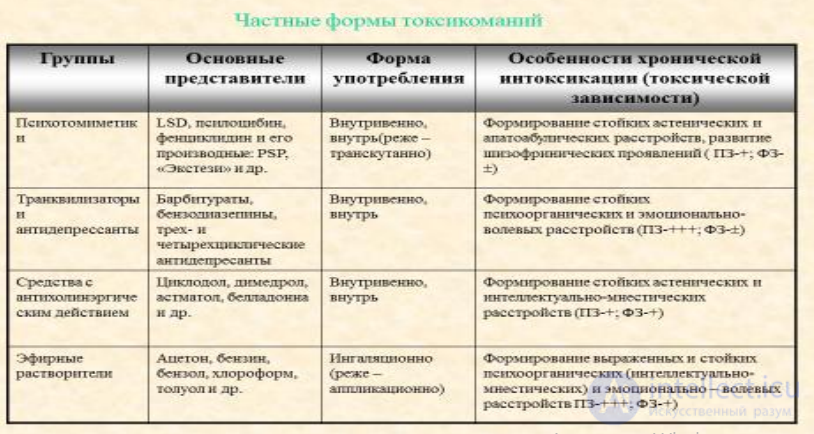
Specific forms of substance abuse (tranquilizers and antidepressants, ether solvents, psychotomimetics, agents with anticholinergic effects)

Drug addiction – a disease caused by systematic drug use, manifesting as a syndrome of altered reactivity, psychological
and physical dependence, as well as other psychotic and social phenomena.
Altered reactivity syndrome – a symptom complex that includes changes in tolerance to psychoactive substances, the form of their use, the pattern of intoxication
(acute intoxication), and the loss of protective reactions to intoxication.
Euphoria – a complacent, elevated, and joyful mood that is inadequate to actual reality.
Sensitization – increased sensitivity of the body to the effects of certain substances.
Intoxication – poisoning of the body by toxic substances.
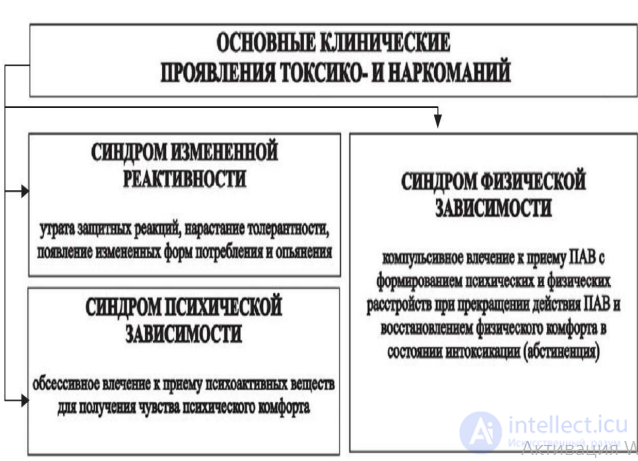
Main clinical manifestations of substance abuse and drug addiction
Altered reactivity syndrome – loss of protective reactions, increasing tolerance, the emergence of altered forms of use and
intoxication
Physical dependence syndrome - an impulsive craving to use psychoactive substances, with the formation of mental and physical disorders upon cessation of the substance's effect and restoration of physical comfort in a state of intoxication (withdrawal)
Psychological dependence syndrome - an obsessive craving to use psychoactive substances in order to obtain a feeling of psychological comfort.
Diagnostic criteria for dependence syndrome (according to ICD-10)
Three or more of the following manifestations must be present, occurring together over the course of 1 month or, if they
persist for shorter periods, recurring periodically over 12 months
1. A strong desire or sense of compulsion to take the substance.
2. Impaired ability to control substance use in terms of its onset, termination, or dosage, as evidenced by the substance being taken in larger amounts and over a longer period than intended, or by unsuccessful attempts or a persistent desire to cut down on substance use.
3. A state of physiological withdrawal when substance use is reduced or discontinued, as evidenced by the withdrawal syndrome characteristic of that substance, or by the use of the same (or a similar) substance with the intention of relieving or avoiding withdrawal symptoms.
4. Increasing tolerance to the substance, manifested by the need for significantly increased doses to achieve intoxication or the desired effect, or by a markedly diminished effect with continued use of the same dose.
5. Preoccupation with substance use, manifested by the partial or complete abandonment of important
alternative sources of pleasure and interests for the sake of taking the substance, or by spending a great deal of time on activities related to obtaining and using the substance.
6. Continued substance use despite clear evidence of harmful consequences, as demonstrated by chronic use of the
substance with apparent awareness of the nature and extent of the harm.
Mental and behavioral disorders due to alcohol use are known as alcohol-related mental disorders or alcohol disorders. Alcohol use can cause various mental and behavioral changes that vary in severity and character.
Some of the alcohol-related mental and behavioral disorders include:
Alcohol intoxication: Occurs as a result of consuming large amounts of alcohol and is characterized by mental and behavioral changes such as euphoria, talkativeness, unsteadiness, and impaired attention and motor coordination.
Alcoholic amnestic state: Also known as a "blackout," in which the individual cannot recall events that occurred while drinking, although other cognitive functions may be relatively preserved.
Alcohol dependence: A chronic and progressive mental condition in which a person suffers from physical and/or psychological dependence on alcohol and experiences a compulsive urge to consume it.
Alcohol withdrawal delirium (delirium tremens): A severe mental condition that occurs upon abrupt cessation of alcohol use in chronic alcoholics, accompanied by hallucinations, delusions, and loss of orientation in time and space.
Alcohol-induced mental disorders: Include depression, anxiety disorders, psychoses, and other mental conditions that may be caused or aggravated by alcohol use.


Stages of chronic alcoholism
Treatment of alcohol-related mental and behavioral disorders usually involves a comprehensive approach that includes psychotherapy, medication, supportive therapy, and rehabilitation. It is important to seek help from qualified specialists for proper diagnosis and to determine the best treatment plan, especially if alcohol use begins to significantly affect a person's quality of life and functioning.
Mental and behavioral disorders due to opioid use refer to a group of mental conditions and behavioral changes associated with the use of opioid narcotic substances. Opioids include various narcotic drugs such as morphine, heroin, oxycodone, hydrocodone, fentanyl, and others.
Some of the mental and behavioral disorders associated with opioid use include:
Opioid intoxication: Characterized by symptoms such as euphoria, drowsiness, sluggishness, pupil constriction, and depression of respiration and consciousness.
Opioid dependence: A chronic mental condition in which a person develops physical and/or psychological dependence on opioids and experiences a strong desire and need to use them.
Opioid withdrawal syndrome: Occurs upon cessation of opioid use in dependent individuals and may be accompanied by various symptoms such as anxiety, insomnia, irritability, muscle pain, vomiting, and diarrhea.
Opioid-induced depression: Opioids can cause depressive symptoms in some people, which can lead to the development of depressive disorders.
Opioid psychoses: Use of opioids in large quantities or in combination with other substances can cause psychotic symptoms such as hallucinations and delusions.
Opioid-induced amnesia: Use of certain opioids can cause temporary loss of memory and awareness of events.
Opioid use can lead to serious consequences for a person's physical and mental health. Frequent and/or prolonged opioid use can cause dependence and negatively affect a person's life and their environment.

Symptoms of opiate intoxication and withdrawal syndrome

Symptoms of amphetamine and cocaine intoxication and withdrawal syndrome
Treatment of mental and behavioral disorders caused by opioid use often includes medication therapy, psychotherapy, supportive therapy, and rehabilitation programs. It is important to seek help from qualified specialists to determine the cause of the disorders and the best treatment plan.
Mental and behavioral disorders due to the use of cannabinoids belong to a group of mental states and behavioral changes associated with the use of products containing cannabinoids. Cannabinoids are active compounds found in cannabis (marijuana) and other plants, and can also be synthetically produced for medical or recreational purposes.
Some of the mental and behavioral disorders associated with cannabinoid use include:
Cannabis intoxication: Occurs with the use of cannabis and is characterized by mental and behavioral changes such as euphoria, elevated mood, increased appetite, and altered perception and motor coordination.
Cannabis withdrawal syndrome: May occur when dependent individuals stop using cannabis and can be accompanied by various symptoms such as irritability, insomnia, loss of appetite, and abdominal pain.
Cannabis-induced psychosis: Cannabis use can trigger psychotic symptoms in some individuals, such as hallucinations, paranoia, and delusional ideas.
Cannabis-induced anxiety syndrome: Some people may experience increased anxiety and unease after using cannabis.
Cannabis-induced amnesia: Cannabis use can cause temporary memory loss and reduced awareness of events.
The use of cannabinoids can produce various effects depending on an individual's characteristics, dosage, and the purity of the product used. Long-term and/or frequent cannabinoid use can affect cognitive functions, memory, mood, and behavior.
Treatment of mental and behavioral disorders caused by cannabinoid use may include psychotherapy, supportive therapy, and rehabilitation programs. It is important to seek help from qualified specialists to determine the cause of the disorders and to establish the best treatment plan, especially if cannabinoid use begins to significantly affect a person's quality of life and functioning.
Mental and behavioral disorders due to the use of sedatives and hypnotics are known as disorders related to the use of sedative-hypnotic or anxiolytic substances. These medications are often used to treat anxiety, insomnia, and other mental and behavioral problems, but their improper or inappropriate use can lead to various adverse effects.
Some of the mental and behavioral disorders associated with the use of sedatives and hypnotics include:
Dependence on sedative-hypnotic substances: Prolonged and excessive use of these medications can lead to physical and/or psychological dependence, in which a person experiences a strong desire and need to use them.
Withdrawal syndrome: Stopping the use of sedative-hypnotic substances can cause various withdrawal symptoms, such as anxiety, insomnia, loss of appetite, headache, and irritability.
Memory and cognitive disorders: Prolonged and/or improper use of sedatives can affect cognitive functions and memory.
Sedative-induced amnesia: Use of sedatives in large quantities can cause temporary memory loss and reduced awareness of events.
Behavioral changes: Use of sedatives can lead to reduced reactivity, impaired motor coordination, and a diminished capacity for active behavior.
The use of sedatives and hypnotics should be prescribed and monitored by a physician, as their improper use can be dangerous and cause various mental and physiological problems. Dependence on these substances can lead to serious consequences for a person's physical and mental health.

Symptoms of sedative intoxication and withdrawal syndrome
Treatment of mental and behavioral disorders caused by the use of sedatives and hypnotics often includes psychotherapy, pharmacotherapy, supportive therapy, and rehabilitation programs. It is important to seek help from qualified specialists to determine the cause of the disorders and to establish the best treatment plan, especially if the use of sedatives and hypnotics begins to significantly affect a person's quality of life and functioning.
Increased sucrose consumption can cause mental or behavioral disorders even in individuals without diabetes mellitus. Sucrose is ordinary table sugar found in many foods, such as sweets, beverages, and baked goods, and consuming it in reasonable amounts usually does not cause mental problems.
Nevertheless, consuming sucrose, especially in large amounts or in combination with a high-calorie diet, can be associated with various physical problems, such as obesity, diabetes, and dental problems. In addition, some people may experience a strong craving for and dependence on sweets, which can affect their behavior and mood.
The appearance of drowsiness after eating, along with sluggishness. After the rapidly risen blood sugar from carbohydrates ingested with food is processed by insulin released in response by the pancreas, blood glucose levels drop just as sharply — an effect called the «insulin crash,» which is accompanied by weakness and drowsiness. If someone is familiar with the tendency to be «knocked out» into sleep after eating porridge, pizza, or ice cream — this is a possible sign of prediabetes. Mentally, the same insulin swings cause a state known as brain fog — sluggishness, difficulty concentrating.
The eyes, extremities (fingers and toes), and the brain are especially vulnerable when consuming high-carbohydrate foods (sweets, flour products) because of the large number of capillaries (the thinnest blood vessels), for which high blood sugar is directly destructive; carbohydrates indirectly cause vascular inflammation and thrombosis associated with blood thickening.
Withdrawal (abstinence) from foods containing high amounts of carbohydrates — sucrose, fructose, glucose, starch — can cause certain physical symptoms, such as headache and irritability, which can trigger serious mental or behavioral disorders (stress, psychopathies, etc.). However, consuming sucrose in normal amounts usually does not cause mental health or behavioral problems.
Psychological dependence on sucrose and fructose consumption refers to a condition in which a person experiences a strong mental craving for or dependence on consuming sweet foods containing sucrose or fructose. This can lead to an overwhelming urge to eat sweets and a feeling of loss of control over their consumption.
Sucrose causes a withdrawal syndrome in the same sense as, for example, alcohol or drugs. Thus, some people may develop a strong craving for or dependence on sweet food, which can lead to uncontrolled consumption of sweets.
Symptoms of withdrawal syndrome from sweet food may include:
However, it is worth noting that the withdrawal symptoms from sugar and sweets may be less pronounced and less severe compared to withdrawal from certain other substances, such as alcohol or drugs.
Consuming sugar and fructose in small amounts as part of a healthy diet usually does not cause mental health or behavioral problems. However, excessive consumption of sweet food or beverages can become a habit or a way of coping with emotional stress, causing psychological dependence. This can lead to the following effects:
Psychological dependence on sucrose and fructose can lead to various health problems, such as obesity, diabetes, dental disease, and others.
If you suspect you have a psychological dependence on sugar or sweets, it is recommended that you seek help from a psychologist or an eating behavior specialist. Psychological support and counseling can help address the dependence and develop strategies for managing sweets consumption and maintaining a healthy diet.
However, the consumption of sucrose or other food products can have different effects on each person depending on their individual characteristics and sensitivity. If you have questions or emerging health concerns related to sucrose consumption, it is recommended that you consult a physician or a qualified nutritionist.

Comments