
Lecture
Neurasthenia is a mental disorder from the group of neuroses, manifesting as increased irritability, fatigability, and loss of the capacity for prolonged mental and physical exertion. It was first described by the American physician George Beard in 1869. Neurasthenia usually arises from a combination of psychological trauma with excessively strenuous work and physiological deprivation (chronic sleep deprivation, lack of rest, etc.). The development of neurasthenia is promoted by infections and intoxications that weaken the body (alcohol, smoking), endocrine disorders, inadequate nutrition, and other factors.
Neurasthenia is a condition characterized by exhaustion of the nervous system. It is a mental disorder from the group of neuroses. Neurasthenia is often called irritable weakness or fatigue. This is not surprising: a patient with this condition experiences constant tiredness and is in a state of nervous agitation.
The premorbid features of patients with neurasthenia are distinguished by specific constitutional characteristics. As a rule, these are people who are asthenic, timid, somewhat shy, inert, poorly adapted to changes in their situation, and prone to reacting painfully — through irritability — even to the slightest unfavorable changes in circumstances.
The neurological status shows some increase in tendon reflexes and heightened autonomic activity manifested as palpitations, facial flushing or paling, and increased sweating (especially of the face and hands). Some patients show mild transient tremor of the fingers and eyelids.
In ICD-10, neurasthenia (F48.0) is characterized by the following criteria:
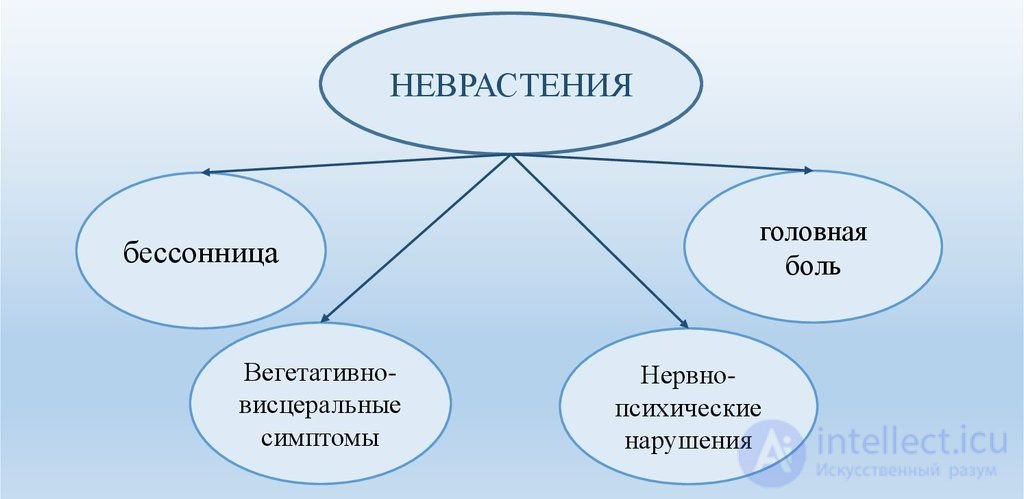
Fig. 1 symptoms
The following symptoms help diagnose a nervous breakdown:
It develops under the influence of prolonged tension, which leads to overstrain; a lasting state of anxiety and tension can take on a pathological form. The most common form affects 5% of various types of pathology. The duration can range from several weeks to several months. If symptoms persist, the condition can drag on, although there is a view that these states may evolve into a differentiated condition: depersonalization syndrome, anxiety, or hypochondriacal syndrome. The most prominent features are asthenia (90%), emotional instability (80%), irritability and weakness (64%), sleep disturbances (58–60%), hypochondriacal complaints (57%), and headaches and anxiety in every second patient.
Depersonalization-derealization occurs in every third patient. The conflict of "I want to but I can't" – a person places demands on themselves that they cannot fulfill, a conflict between demands and capabilities. This is known as the "manager's disease." It is a form of substress, a prolonged existence of conflict. Clinical picture: despite the desire to work, the person tires quickly, cannot concentrate, and may experience drowsiness and exhaustion. When trying to fall asleep, a flood of thoughts prevents sleep. In the morning it is hard to get up and come to one's senses, and as soon as one starts doing something, fatigue sets in again. Asthenia is perceived as general tiredness or bodily weariness. Vacations and weekends change little. Concentration becomes difficult, causing self-dissatisfaction and tearfulness. Any attempt to force oneself to do something leads to worsening of the condition. What used to take minutes now takes half a day. Hyperesthesia – increased sensitivity both to the external environment and to one's own state: decreased vitality, every movement requiring great effort, headaches with the slightest strain, possible complaints of noise and ringing in the ears, irritation upon touch (even from clothing), and sometimes pain when combing one's hair.
Patients themselves are unable to suppress their condition. It is impossible to control the outward manifestations of their anxiety, which often results in tearfulness and a feeling of helplessness over their emotions. Irritability and excitability increase, accompanied by heightened fatigability and exhaustion. Intense reactions arise over the slightest provocation; they may be brief but recur. Mood is unstable, fluctuating between melancholy, anxiety, and listlessness. Patients are hypochondriacal, focused on painful sensations. Interest in any form of entertainment is lost.
Anxiety intensifies in situations of uncertainty and those involving forced waiting. Sleep disturbances: difficulty falling asleep and shallow sleep. Frequent awakenings, with a subjective feeling of insomnia. Abundant anxious dreams. A distinctive feature of the dreams is that the inability to resolve the problem leads to stereotyped dreaming, with the psyche returning again and again to a symbolic reflection of the problem without finding a way out.
After sleep there is a feeling of fatigue, which weakens by midday. Fatigue increases toward evening. During the day there are complaints of drowsiness, while evening insomnia is present. Work capacity is worse in the morning than in the afternoon. Autonomic disorders: cardiovascular system - 18% (palpitations, slowing of heart rate, constricting and aching pain); the main manifestations are autonomic lability (fluctuations in blood pressure, mild changes in pulse rate (increasing under mental strain), sweating, vasomotor changes); gastrointestinal tract - poor appetite, bloating, belching, dyspeptic disorders, constipation and diarrhea, a feeling of heaviness and nausea. Respiratory system - a subjective feeling of difficulty breathing due to chest tightness, shortness of breath, polyuria (frequent urge to urinate).
Sexual sphere in men: in the hypersthenic form, decreased sexual desire (down to alibido), weakened erection, and changes in behavioral activity (decreased initiative and sexual activity) are observed. In the hypersthenic form, problems with erection and premature ejaculation are possible, as well as weakened orgasmic experiences. Excessive sexual behavior is also possible.
In women: in the hypersthenic form, blunting of orgasm or its absence may occur, even with mild arousability. In the hyposthenic form, a complete absence of desire is noted, along with decreased sexual activity and initiative, and a reduction in sensitivity and range of acceptability.
All these manifestations can lead to persistent conflict in relationships and fear of pain. The prognosis is favorable: this is a functional condition that is fully curable, though if the causes persist it may continue for a long time. In the first months the hypersthenic variant predominates, after which the hyposthenic or depersonalization variant may develop. 75% of cases end in complete recovery, about 15% in relapses, and less than 10% in worsening. A prolonged course can lead to neurotic development (in the form of astheno-hypochondriacal syndromes combined with nosophobias).
Treatment involves identifying the causes and, where possible, neutralizing them. Correction of the scale of the experiences involved. Most often the cause is related to overestimating or underestimating the situation or oneself within it. Comprehensive treatment is used: psychotherapy and pharmacotherapy (stabilizing the effect on the self-regulation system) to improve the condition. In hypersthenic individuals, general tonic agents are used, while in those with hyposthenia and anxiety, sedatives and tranquilizers are used. Antidepressants may also be used. Therapy is aimed at restoring motor activity in accordance with the causes and clinical manifestations. Differential diagnosis is challenging, since asthenic manifestations can be present in any illness: organic lesions, somatic disease, or other mental illnesses in their initial stage. The differential diagnosis includes schizophrenia, masked depressions, somatogenic asthenic states, residual organic lesions, or the aftereffects of injuries.
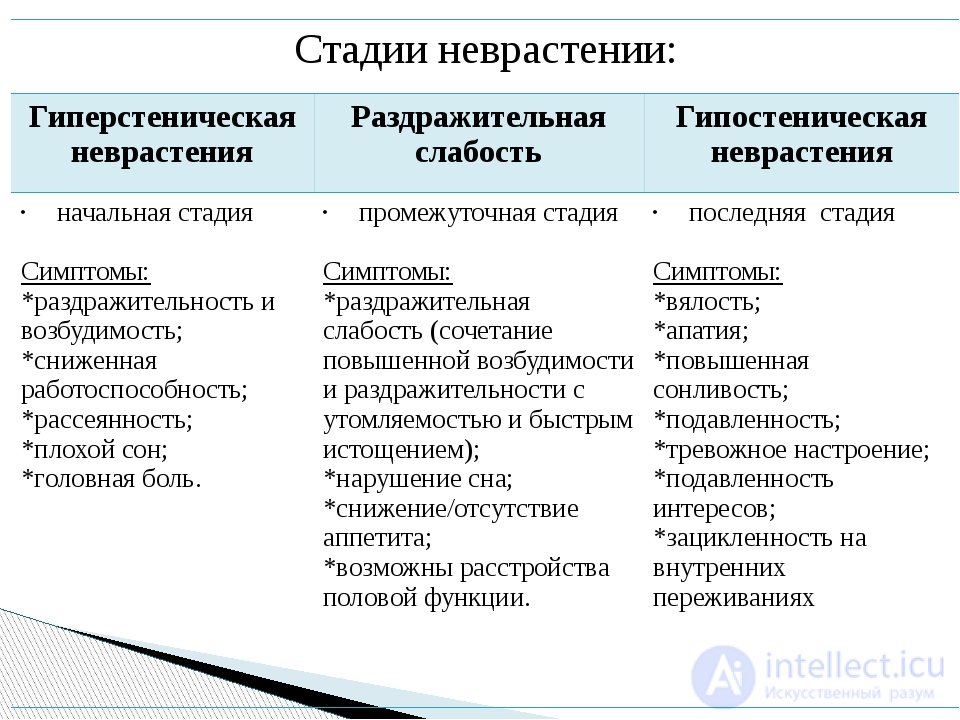
Neurasthenia is characterized by three phases of development:
Treatment of neurasthenia depends on the severity of the disorder. At the initial stage, it is often enough to bring order to one's regimen and to daily life as a whole. It is also necessary to identify the stress-inducing cause and eliminate it, and to normalize nutrition and rest. As a rule, at this stage increased excitability and irritability predominate.
The second stage is characterized by so-called "irritable weakness" - a combination of high excitability with increased exhaustion and fatigability, to which sleep disturbance and decreased appetite may already be added. Here too it is necessary to eliminate the pathogenic situation, and the help of a specialist is already required. Otherwise the disorder risks progressing to the third stage, where weakness and exhaustibility can (according to some clinical data) develop into depression or cyclothymia. In this case, inpatient treatment may be indicated, possibly with the prescription of pharmacological therapy (antidepressants and tranquilizers).
Neurasthenia, even if it has reached the third stage of manifestation, is reversible in nature, and correct treatment gives a one-hundred-percent favorable prognosis.
The main cause of asthenic-neurotic syndrome is negative social factors. In particular, the disorder is triggered by stress associated with emotionally demanding work. Constant rivalry within a team, an irregular working schedule, and insufficient rest provoke the development of neuroses. Therefore, avoiding mental disorders is only possible by reconsidering one's attitude toward work.
Prevention of neuroses includes normalizing the work-rest schedule, alternating active and passive leisure, and resolving conflicts within the team. It is also worth engaging in spiritual practices. Yoga provides calmness and inner balance.
Psychological traumas are also a source of neuroses. They cannot always be avoided. However, psychological traumas can be treated. Periodic visits to a psychotherapist make it possible to address the problem without waiting for mental disorders to develop. In addition, psychotherapy sessions help reconsider one's life priorities and values.
Family relationships are also important for a person's mental state. Therefore, seeking compromises and building emotional connections within the family are essential. This is especially true for children. At an early age, family conflicts trigger neuroses much more often.
People prone to disorders of the nervous system need to pay special attention to their health. It should be remembered that asthenic-neurotic syndrome progresses under the influence of infectious and somatic diseases, overexertion, and physical exhaustion. Therefore, preventive measures include a healthy diet, timely treatment of illnesses, and a healthy eight-hour sleep.
Folk medicine recommends drinking special decoctions and teas. St. John's wort, hawthorn, mint, and chamomile have a positive effect on the nervous system. Regular use of herbal blends made from these medicinal plants provides a long-lasting sedative effect. It is also advisable to take valerian tablets and eleutherococcus extract for preventive purposes.

Comments