
Lecture
Dissociative identity disorder (also referred to as multiple personality disorder, informally known as split personality) is a mental disorder from the group of dissociative disorders in which a person's identity is not whole, and it appears that several distinct personalities (or, in other terminology, ego states or alters) exist within the body of one person. At certain moments, a «switch» occurs in the person — one part of the identity replaces another. Besides «switches,» there can also be «passive influence,» in which a part of the identity does not take executive control but nonetheless interferes with functioning in some way. Examples include a child's voice in the head, arising as if from nowhere and not perceived as one's own thoughts, or talking about things the person does not remember or did not want to say. These parts of identity can differ in gender, age, nationality, character, mental abilities, and worldview, and can react differently to the same situations. Parts of identity may or may not share memories with one another. In the first case, one part of the identity will fully or partially remember what another part remembers; in the second case, the opposite is true.
Alternative identities are not personalities in the broad sense of the word. They are artificial, fragmentary parts of a single personality that help cope with distress that cannot otherwise be managed.
Even if other people know about the existence of "doubles", they usually know nothing about them, although they sometimes sense them "fighting" for control over consciousness.
The personality acting during a given period of time, as a rule, fully takes over the person's behavior.
Often one personality is "good" while another is "bad" (willful, irresponsible, malicious, sexually promiscuous).
one of the personalities knows everything, and if it shows a willingness to cooperate, it becomes a valuable consultant to the therapist.
It is not clear whether split personality is caused by psychological defense mechanisms (retreat into a "double") or by the inferiority or immaturity of the personality, in which uncontrolled traits that are not integrated into a single harmonious personality periodically "surface."
Multiple personality (dissociative identity disorder)
– the existence of two or more «personalities» within one person, each personality being a unity with its own particular patterns of behavior, memories, and relationships.
One, the original host personality, while the others differ strikingly from it and often from one another.
a given personality belongs to another sex or is younger than the person actually is. Individual subpersonalities often have their own names and their own specific, characteristic patterns of behavior.
Needs and behavior patterns forbidden to the main personality are freely expressed in the others. The quality of existence of such personalities varies significantly, from stable, robust, and elaborately organized to fragmentary, amorphous, and fleeting.
rejected parts of the original self find expression in them. Among them there may even be beings that do not belong to the human race. An individual can shift from one identity to another over periods ranging from a few minutes to several years.
Among the causes of the emergence and development of DID, the following factors stand out:
1. Traumatic situations involving physical, sexual, or psychological abuse at an early age. In this case, DID is regarded as a delayed response to psychological trauma.
2. Personal predisposition, namely personality traits such as high suggestibility (including self-suggestion), and, as a consequence, an increased capacity for deep dissociation and immersion in a hypnotic state (high hypnotizability), as well as vulnerability, impressionability, and an underdeveloped set of coping strategies.
3. Features of the nervous system. There are observations according to which 25% of patients with this diagnosis showed changes on the EEG
characteristic of the changes seen in temporal lobe epilepsy.
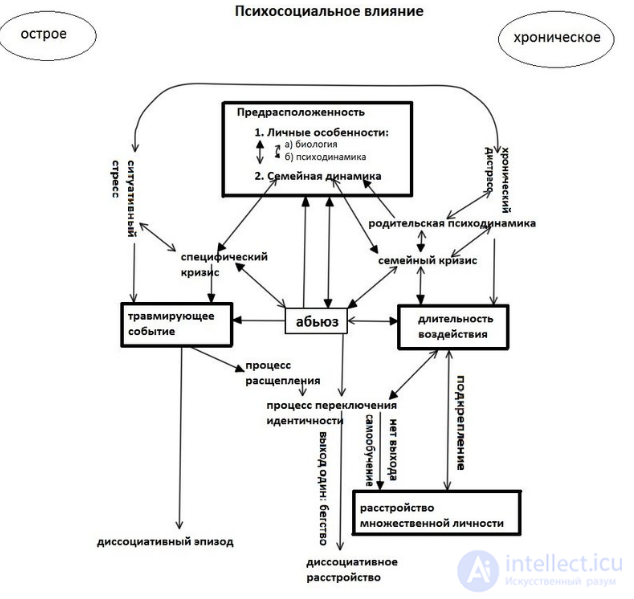
Bennett Braun proposed a model for the development of dissociative disorder that takes into account various factors: personal predisposition to develop dissociative defenses; family factors; acute traumatization and a chronic unfavorable background; abuse; the presence of objective resources (the fewer the chances of escaping the negative influence, the higher the risk of developing dissociation). Note that Braun proceeds from an outdated view, separating multiple personality disorder and dissociative disorder; in the modern approach this is one and the same phenomenon, although not a single disorder but a group of dissociative disorders is distinguished, each with its own particular features.

Pseudodementia is understood as a condition arising as a hysterical reaction and manifesting as a peculiar form of «feeblemindedness,» in the clinical picture of which phenomena of «approximate speech» and sometimes «approximate actions» come to the fore.
«Approximate speech» manifests as incorrect, even absurd, answers to questions, but always within the plane of the question asked. When asked about the color of snow, the patient will answer that it is black, but will never answer that snow is a horse.
«Approximate actions»: when asked to raise the left hand, the patient raises the right hand instead, but still a hand, not a chair from the floor.
In the depressive variant, one observes slowness of motor manifestations and slowness of answers to questions. Questions have to be repeated. The patients may not answer many questions at all, or answer in a quiet voice. Their facial expression is demonstratively pained. Phenomena of verbigeration and approximate answers are observed. Memory is significantly impaired - patients cannot remember the names of their wardmates or the first and patronymic name of their doctor.
In cases of «approximate actions,» patients may refuse, for example, to light a match, saying «I can't, I don't remember,» or, in more pronounced states of pseudodementia, attempt to strike the match against the box using the wrong side.
In the agitated variant, phenomena of puerilism are incorporated into the structure of the pseudodementia syndrome. Patients are fussily restless, easily distracted, grimace, stare wide-eyed, gesture absurdly, walk in a caricature-like manner, and maintain an expression of astonished fright or foolish merriment on their face.
The patients' «approximate speech» takes on an absurdly random character,
«Approximate actions» take on an extremely pronounced character - for example, they stick a pencil in their ear, put shoes on their hands, and try to push their legs into the sleeves of a robe.
Diagnostic criteria for pseudodementia:
It arises through a hysterical mechanism, psychogenically, often in arrested and imprisoned persons;
the nature of the patients' answers and actions, which are absurd in character, always reveals the regularity that they are given within the plane of the task, but always «approximately»;
it has a functional character and always resolves, i.e. it does not represent a persistent mental defect.
Histrionic personality disorder is characterized by:
Histrionic personality disorder
These are shallow, superficial, disorganized people, lacking firm and realistic views on life and a harmonious and adequate system of personal values.
Their behavior draws attention through theatricality, stiltedness, extravagance, inconstancy, and lack of simplicity and sincerity.
hyperbolization and vividness in expressing their experiences
they strive to appear far more significant than they actually are, to experience more than they are capable of experiencing, such that they rather «want to seem, rather than to be».
behavior is dictated not by internal motives, but is calculated for external effect
they are characterized by enviousness, scandalousness, mendacity, absence of stable attachments, inability to distinguish reality from fiction, and eccentricity in manners, clothing, tastes, and hobbies.
Histrionic personality disorder
they enjoy an idle life with external, ostentatious splendor, varied entertainments, and frequent changes of impressions
absence of clear boundaries between the products of one's own imagination and reality
Due to the vividness of some images and representations and the dimness of others, they do not see the difference between fantasy and reality, between what happened in waking life and what was seen in a dream
a variant of the tendency toward pathological fantasizing («pathological liars» according to P. B. Gannushkin, «pseudologues»): they become so absorbed in situations created by their imagination that they themselves come to believe in them. Fantasies sometimes turn into self-incrimination with confessions to fictitious crimes and even murders. Instead of real problems, they are preoccupied with fantastic fabrications, often pursuing certain self-serving goals (swindlers, fortune-tellers, marriage fraudsters, charlatans)
From the standpoint of the systems approach, hysterical disorder can be defined as an acquired, learned, and relatively stable disruption of self-management (self-regulation) of a living system, manifested as a dysfunction of integration mechanisms at various levels of intra-system organization.
Hysterical neurotic and reactive disorders differ in the essential structure of their etiopathogenesis (the hierarchy of importance of pathogenetic factors), as well as in the level of disintegration of the system's regulatory mechanisms, which determines the features of the clinical picture.
Three main factors, closely interrelated, are most often mentioned in the genesis of hysteria:
The most significant factor is S (situation), the least significant is C (constitution)
In clinical practice, the concept of hysterical neurosis is quite often confused with the concept of the hysterical personality
one may encounter the mistaken belief that a hysterical personality structure is a precondition for the emergence of hysterical syndromes.
The results of detailed clinical studies indicate that among patients with hysteria, a hysterical personality structure is diagnosed in only 7-18%
Nowadays the diagnosis used in the USA for the phenomenon of personality splitting is dissociative identity disorder (English dissociative identity disorder, DID), adopted in the Diagnostic and Statistical Manual of Mental Disorders (DSM-5). Previously, the diagnosis multiple personality disorder (English multiple personality disorder, MPD), adopted in the International Classification of Diseases, was more commonly used. The term currently accepted for the diagnosis is considered by most American specialists to be more correct, since parts of self-identity of the patient, formed as a result of separation (dissociation) from his personality, cannot be considered independent, full-fledged personalities, although they are unofficially called so in the absence of a more suitable word. In Russia the term "multiple personality disorder" (ICD-10) is more widespread, since the International Classification of Diseases is used in health care bodies and institutions by order of the Ministry of Health of the Russian Federation.
According to DSM-IV, dissociative identity disorder is diagnosed when the following 4 criteria are met[14]:
- The patient has two or more distinct identities or personality states, each of which has a stable pattern of perceiving the world, its own worldview, and its own attitude toward surrounding reality.
- At least two of these identities alternately take control of the patient's behavior.
- The patient cannot recall important information about himself, and this goes far beyond ordinary forgetfulness.
- This condition did not arise as a result of alcohol, drug, or other toxic substance use, or from an illness (for example, in a complex partial seizure). In children, these symptoms are also important not to confuse with playing with an imaginary friend or other games involving imagination.
In ICD-10, multiple personality disorder (F44.81) belongs to the category "other dissociative (conversion) disorders" (F44.8). According to ICD-10, diagnosing multiple personality disorder requires meeting the following criteria:
- A. The existence of two or more distinct personalities within an individual, but only one is present at any given time.
- B. Each personality has its own memory, preferences, and behavioral characteristics and periodically takes full control of the individual's behavior.
- C. There is an inability to recall important personal information that, in scope, exceeds ordinary forgetfulness.
- D. The symptoms are not due to organic mental disorders (F0) (for example, epilepsy) or disorders related to psychoactive substance use (F1) (for example, intoxication or withdrawal).
— International Classification of Diseases, 10th Revision. Diagnostic Research Criteria[15]
Despite the emergence of new personalities, the base personality, bearing the person's real first and last name, remains among them. The number of personalities within a person can be large and grow over the years. This is mainly explained by the fact that a person unconsciously develops new personalities within themselves that could help them better cope with various situations. Thus, if at the beginning of treatment a psychotherapist usually diagnoses 2—4 personalities, then over the course of treatment another 10—12 are revealed. Sometimes the number of personalities exceeds a hundred. The personalities have different names, different manners of speaking and gesturing, different facial expressions, gait, and even handwriting. Usually a personality is unaware of the presence of other personalities in the body .
The criteria for diagnosing dissociative identity disorder published in the DSM-IV have been criticized. One study (2001) argues that these criteria do not meet the requirements of modern psychiatric classification, since they are not based on a taxometric (multidimensional) analysis of the symptoms of dissociative identity disorder and describe the disorder as a closed concept detached from other dissociative disorders, which, in the authors' opinion, is incorrect. The study proposes a complete revision of the current classification, dividing all dissociative disorders into simple dissociative disorder, generalized dissociative disorder, extensive dissociative disorder, and dissociative disorder not otherwise specified[16].
In addition to the core symptoms listed in the DSM-IV, patients with dissociative identity disorder may also experience depression, suicide attempts, sharp mood swings, anxiety and anxiety disorders (including phobic disorders), panic attacks, sleep and eating disorders, other dissociative disorders, and, in rare cases, hallucinations . There is no consensus as to whether these symptoms are related to the identity disorder itself or to the psychological traumas experienced that caused the identity disorder.
Dissociative identity disorder is closely linked to the mechanism of psychogenic amnesia — memory loss of a purely psychological nature, without organic brain lesions. This is a psychological defense mechanism through which a person is able to suppress traumatic memories from consciousness, but in the case of identity disorder, this mechanism helps the personalities to «switch». Excessive reliance on this mechanism often leads to the development of general everyday memory problems in patients suffering from identity disorder.
Many patients with dissociative identity disorder also experience depersonalization and derealization, and episodes of confusion and bewilderment in which the person cannot understand who they are.
Although schizophrenia and dissociative disorders are entirely different in nature, certain symptoms of schizophrenia and dissociative disorders can sometimes resemble one another. In such cases, diagnosis begins by looking for symptoms of schizophrenia that are not characteristic of dissociative disorders[17]. It is also taken into account that people with schizophrenia tend to perceive dissociative symptoms more often as the result of hostile external influence rather than as something internal[17]. Finally, in dissociative identity disorder, fairly complex and relatively internally integrated multiple personalities are formed; whereas the splitting of personality in schizophrenia, described as discrete, represents the splitting off of only individual mental functions from the personality, leading to its disintegration.
Dissociation is characterized by the disintegration of the Ego. From a psychological standpoint, the integrity of the Ego can be defined as a person's ability to successfully incorporate external events or social experiences into their perception and then act in a consistent manner during such events or social situations. It is assumed that a person (a child) who is unable to cope with this successfully may experience both emotional dysregulation and a potential collapse of ego integrity — a state of emotional dysregulation that in some cases can be so intense that it can force the disintegration of the Ego.
Dissociation is a collapse of ego integrity so severe that the personality splits. For this reason, dissociation is often called «splitting», although in psychology this term is reserved for a different psychic mechanism. Milder manifestations of dissociation are in many cases clinically described as personality «disorganization». According to many psychologists, the difference between a psychotic manifestation and a dissociative manifestation is that, although a person experiencing dissociation mentally detaches from a traumatic situation they cannot control, some part of that person's consciousness nevertheless remains connected to reality. In a psychotic reaction, by contrast, the break is complete. And since a person experiencing dissociation does not fully detach from reality, according to this theory, they may in some cases create within themselves another personality that could cope better with the given situation.
To this day, the scientific community has not reached a consensus on what should be considered multiple personality, since medical history before the 1950s contains too few documented cases of this disorder. In the 4th edition of the «Diagnostic and Statistical Manual of Mental Disorders» (DSM-IV), the name of the condition in question was changed from «multiple personality disorder» to «dissociative identity disorder» in order to remove the confusing term «personality». In ICD-9, «multiple personality» was included in the diagnostic category of hysteria (ICD-9 code 300.1) and was not distinguished as a separate disorder[18]. ICD-10 uses the variant «multiple personality disorder». In the ICD-11 version, this disorder is named, as in DSM-5, dissociative identity disorder (code 6B64) . In addition, ICD-11 introduced a new diagnosis — partial dissociative identity disorder (code 6B65), in which non-dominant personality states periodically take incomplete control over the individual's functioning and consciousness[19][20].
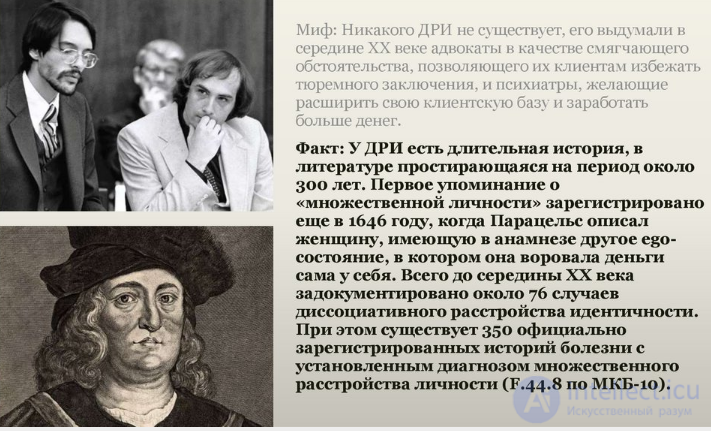
A survey of 19th- and 20th-century medical literature on multiple personality, conducted in 1944, found only 76 cases. In recent years the number of reported cases of dissociative identity disorder has risen sharply (according to some data, about 40,000 cases were recorded between 1985 and 1995)[21]. Other studies have shown that the disorder nonetheless has a long history, spanning roughly 300 years in the literature[22].
At present, dissociation is regarded as a symptomatic response to trauma and severe emotional stress, and it is linked to emotional dysregulation and borderline personality disorder[23]. According to a longitudinal study by Ogawa et al., the strongest predictor of dissociation in young adults was the lack of access to the mother at age 2. Many recent studies have shown a link between disrupted attachment in early childhood and subsequent dissociative symptoms; there is also clear evidence that childhood abuse and neglect often contribute to the formation of disrupted attachment (manifesting, for example, when a child watches very closely to see whether a parent's attention is directed at them or not).
Some psychologists and psychiatrists believe that dissociative identity disorder is iatrogenic or fabricated in nature, or argue that true cases of multiple personality are very rare and that most documented cases should be regarded as iatrogenic.
Critics of the dissociative identity disorder model argue that the diagnosis of multiple personality is a phenomenon largely characteristic of English-speaking countries. Before the 1950s, cases of split personality and multiple personality were described and treated as a rarity in the Western world[24]. In 1957, the publication of the book «The Three Faces of Eve» and the later release of the film of the same name contributed to growing public interest in the phenomenon of multiple personalities. In 1973, the book «Sybil», later adapted into a film, was published, describing the life of a woman with multiple personality disorder. However, the diagnosis of «multiple personality disorder» itself was not included in the «Diagnostic and Statistical Manual of Mental Disorders» until 1980. Between the 1980s and 1990s, the number of registered cases of multiple personality disorder rose to twenty to forty thousand
Some people, including those who self-identify as having multiple personality, believe that this state may not be a disorder but a natural variation of human consciousness that has nothing to do with dissociation. One of the convinced proponents of this view is Truddi Chase, author of the bestseller «When Rabbit Howls». Although she acknowledges that in her case the multiple personalities arose as a result of abuse, she at the same time asserts that her personalities refused to undergo integration and live together as a collective.
Within depth or archetypal psychology, James Hillman argues against defining multiple personality syndrome as an unambiguous disorder. Hillman supports the idea of the relativity of all personifications and refuses to accept the «multiple personality syndrome». According to his position, regarding multiple personality either as a «mental disturbance» or as a failure to integrate «partial personalities» is to display a cultural bias that mistakenly identifies a single partial personality, the «I», with the whole personality as such[26].
Anthropologists Luh Ketut Suryani and Gordon Jensen are convinced that the phenomenon of pronounced trance states in the community of the island of Bali has the same phenomenological nature as the phenomenon of multiple personality in the West[27]. It is argued that people in shamanic cultures who experience multiple personalities do not define these personalities as parts of themselves, but as independent souls or spirits. There is no data on a connection between multiplicity of personality, dissociation, and the recovery of memories and sexual abuse in these cultures. In traditional cultures, multiplicity, as manifested for example by shamans, is not considered a disorder or an illness
Dissociative identity disorder is thought to be caused by a combination of several factors: unbearable stress, the capacity for dissociation (including the ability to separate one's memories, perceptions, or identity from consciousness), the manifestation of defense mechanisms in ontogenesis, and — during childhood — a lack of care and involvement toward the child amid traumatic experience or a lack of protection from subsequent unwanted experience. Children are not born with a sense of unified identity; it develops based on a multitude of sources and experiences. In critical situations, child development encounters obstacles, and many parts of what should have been integrated into a relatively unified identity remain segregated[28].
North American studies show that 97—98% of adults with dissociative identity disorder report situations of abuse in childhood, and that the fact of abuse can be documented in 85% of adults and 95% of children and adolescents with multiple personality disorder and other similar forms of dissociative disorder. This data indicates that childhood abuse acts as the main cause of the disorder among North American patients, whereas in other cultures the consequences of war or natural disaster may play a larger role. Some patients may not have experienced instances of abuse but may have gone through an early loss (for example, the death of a parent), a serious illness, or another extremely stressful event[28].
Human development requires the child to have the capacity to successfully integrate various kinds of complex information. In the course of ontogenesis, a person passes through a series of developmental stages, at each of which different personalities may be created. The ability to generate multiple personalities is not observed or manifested in every child who has undergone abuse, loss, or trauma. Patients with dissociative identity disorder have the ability to enter trance states easily. This ability, in combination with the capacity for dissociation, is considered to be a factor in the development of the disorder. That said, most children who possess these abilities also have normal adaptive mechanisms and are not in an environment that could trigger dissociation[28].
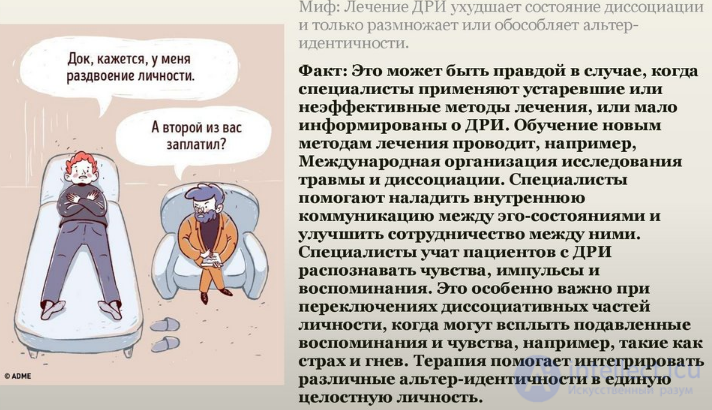
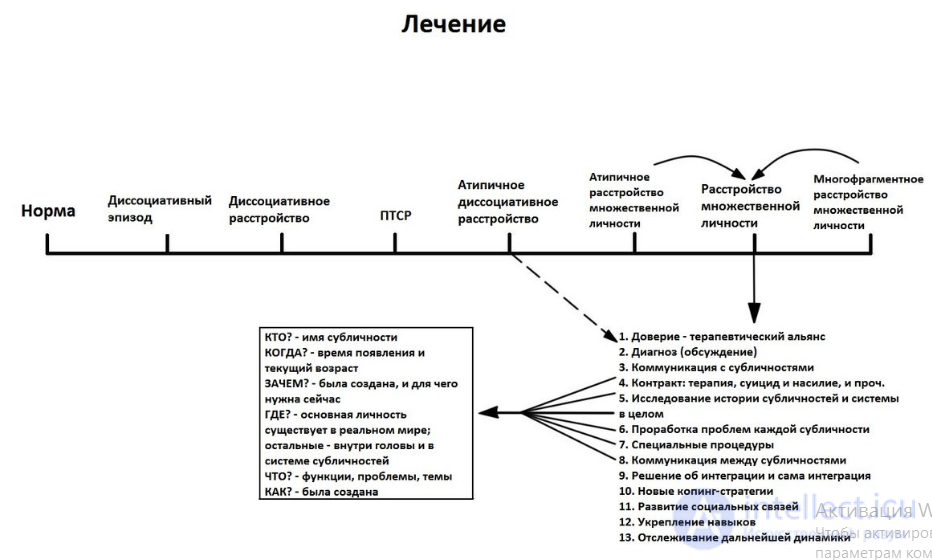
The most common approach to treating multiple personality disorder consists of alleviating symptoms in order to ensure the individual's safety, and reintegrating the various personalities into a single, well-functioning identity. Treatment may take place using various types of psychotherapy — cognitive psychotherapy, family psychotherapy, clinical hypnosis, and so on.
Insight-oriented psychodynamic therapy is used with some success, helping to overcome the trauma sustained, uncovering the conflicts that determine the need for separate personalities, and correcting the corresponding defense mechanisms[17]. A possible satisfactory outcome of treatment is achieving a conflict-free, cooperative relationship between the separate personalities. The therapist is advised to treat all alter personalities with equal respect, avoiding taking sides in the internal conflict[17].
Medication therapy does not achieve noticeable success and is purely symptomatic in nature; there is no pharmacological drug for treating dissociative identity disorder itself, however some antidepressants are used to alleviate accompanying depression and anxiety




 .
.

Comments