
Lecture
Beyond the «Galilean» mode of thinking
The analysis of the subjective situation comes to the fore — the "internal" situation is not merely taken into account but becomes the primary subject of consideration: What matters is what the situation is for the person themselves, not for an external observer.
A given influence can have different effects depending on the overall life situation of the individual, since the behavior and psychological meaning of any given influence, in the case of both reward and punishment, is not determined by an isolated stimulus or a separate mental process
The task of constructing a psychological representation of the situation
The task for psychology
What matters is how particular physical or social facts present themselves to the person
The task is to scientifically capture the "subjective" field — that which exists for the subject — to find means that would allow one to deal "scientifically" with the subjective, with what exists for the subject psychologically.
The transition to the concept of "valence", which pointed only to the fact of an attracting or repelling force.
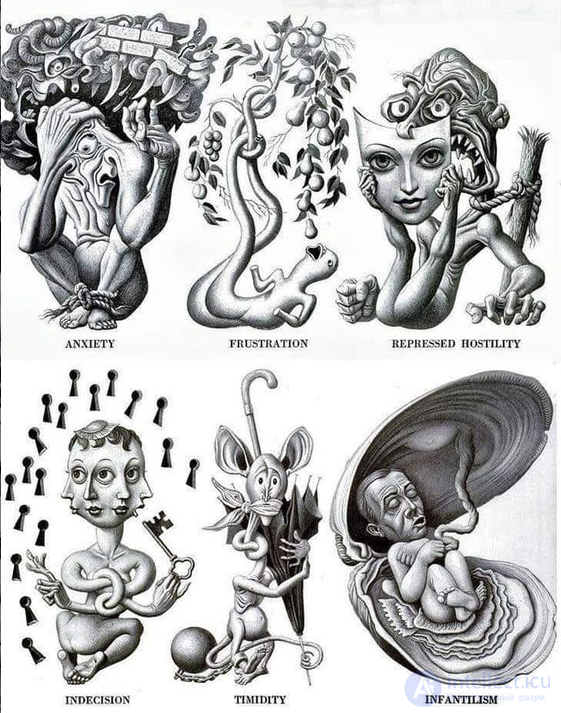
Neurotic symptoms: anxiety, frustration, suppressed anger, indecisiveness, timidity, infantilism / Neurotic Symptoms, Boris Artzybasheff, 1947
The role of social relations: many objects of the external environment, forms of behavior, and goals acquire valence not on the basis of the individual's own needs, but through prohibition, command, or example set by an Other.
Constructive methodology
The psychological experiment becomes part of real life.
a method for analyzing causal relationships and building scientific constructs
the predominance of constructive rather than classificatory concept formation;
interest in the dynamic aspect of events;
priority of psychological rather than physical description;
analysis proceeding from consideration of the situation as a whole
The essence of the constructive method lies in representing an individual case by means of a small number of constructive "elements".
In psychology such elements can be the psychological "position", psychological "forces"
The model is based not on the reproducibility of the fact itself, but on the reproducibility of the conceptual scheme of analysis, with the correspondence of conclusions to actually observed phenomena serving as the criterion of their correctness.
The cognitive structure of the life space: differentiation of the dimensions of the life space (distinguishing the psychological present, past, and future); separation of the levels of the real and the unreal.
Problems of the individual's location in the life space; accessibility and inaccessibility of regions;
Movement within the life space: adaptation to the situation, problems of group belonging, including differences in the sense of group belonging in an authoritarian versus a democratic group atmosphere.
Changes in cognitive structure: the problem of the detour and insight; learning as the structuring and differentiation of a previously unstructured region; the ambiguous role of repetition in learning
Problems of psychological forces and force fields: the situation of a goal almost attained; the problem of the relationship between "personal" and "impersonal" forces in a given situation; analysis of situations of motivational conflict (including situations of an adult's power over a child) and their main types; "leaving the field"; emotional tension and anxiety
Overlapping of situations: overlapping of activities; the process of decision-making; the influence of the group on the individual; the influence of a marginal position.
Factors determining the field and its changes. This concerns the problem of needs and valences. Specific phenomena: the influence of the state of needs on cognitive structure; real and substitute satisfaction of a need
Change of needs and goals:
persistence;
the influence of level of difficulty;
psychological satiation;
intention as the creation of a quasi-need;
level of aspiration and the factors determining it;
the degree of maturity of aspirations;
the problem of induced needs and sources of ideology;
egoism and altruism;
submission and social pressure;
adoption of others' goals;
situations of aggressive and apathetic authoritarianism;
adoption of group goals
Analysis of real-life situations with real problems.
The concept of the psychological field as everything that exists for the individual psychologically. The combination, within a single study, of "objective» and "subjective" representations of the situation
The separation of phenotype and genotype — the ability to identify the "genotypical" characteristics of real-life situations (group atmosphere, marital conflicts, etc.)
Typological analysis and the identification of causal-genetic types (types of situations involving the promise of reward and the threat of punishment, types of conflict situations, types of leadership and group atmosphere, types of forces acting on the individual, types of life space)
Constructive method:
Theoretical reconstruction of a unique individual situation using a small number of basic constructive elements.
The method of successive approximation — from the general structure of the situation to the full reality of a given individual case.
Learning and discussion as part of action research.
The researcher's involvement in the situation as opposed to a position «above» it.
The fundamental equality of the researcher and the participant.
Also relevant to the current stage of development of psychology is the mode of thinking characteristic of abstracting classification, and the gradual transition to functional concepts.
Discrete classifications of certain phenomena, which treated them as elements of different essences, have given way to their ordering along a certain continuum
Social constructivism has voiced a range of new problems, such as the social construction of personal identity, the role of power in the social formation of meanings, the role of rhetoric and narrative in scientific discourse, the central importance of everyday life, remembering and forgetting as a socially constructed activity, and the reflexivity of method and theorizing.
Five basic premises of social constructivism
1. An attitude in which our approach to the world and to ourselves is not under the pressure of pre-accepted theoretical assumptions.
2. Our terms and ways of understanding the world and ourselves are social artifacts, products of historically and culturally determined relations among people.
3. The degree to which an approach to the world and to the person remains stable over time depends not so much on its objective validity as on the vicissitudes of social development
Five basic premises of social constructivism
4. The importance of language in the human world is determined by the way it functions within patterns of human relations.
5. To evaluate existing forms of discourse means to assess certain cultural patterns, and thereby to allow other cultural enclaves, territories, and groups to be heard.
Consciousness is viewed anti-essentialistically, as something that has no fixed essence, but is built from cultural-symbolic resources
For some constructivists, consciousness is not a mental object at all, but a discursive and narrative action. It is a collection of stories that people tell, a set of speech practices for communicating with others as moral and understanding beings.
This is why constructivists tend to regard discourse as the fundamental principle of social construction.
Discourse analysis focuses on talk and texts as objective social practices, as well as on the resources drawn upon to study and master these practices.
Discourse analysts also reject traditional cognitive explanations in psychology. Instead of explaining actions as consequences of mental processes or entities, they attempt to understand how mentalistic concepts are constructed and used in interaction.
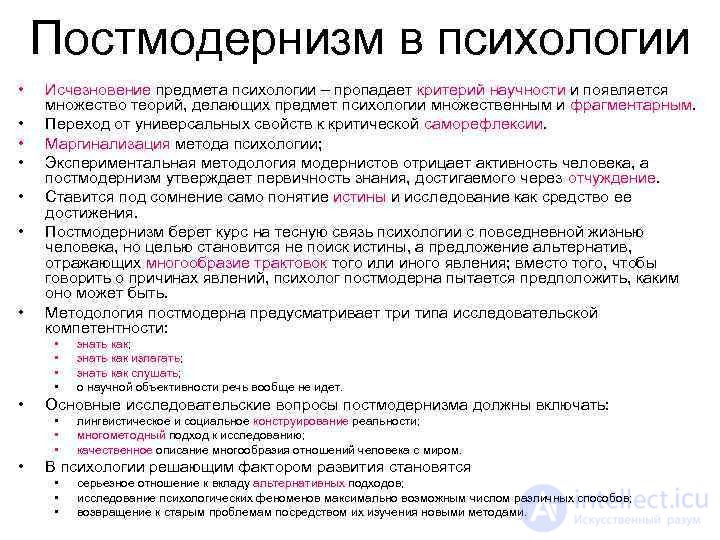
postmodernism in psychology
Classical science, following the well-known definition of I. Kant, equated scientific status with the use of mathematics, whereas in non-classical research an attempt is made to put qualitative methods in place of quantitative-mathematical ones.
The key concepts turn out to be «interaction», «competence», «context», «discourse», «reading», «writing», «narrative», «polydisciplinarity», «comparativism», and the like.
The applicability of quantitative methods is not called into question with regard to the testing of already formulated hypotheses (in the context of justification).
However, the questions formulated in a questionnaire will not adequately reflect the full diversity of individual meanings and senses that are «projected» into them.
Standard survey methods force the researcher to use a system of concepts that may partially, or even completely, fail to coincide with the respondent's system of concepts.
One and the same attitude or one and the same motive can have opposite meanings within different systems of representations and relations. As a result, the inadequacy of interpreting individual representations and predicting behavior increases sharply.
The self is in a constant state of becoming and development, the self is constructed.
J.G. Fichte:
The self not only constructs itself, but in some sense reality is a product of the activity of self.
Consciousness generates itself
The subject is always faced with the task of self-determination
The self is already posited from the outset, and on the other hand, is a goal to be striven for, that is, it contains within itself both a beginning and an end.
Sartre's concept
The self can be mistaken about what it actually is
The self may consider itself envious or irritable, yet be mistaken about itself. It is even possible that the self is constructed entirely out of false memories.
an important factor in the construction of the self, according to Sartre, is the presence of the Other in my experience. The self as an act of self-reflection and as its object arises from the individual's relation to others.
First, a person feels observed, an object of the Other. And only then, as a result of verbal communication, does a full-fledged self.
The self blocks the subject's authentic life from himself (Sartre calls it one of the forms of "false consciousness")
Consciousness, empty in itself, tends toward self-objectification in the form of the self
And life in human society forces consciousness to take on the image of the self (it is precisely other people who force a person to take on the image of the self, thereby making access to himself more difficult for him)
Martin Heidegger
Martin Heidegger puts forward the idea of the human being as the author of himself.
A person strives to create his authentic self, and this process is possible only on the basis of the project of being oneself.
Only an authentic personality can possess the essential characteristics of selfhood (individuality, self-identity, unity, substantiality).
A person has the ability to choose his own possibilities in the various situations that arise in his life, and in this way he realizes his authorship of himself.
According to Heidegger, the whole of human being comes down to a constant striving for wholeness, authenticity, and the struggle to preserve it.
To be oneself — means to achieve these qualities and remain true to them.
Sigmund Freud
Our consciousness is a complex system similar to an iceberg — the conscious Ego is not only controlled by the suppressive mechanisms of the Super-Ego, but also occupies a rather small "space" in our psyche compared to the bottomless depths of the unconscious Id.
The self-Ego is a constructed result of the interaction between the Super-Ego and the Id
The conscious self arises when the unconscious comes into contact with the external world.
The main agent is the social environment surrounding us, that is, other people. It is precisely society, whose attitudes are transmitted to us through significant Others, that is embodied in Super-Ego, which allows us to construct our self.
Abraham Maslow
The highest of human needs, from Maslow's point of view, is the need for self-actualization, that is, for realizing one's potentials in the most successful way.
One cannot be born a human being; one must become one.
Parents, society, and culture help in this becoming — it is they who form the person, and then he himself faces the task of finding and revealing his individual traits, his "strong" sides.
It is precisely in self-actualization that the self realizes itself, turning away from the voices of Others and listening only to itself.
Self-actualization is also linked to nonconformism, to the opposition of one's unique self to any other authorities.
The constructivist approach
Presupposes the gradual construction and reconstruction of the self in the course of the individual development of the human personality
Constructionists offer a fundamentally new approach, arguing that there is not a single self, but a multitude of selves, present in various linguistic practices.
The self is constructed with the help of the symbolic resources of culture.
The focus shifts from viewing the self as an entity to the methods of constructing the self, and the self comes to be understood as a life story or a set of stories. These theories are also united by the notion of discourse as the central organizing principle in the construction of the self.
One of the founders of social constructionism, Kenneth Gergen
All forms of our understanding of the surrounding world and of ourselves are products of society, historically and culturally conditioned by interactions between people.
A special role in the construction of the self is played by language as the main means of interaction between people. It is language that is one of the main factors in the cultural environment surrounding a person, which creates certain conditions called, in social constructionism, "discourse".
Discourse – a sociocultural context, expressed through the possibilities of language, that influences a person's comprehension of the surrounding world and their positioning of their own selfhood.
discourse is the particular way of describing the world that a given individual uses, as well as the very situation in which communication or self-description unfolds.
Discursive practices
The constructionist philosophers Bronwyn Davies and Rom Harré propose calling «discursive practices» all the ways in which people actively create social and psychological realities.
The institutionalized use of language and language-like systems
Often they create unambiguous versions of reality that are incompatible with others
every language already imposes its own framework on discourse — the difference in mentalities of representatives of different peoples is not only emphasized by linguistic difference but is also created through it.
The very individuals who form discursive practices are simultaneously formed by them
A person is constantly in a situation of conflicting discourses, and each discourse assigns the individual a particular position, whereby a person can simultaneously occupy various positions, each corresponding to one of the conflicting discourses.
This complicates the process of constructing the Self as a whole and consistent system, and leads to a certain centrifugal tendency within the personality and the impossibility of fixing a single permanent center.
From R. Harré's point of view, the Self is a theory of a particular kind that a person possesses. This theory is itself a construction, actively created by the person within the framework of discourse.
The Spanish psychiatrist Luis Botella, a representative of narrative psychology, points out that in his understanding the Self is constructed not as a theory but as a «narrative». the foundation of the narrative is the definition of values and self-evaluation.
Our current identities, which we attribute to ourselves, are personal ways of linking our past to our anticipated future. They tie the events of a person's life (past and expected) into a single knot.
So what is a narrative?
- it is the life story told by the person themselves.
Miller Mair formulates the basic principle of constructionist psychology — «personal processes are psychologically guided by the stories in which these persons live and the stories they tell»
The self-narrative ties all the events of our lives into a single system, resembling a logically constructed story, and the Self, thus, is simultaneously both its hero and its narrator. Thus a person, in creating a narrative, tells it, first and foremost, to themselves.
The psychologist Theodore R. Sarbin defines narrative as «a way of organizing episodes, actions, and accounts of actions; something that connects plain facts and fantastic fictions...»
the person themselves determines the significance of each event for incorporating it into the construction of their own Self.
The Self-narrative is not a single story but the totality of all the life plots in which the Self finds itself.
The idea of the variability of the Self, of its construction depending on sociocultural factors, does not presuppose a denial of the Self as a stable construct.
Postmodernism regards the Self as a decentralized, dialogical, and polyphonic narrative construct
The Dutch psychologists Hermans, Kempen, and van Loon propose the idea of the polyphonic novel (i.e., a novel in which there is not a single author but a multitude of authorial voices speaking from different points of view) as a metaphor for selfhood.
For them the Self has the ability to imaginarily occupy different positions and to engage in dialogue with its other positions. These different voices are regarded as «possible Selves», and form a complex, composite structure of selfhood.
The concept of «possible Selves» («possible selves») is proposed by the American psychologists Hazel Markus and Paula Nurius, who work on problems of selfhood and identity.
This is a set of Self-images — what we would like to be, what we would be afraid to become, what we could become.
The idea of possible Selves is directed toward the future — it is our expectation of the path of development of our Self.
Our present Self is called the Self-concept — the idea of ourselves that we currently hold.
The Self-concept is not a monolithic entity but a set of particular Self-schemas, which in turn are generalizations of the individual's past experience in various situations. In different situations, different working Self-concepts may manifest.
Creating one's own narrative is a kind of detachment from one's own Self and its presentation as an Other
In telling the story of their Self, the author estranges it and constructs the story of its life as the story of an Other. Creating such a narrative is impossible in any other way.
The possibility of telling a story about oneself rests solely on the ability to look at oneself from the outside.
Discourses always define specific subject positions occupied by people. These positions are taken up by subjects depending on the way the Other addresses them.
However, a single discourse can never become dominant for a person; discourses are constantly in conflict with one another. Even at the same time, different discourses may attribute different positions to the same subject.
Each individual has several identifications (depending on the possible ways of being addressed), and consequently is a decentered entity.
From the standpoint of the discursive psychology of Potter and Wetherell, the Self is a dynamic entity in constant interaction with the surrounding world.
The basis for the formation of personality is social dialogues.
Personality is regarded as consisting of multiple identities formed within various discourses.
Michel Foucault defines identities as a temporary product of subject positions within discourses
Many discursive psychologists speak of the existence of multiple versions of the Self, from which we form our sense of personality.
Sometimes it is easier for us to accept identities imposed from outside (prescribed by society), since in discursive practice a person can act on the basis of an identity recognizable both to themselves and to other people.
However, we can speak of multiple identifications in different situations, that is, of moments of determining one's position within a given discourse while at the same time remaining within one's identity, which, although subject to change and restructuring, is nevertheless unified and possesses a certain constancy. It is precisely the constancy of identity (albeit relative) that is necessary for my existence as a whole self, rather than a set of various impressions and temporary identifications.
We can understand an individual's Self as an «open work» (following U. Eco), in which the individual is both author and performer, while Others, also acting from the position of «reader» («listener»), contribute their own understanding of selfhood, supplementing the person's Self-narrative.
By identity in the context of narrative and discourse we can understand the way in which various life plots are constructed into a single, coherent life story authored by the Self.

Comments