
Lecture
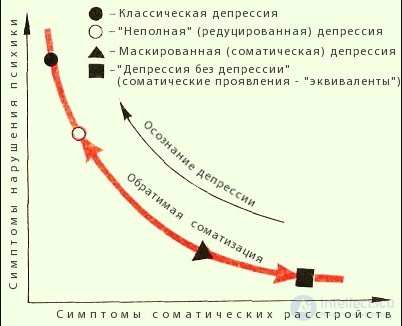
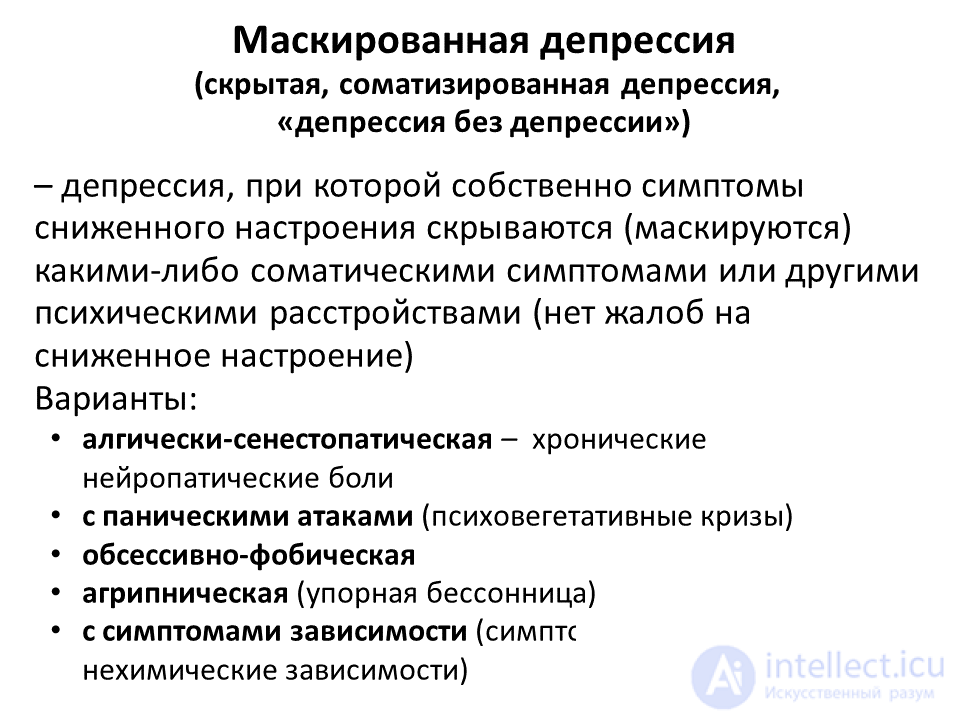
«Masked depression» (larvate depression) — a term in psychiatry and psychotherapy denoting hidden depression. Such conditions are also often referred to as «masks of depression». In masked depression, the classic affective components of depression (lowered mood, apathy, withdrawal from contact with the outside world, etc.) may be very minor or even entirely absent. The patient, as a rule, is not aware of having a depressive disorder. Often he or she is convinced of having some rare and difficult-to-diagnose somatic illness, or has various neurotic symptoms, disturbances of biological rhythm, and so on.
Hidden depressions are a cluster of psychopathological conditions in whose clinical presentation the symptoms indicating depressive disturbances are not clearly visible, and the leading place is occupied by various somatic complaints pointing to functional deviations in the activity of organs and systems. In the presentation of «hidden» depression, the main role is played by somatic (bodily) and autonomic symptoms that «mask» the depression and anxiety itself.
1. Psychopathological disorders:
2. Disturbances of biological rhythm and sleep (insomnia, hypersomnia, nightmares)
3. Autonomic, somatized, and endocrine disorders
4. Masks in the form of algias (headache, chest pain, abdominal pain, pain in the joints or spine, neuralgia (trigeminal, facial nerve, intercostal neuralgia, lumbosacral radiculitis), pseudo-rheumatic arthralgias)
5. Masks in the form of pathocharacterological disorders

Comments