
Lecture
Addiction (from Eng. addiction — dependence, a harmful habit, habituation), in a broad sense, is a person's felt compulsive need for a particular activity.
Addictive behavior (in sociology) (from Lat. addicton — blindly devoted, reduced to slave-like dependence) — a set of behavioral processes and social actions of a person based on addiction. It is a subtype of dependent deviant behavior.
The term is often used for phenomena such as drug dependence and substance abuse, but it is now applied more to psychological rather than chemical dependencies, for example behavioral ones, examples of which include: internet addiction, gambling addiction, shopping addiction, psychogenic overeating, fanaticism, addiction to pornography, and so on
In the medical sense, addictiveness is a compulsive need to repeat certain actions, accompanied, in the event of disruption of the patient's usual routine, by clearly expressed physiological and psychological abnormalities, atypical behavior, and other mental disturbances.
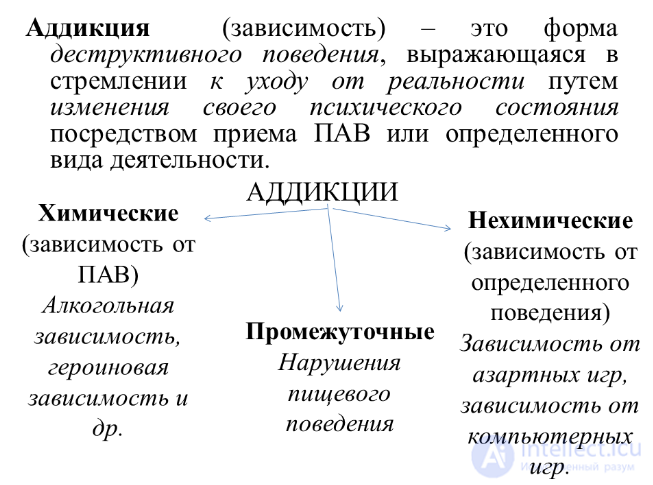
All addictions can be divided into:
1. Chemical (based on dependence on psychoactive substances): alcohol dependence, heroin dependence, etc.
2. Non-chemical (dependence on a particular behavior): gambling addiction, computer game addiction, etc.
3. Intermediate (combining features of chemical and non-chemical addictions): eating disorders.
The following forms of addictive behavior are distinguished (E. Zmanovskaya):
Decades ago, addiction was a pharmacological term implying the use of a drug (a medication, a legal or illegal narcotic) in a sufficient amount to avoid unpleasant withdrawal effects. Addictive behavior associated with such a state of dependence («narcotism») was regarded as deviant and was contrasted with addiction as a disease. At present, the perspective on the essence of such addictive disorders has shifted. «Narcotism» came to be viewed, alongside other behavioral addictive disorders, as a unified phenomenon, although no common view exists regarding its psychopathological essence.
Different authors classify addictions as obsessive-compulsive disorders , as disorders of the productive spectrum , or compare them with twilight states of consciousness , and so on. A number of authors note persistent (up to 60%) comorbidity of addictive disorders both with one another and with other mental disorders (affective, obsessive-compulsive, etc.) .
Addictive illnesses are sometimes classified as non-infectious or social diseases. In clinical and social addiction medicine and addictology of recent decades, new risk factors have been noted, along with early and very rapid formation of states of dependence, therapeutic resistance, and a remission-free course of the disease.
Overall, addictions can be conditionally divided into «chemical» (substance-related) — also called physical dependence — and behavioral addictions (non-substance-related, psychological)
Behavioral addiction in psychology is a state of a person's consciousness characterized by attachment to a particular activity and an inability to stop it independently.
Addictive behavior is associated with a person's desire to escape real life by altering the state of their consciousness. This phenomenon is studied by addictology, clinical psychology, and sociology .
There are forms of addiction accepted by society : spiritual practices, meditation, falling in love, creativity, workaholism, internet addiction, shopping addiction, extreme sports, overeating, as well as socially dangerous ones: substance abuse, drug dependence, kleptomania, and others. In certain cases, addictions can be deliberately developed (for example, factors of cognitive addiction in intellectually gifted adolescents are studied).
With the development of the information society and the growth of traditional information-dependent conditions, new addictions have appeared — pathological dependencies on television , on social networks , internet addiction, addiction to computer games, and so on.
Research data show that there are certain biological mechanisms responsible for addictions. However, this area remains a subject of debate. As was raised in the «Sociogenetics or biogenetics» discussion, the biological nature of innate qualities can influence decision-making and actions. Certain factors related to genetics, DNA, and mental disorders may be present in a latent form, only to become activated at a certain point .
On the other hand, addictive behavior can be triggered by environmental influences that lead to behavior modification (rus. Behavior modification) of the personality. Favorable relationships, abuse, social interaction, and exposure of the body to toxic substances — all of these can alter a person's behavior. Some researchers acknowledge the influence of both social and biological factors, which jointly shape the pattern of behavior
Certain areas of the brain may be involved in the biological mechanism of addiction. The most notable is the mechanism of dopamine release in the Nucleus accumbens, which is triggered by many narcotic substances, thereby reinforcing dependence. Dopamine release is a natural stimulating process characteristic, for example, of eating or sex. Drugs act in a similar way. In particular, some drugs increase dopamine production and release in the brain by 5—10 times, allowing users to obtain a feeling of pleasure artificially . Thus, amphetamine directly stimulates dopamine release by acting on its transport mechanism. Other drugs, such as cocaine and psychostimulants, block the natural mechanisms of dopamine reuptake, increasing its concentration in the synaptic space . Morphine and nicotine mimic the action of natural neurotransmitters , while alcohol blocks the action of dopamine antagonists. Beginning in the limbic dopaminergic system, the process then modifies other parts of the brain, for example, the ventral tegmental area .
The mechanisms by which this process takes place include the insertion of additional AMPA receptors into the postsynaptic membrane of dopaminergic neurons. Studies in mice show that exposure to cocaine over a two-week period causes long-term changes in the ventral tegmental area. Moreover, the pleasurable effect of the drug reinforces the behavior associated with obtaining and taking it until it becomes a habit. Initially the process takes place in the ventral striatum, mainly in the reinforcement center (Nucleus accumbens), but changes then develop in the upper part of the striatum (dorsal striatum). Presumably, addiction-related neuronal modifications proceed in a dorsally cascading sequence of mutual connections between the two aforementioned regions .
Several factors influence predisposition to the development of drug dependence. It may be related to the prefrontal cortex of the brain, which is responsible for judgment, risk-taking decisions, and impulse control. This would explain why children are more predisposed to drug addiction. Individual studies show that children aged 10 to 12 who display the least behavioral inhibition are at maximum risk for developing addiction to narcotic substances .
The main motive of individuals prone to addictive forms of behavior is actively changing their unsatisfying mental state, which they most often perceive as «gray», «boring», «monotonous», «apathetic».
The following psychological features of individuals with addictive forms of behavior are distinguished (B. Segal):
According to the available criteria, the main feature of an individual prone to addictive forms of behavior is a mismatch in psychological stability between everyday situations and crises.
Normally, mentally healthy people, as a rule, easily («automatically») adapt to the demands of everyday (ordinary) life and find it harder to cope with crisis situations. Unlike individuals with various addictions, they try to avoid crises and exciting, unconventional events.
The addictive personality exhibits a phenomenon of "thirst for thrills" (V.A. Petrovsky), characterized by an urge toward risk stemming from the experience of overcoming danger.
According to E. Bern, a person has six types of hunger:
Within addictive behavior, each of the listed types of hunger becomes intensified. A person fails to satisfy this hunger in real life and seeks to relieve the discomfort and dissatisfaction with reality through stimulation from one activity or another. They attempt to achieve a heightened level of sensory stimulation (giving priority to intense stimuli, loud sounds, sharp smells, bright images), recognition through unconventional acts (including sexual ones), and filling their time with events.
Thus, the core feature of an addictive personality's behavior is the drive to escape reality, fear of an everyday life filled with obligations and regulations that is "boring," a tendency to seek extreme emotional experiences even at the cost of serious risk, and an inability to be responsible for anything.
Escape from reality in addictive behavior takes the form of a peculiar "flight," in which, instead of harmonious interaction with all aspects of reality, activation occurs in a single direction. In this process, the person becomes focused on a narrowly directed sphere of activity (often disharmonious and destructive to the personality), while ignoring all others. According to N. Peseschkian's concept, there are four types of "flight" from reality:
"flight into the body," in which traditional life activity oriented toward family, career advancement, or hobbies is replaced, the hierarchy of everyday values shifts, and reorientation occurs toward activity aimed solely at one's own physical or psychological improvement.
"flight into work," characterized by a disharmonious fixation on professional matters, to which the person begins devoting a disproportionate amount of time compared with other areas of life, becoming a workaholic.
"flight into contacts or solitude" in which communication becomes either the sole desired means of satisfying needs, replacing all others, or the number of contacts is reduced to a minimum.
"flight into fantasy" a tendency toward musing and grand plans in the absence of any desire to actually realize anything, to perform any action, or to display any real activity. Within this type of escape from reality, an interest arises in pseudo-philosophical quests, religious fanaticism, and life in a world of illusions and fantasies.
The only proven effective method (according to AA and specialists) for overcoming addictive behavior or reducing addictive dependence is participation in mutual support groups (Addiction recovery groups), in which people affected by one dependence or another come together to share their problems and support one another on the path to freeing themselves from compulsive needs. A well-known example of such groups is the "Alcoholics Anonymous" community. The only condition for membership is a desire to stop drinking. Members of "Alcoholics Anonymous" pay neither admission nor membership fees; they support themselves through their own voluntary donations. The main goal of holding group meetings is to maintain a sober lifestyle (abstinence from alcohol), as well as to help others solve this problem. By talking at meetings, participants share their experience and strength, and tell about who they were, what happened to them, and how they are living now. Alongside "Alcoholics Anonymous" groups, groups for co-dependents are often created as well — that is, for relatives or close ones whose lives are negatively affected by the habit of the person involved.
Based on the experience of "Alcoholics Anonymous," similar mutual support groups were created for other dependencies: Narcotics Anonymous, Adult Children of Alcoholics, Nicotine Anonymous, Gamblers Anonymous, and others. Overall, different groups use various methods ranging from entirely non-religious to distinctly religious. There is a hypothesis that social interaction increases the likelihood of success in overcoming dependence due to collective effectiveness and because the neurotransmitters released during meetings can naturally trigger a feeling of satisfaction without the need to take drugs or alcohol .
The activity of many mutual support groups is based on the "12 steps" program (Twelve-step program). Originally proposed by "Alcoholics Anonymous" as a method of overcoming alcoholism , the twelve steps were published in the book "Alcoholics Anonymous" in 1939 . The method was later adapted for other forms of dependence. The American Psychological Association identifies the following steps in this method :
Alongside such groups, there is also a range of preventive and therapeutic approaches for combating addictions. For example, a common substitution therapy for opioid addiction (heroin and others) is methadone replacement therapy. Methadone therapy primarily aims to socialize drug addicts and wean them off intravenous drug use. The therapy is conducted strictly under the supervision of the attending physician and involves the participation of other necessary specialists. As a rule, methadone is used in the form of a liquid substance mixed with syrup and is taken orally.
Another narcotic analgesic used for substitution therapy is buprenorphine, which may be safer than methadone . A limiting factor for its wider use in substitution therapy is the price of the drug (by some estimates, it is at least 10 times more expensive than methadone).
Research is being conducted showing the possibility of synthesizing antibodies that would prevent drugs from affecting the brain, minimizing feelings of pleasure. Vaccines against cocaine, heroin, methamphetamine, and nicotine have recently been developed. These drugs are being tested with the hope of using them as a preventive and restorative agent for those suffering from addictions or prone to them .
Another method being considered for treating addictions is deep brain structure stimulation. This method involves surgically implanting a special device into the patient's brain, which subsequently exerts a weak electrical effect on certain areas of the brain. Currently, the method is used to treat, for example, movement disorders such as Parkinson's disease, but there is speculation that it may also prove effective for addictions. The effect can be applied to the reward center (Nucleus accumbens), the striatum, the upper part of the striatum (dorsal striatum), and the medial prefrontal region of the cerebral cortex.
Primary prevention: The main focus should be on primary prevention aimed at preventing involvement in addictive behavior. This includes:
The goal of primary prevention is to maintain the physical, personal, and social health of the nation, especially among adolescents and young people, and to prevent the negative influence of social and natural factors.
Secondary prevention: Secondary prevention is aimed at preventing relapses at the early stages of the formation of addictive behavior. This includes:
Tertiary prevention: Tertiary prevention is aimed at rehabilitation in severe cases of addictive behavior and preventing relapses. This includes:
Thus, the prevention of addictive behavior is carried out at three levels: primary (preventing involvement), secondary (preventing relapses at early stages), and tertiary (rehabilitation and prevention of relapses in severe cases).

Comments