
Lecture
Melancholia (from Ancient Greek μελαγχολία — «an outpouring of black bile», that is, «melancholia» , ← μέλας «black; dark» + χολή «bile; anger»); in Russian terminology khandra, gloomy madness, — a term used until the beginning of the 20th century to denote a type of mental disorder characterized by states of lowered mood. It is now a synonym for severe endogenous depression.
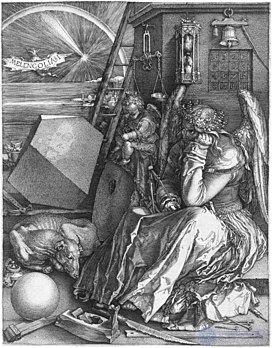 Melancholia in an engraving by A. Dürer |
|
| ICD-11 | 6A80.3 |
|---|---|
| ICD-10 | F32.2 |
| ICD-9 | 296.9 |
| ICD-9-CM | 296.90 |
The term «melancholia» was proposed back in antiquity by the «father of medicine», the Greek physician Hippocrates (4th century BC). For centuries, an excess of bile in the body was considered the cause of melancholia. An encyclopedic description of all the types and manifestations of melancholia (as it was understood in the 17th century) is given in Robert Burton's extensive treatise «The Anatomy of Melancholy» (1621).
In the International Classification of Diseases, Injuries, and Causes of Death, 9th Revision (ICD-9), «melancholia, unspecified» was included under code 296.9 (unspecified affective psychoses), while «involutional melancholia» was coded as 296.13 . Involutional melancholia was described in the classification as a psychosis defined by «anxious-delusional depression with a chronic course tending toward fixation», with no indication of previously experienced affective or affective-delusional disorders .
In the International Classification of Diseases, 10th Revision (ICD-10), melancholia is a synonym for severe depression. «Melancholia without psychotic symptoms» falls under the diagnosis «severe depressive episode without psychotic symptoms» (F32.2). The diagnosis F32.2 also includes major depression, vital depression, and agitated depression (with anxiety and agitation of the patient).
At present, the term «depression» is used for medical purposes instead of the concept of «melancholia». In everyday usage, «melancholia» simply refers to a sad, gloomy mood.
The duration of melancholic phases varies. It is believed that in 40—50% of cases the phases last up to three months, in 25-30% - up to a year, in 20-25% - more than a year. Many melancholics, after the end of a phase, remarkably return to everyday life, resuming their affairs from the point where they left off. However, difficulties in restoring interpersonal, social, and occupational relationships are not uncommon.
The extremes lie in the duration of the phases — from a few days to several years. A phase lasting more than two years indicates chronic depression, in which the intensity of symptoms may fluctuate. An extremely rapid course with almost daily switches between a healthy state and melancholia is called rapid cycling.
Whether and to what extent the phases shorten with treatment has not been established. The phases end (regardless of their duration) sometimes gradually, sometimes suddenly. Remarkably, patients, after a melancholic phase that completely transformed their experience, almost immediately and in most cases effortlessly return to their previous life. Many leave the phase behind without any consequences. A melancholic phase is followed in 10% of cases by a hypomanic surge, generally of low intensity and short duration.
The course of the manic phase is less well defined. The average duration of the phase is shorter than that of the depressive phase. A manic phase can attach itself in a mild and brief form to the end of a depression. In the manic phase, a depressive pre-stage is also observed.
The duration of the intervals between two phases varies, just as the duration of the phases themselves does. It ranges from a few days to several decades. Prognostic predictions in individual cases are impossible. The cycle length, i.e. the interval between the onset of one phase and the next, at the beginning of the illness in unipolar melancholia averages 4 to 5 years, and in bipolar affective psychoses 3—4 years. It shortens the more the number of phases increases in a given patient, primarily at the expense of the symptom-free interval. In a multiphasic course, the severity of symptoms increases and resistance to therapy is more common (if prevention of this course is not carried out).
On the one hand, they are determined by various syndromes (melancholia or mania), and on the other hand, by the frequency of phases. In Fig. 21, the sizes of the squares determine their division by frequency.

Fig. 21. Forms of course of affective psychoses
In unipolar course, only melancholic or only manic phases occur: either single (monophasic) or multiple (polyphasic). In bipolar forms of course, both melancholic and manic phases occur.
Multiphasic unipolar melancholias are the most common. But only a quarter of these patients go through a single melancholic phase. Compared with unipolar melancholia, bipolar course occurs half as often. Unipolar manic phases are noted in only 5—10% of all patients with affective psychoses; single manias are very rare. Overall, melancholic phases are observed three times more often than manic ones. However, it is very difficult to present reliable figures, since mainly severe and recurrent affective psychoses are diagnosed, while mild and single-episode illnesses rarely make it into epidemiological studies. Errors can also arise because bipolar affective psychoses are classified as unipolar, since initially only a melancholic (or manic) phase occurs. Thus, bipolar course occurs more often than is initially determined.
In most cases the illness begins at age 30—40. The mean age of onset is only slightly higher than in schizophrenia. The first manic phase occurs less often than the first melancholic one. Bipolar affective psychoses arise earlier (in 20% of cases before age 20) than unipolar ones. Affective psychoses arise at the earliest in the prepubertal age, but even at this age they are extremely rare. Depressive disorders in children are almost always neurotic in nature, or, in the case of chronic depressions in children, are a consequence of early childhood deprivation. Characteristic melancholic syndromes can precede the onset of schizophrenic psychosis at a young age. It remains unclear here whether this represents an atypical onset of schizophrenia or a transition from affective to schizophrenic psychosis.
Late melancholias (late depressions) are illnesses that begin after age 45. They have certain features compared with illnesses arising at an earlier age; their symptomatology appears less characteristic. Multiphasic course, taking age into account, is just as common as at a younger age. Manias and bipolar course are observed less often than at a younger age. But these differences do not nosologically justify a special status for so-called involutional depressions.
Bipolar affective psychoses can be subdivided into bipolar I — the presence of severe manias requiring hospitalization, and bipolar II — with hypomanic states. This subdivision is of little clinical justification, as is the attempt to dissect unipolar forms of course or the division into primary and secondary depressions; primary depression means that the illness begins with a depressive syndrome, while secondary depression arises after other disorders; this purely temporal designation leaves aside differentiation by the type of depressiveness.
A complication in the course of affective psychoses is alcohol abuse, up to the stage of dependence, more often in manic patients than in unipolar melancholics. Some patients drink only during a phase, while others develop typical alcoholism. This combination of illnesses causes major therapeutic problems.
ICD-10 distinguishes the following categories: manic episodes (F30), depressive episodes (F31), bipolar affective disorders (F32), recurrent depressive disorders (F33). The third digit denotes the syndrome and form of course. The fourth digit denotes specific features of the symptomatology. It should be noted that the figures for depressive disorders sum up (almost) all depressive symptoms, not only the melancholic ones. In ICD-10 (under the influence of DSM), melancholias are understood differently than traditionally, namely as «severe depressive episodes» (F32.2). Thus, the criterion is severity rather than the specific features of the clinical picture of melancholia, which is more useful than harmful: mild (as well as incipient and resolving) melancholias are perceived as mild or moderate depressive episodes (F32.0 to F32.1), i.e., depressive and similar disorders are combined into one group.
Unlike schizophrenia, affective psychoses do not show significant residual states in the sense of loss of potential. Milder psychic changes (for example, residual depressiveness, emotional lability) are observed in some patients — according to current data, in 1/3; the baseline level and emotional balance are affected. With a prolonged course, overt changes in the psyche, its leveling and simplification, may occur. Such residual states are especially common after multiple manias and in bipolar psychoses. They are regarded not only as direct consequences of the illness, but also as consequences of personality development disrupted by the illness and by social difficulties. In these illnesses, rehabilitation measures (work, living arrangements, etc.) are carried out no less than in schizophrenia.
To summarize, it can be said that affective psychoses generally have a favorable course. However, having carefully studied the frequency of relapses, protracted forms of course, suicide risk (10-12% of melancholic patients die as a result of suicide), and residual states, the illness should be regarded more seriously than has been the case up to now. On the other hand, by now the prognosis has become more favorable thanks to therapeutic and preventive measures.
Depressive disorders are common in late life, but there is no single "late-life depression" — symptomatically and etiologically, depressive states in this age group are highly diverse. Some are reactive depressions linked to life situations, conflicts, and health difficulties, while others are organically determined depressions (in the sense of a direct expression of impaired brain function), for example in Parkinson's disease. And finally, there may be pure melancholia (so-called endogenous depression). Here, however, the emphasis is less on nosological categories than on pathogenetic factors, which in many cases act together.
Melancholia in old age is relatively rare, and the activity of affective psychoses declines with aging. Nevertheless, the possibility of melancholic phases in old age must be taken into account, especially if the history indicates such phases in the past; but in old age a melancholic illness can also occur for the first time. In that case an incorrect diagnosis may be made and treatment carried out improperly.
Depression with a melancholic character in old age may precede dementia, i.e., mark its onset. And in dementia that has already set in, as well as in vascular dementia, depressive states often occur (in about 40% of cases). In some instances these are melancholic phases, which in principle are treatable, of course with caution and in accordance with the patient's somatic condition.
In the melancholic phases of aging and elderly people, instead of mild cognitive impairment, overt and significant manifestations of dementia may appear, which are often (and, unexpectedly for non-specialists) reversible, i.e., they disappear once the melancholic phase ends. Little is still known about this depressive pseudodementia (also called the dementia syndrome of depression) (it is possibly a harbinger of dementia that is imminent or will develop later). In these patients it is clinically important not to rush to speak of senile dementia, but to treat the depressive state. The relationship between depression and dementia is complex and poorly understood.
Mania in old age: this concerns a recurrent, or, less often, a first-onset manic phase. Misdiagnoses are quite common, either because physicians do not consider the possibility of mania at this advanced age, or because its symptoms are atypical, for example combined with delusional ideas or with a psychoorganic syndrome. The diagnostically leading feature is an overestimation of one's own vitality and needs. Whenever hyperactivity occurs, possibly combined with expansive or even aggressive emotions and behavior that do not correspond to the patient's usual temperament fluctuations, the possibility of mania must be considered even in elderly people.

Comments