
Lecture
Questions for consideration:
Syndrome (Ancient Greek συνδρομή "confluence, accumulation"; from συν- "with, together" + δρόμος "run, movement") — a set of symptoms with a common etiology and a unified pathogenesis .
In a broad sense, a syndrome is a complex of organically interconnected signs, united by a single mechanism of occurrence and development of the phenomenon under consideration, not necessarily associated with a pathology (disease)
Avicenna, in "The Canon of Medicine" (published 1025), was the first to propose the idea of a syndrome in the diagnosis of specific diseases[B: 3]. The concept of a medical syndrome was further developed in the 17th century by Thomas Sydenham
In medicine and clinical (medical) psychology, a set of symptoms united by a common pathogenesis is called a syndrome; sometimes this term is used to denote independent nosological units or stages (forms) of a disease . Many syndromes are named after the scientists who first described them: Down syndrome, Tourette syndrome, and so on .
A characteristic feature of a syndrome is that it can result from the influence of various pathogenic causes on the body. The body often responds unambiguously to various "harmful factors," reacting with a limited number of general typical reactions (for example, inflammation). The same syndrome can be observed in different diseases; and at the same time, the same disease (at different stages and in different clinical forms) can manifest itself through different syndromes. Thus, the difference between a disease and a syndrome corresponds to the difference between essence and phenomenon. Syndromes manifest and change depending on the development and stage of the disease; they can arise under the influence of various causes and primarily reflect the characteristics of the body's reaction. After establishing a syndrome, the physician must determine the cause and conditions of the observed functional and organic disorders in the patient's body .
A distinction is made between simple and complex, or major, syndromes. A major syndrome represents a combination of symptoms pathogenetically related to one another and affecting the whole organism. For example, in diffuse kidney diseases, major syndromes are distinguished — azotemic, chloruremic, and hypertensive .
Two types of syndromes are distinguished — anatomical and functional . Combinations of physical symptoms or signs that correspond to structural changes in organs are called an anatomical syndrome. For example, dullness of percussion sound in the lung area, bronchial breathing, increased vocal fremitus, and bronchophony constitute the anatomical syndrome of pulmonary tissue infiltration . A combination of functional symptoms produces a physiological, or functional, syndrome. For example, a decrease in blood alkaline reserve, an increase in ammonia content in urine, and a decrease in the partial pressure of carbon dioxide (PaCO2) in alveolar air constitutes the functional syndrome of non-gaseous acidosis .
When syndromes are identified, one moves from stating symptoms to establishing deeper connections and causal relationships between them in a given patient. Based on individual symptoms and syndromes, the physician makes an initial conclusion about the anatomical and functional state of the organs. Moving from symptoms to a syndrome, the physician selects certain diagnostic hypotheses and rules out others.
In professional medical language, a syndrome relates only to a set of detected characteristics. A specific disease, condition, or disorder is possibly identified as the underlying cause. Once the physical cause has been identified, the word "syndrome" sometimes remains in the name of the disease.
In general psychology, personality psychology, occupational psychology, social psychology (and sociology), the concept of syndrome is used in an even broader sense — to characterize a set of psychological traits and their manifestations, combinations of their particular features. L. S. Vygotsky put forward the idea that in psychology, as in medicine, in order to describe the characteristics of a child's psyche one should use not a list of individual indicators (symptoms) but a larger unit — a syndrome. The concept of "personality syndromes" is used by A. Maslow in his study of self-esteem and personal security. E. Fromm writes about the "growth syndrome." T. Adorno[A: 1] uses the concept of syndrome to describe personality types, in particular, the authoritarian personality. A. L. Wenger uses[A: 2] the concept of syndrome in analyzing unfavorable variants of a child's mental development and burnout in professional activity; he also proposed[A: 3] a general scheme of interrelations between symptoms that ensures the stability of a syndrome and the direction of its change. The concept of "Stockholm syndrome" has gone beyond use in psychology and gained wide public recognition.
In the psychology of labor, the syndromal approach is used to study individual professionalism. In this framework, a person’s professionalism is regarded not as a collection of traits (symptoms) but as a more complex unit — a symptom complex, or syndrome, that combines these interrelated traits[B: 5]. The advantage of the syndromal approach (compared with the «symptomatic» one) here is determined by the same factor as in medicine: the ability to formulate a «diagnosis» (the formation of professionalism, as well as the development of its professional deformations) in terms that indicate the direction of psychological correction[A: 4].
In recent decades the term has also been used outside of medicine to describe similar phenomena.
Neurosis-like syndromes, also known as neurosis-like conditions, are a group of mental disorders that share some similarities with classic neuroses but do not fully match their characteristics. These conditions are typically characterized by psychological and physiological symptoms that can be triggered by various stressful situations or psychological factors.
Some neurosis-like syndromes include:
Reactive depression: A condition that develops in response to stressful events or situations. A person may experience symptoms of depression, but their severity and duration depend on how strongly the stress factors affected them.
Somatization disorder: Patients with this disorder experience physical symptoms and pain that have no clear medical cause but may be related to stress and psychological discomfort.
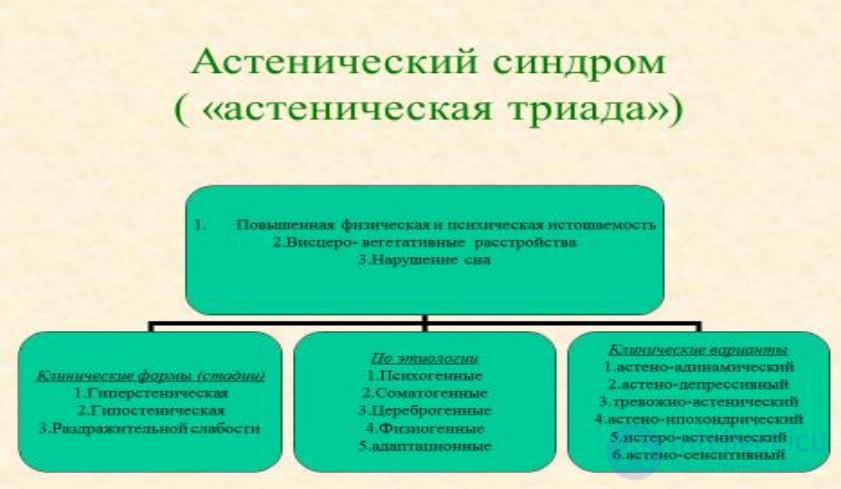
Asthenic syndrome: This syndrome is characterized by increased fatigue, weakness, irritability, reduced performance, and a lack of interest in the surrounding world.
Dissociative disorders: Patients with dissociative disorders experience disruptions in consciousness and memory, which may be related to traumatic events or stress.
Chronic fatigue syndrome: Characterized by prolonged fatigue and weakness that do not improve with rest and sleep.
Somatic symptom and related anxiety syndrome: Patients may experience a range of diverse physical symptoms that cause anxiety and worry.
Neurosis-like syndromes can often be caused by stress, traumatic events, psychological conflicts, and other psychosocial factors. Although they may overlap with some symptoms of neuroses, they do not fully meet the criteria for diagnosing classic neuroses. Treatment of neurosis-like syndromes may include psychotherapy, stress management, supportive measures, and, when necessary, medication. It is important to seek help from qualified specialists for proper diagnosis and to determine the best treatment plan.
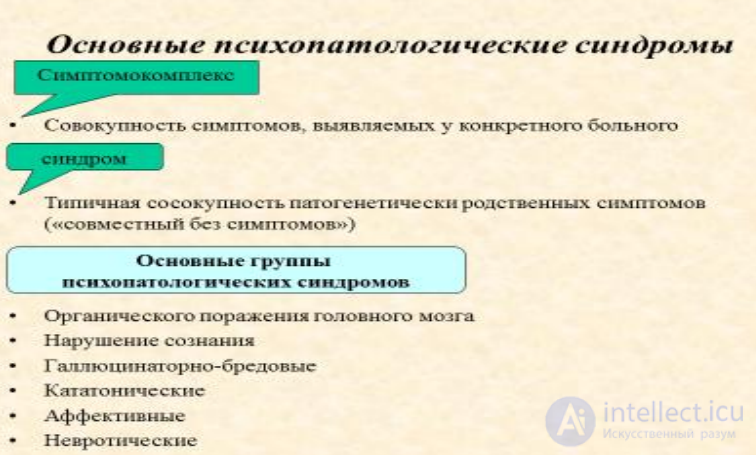
Delusional syndromes belong to a group of mental disorders characterized by the presence of delusions. A delusion is a false, implausible belief or conviction that does not correspond to reality but persists despite logical counterarguments and evidence to the contrary. Delusional syndromes can be a symptom of various mental illnesses.
Some typical delusional syndromes include:
Paranoid delusion: Patients hold beliefs that people around them are intentionally causing them harm or conspiring against them.
Religious delusion: People may believe that they are a special messenger of God or possess supernatural abilities.
Jealous delusion: A person believes that their partner is being unfaithful without sufficient grounds or evidence.
Grandiose delusion: Patients believe in their own grandeur and consider themselves to possess extraordinary and great abilities.
Somatic delusion: People are convinced that they have a serious physical illness or that something is wrong with their body.
Revolutionary delusion: Patients believe that they play a key role in an upcoming revolution or social change.
Delusional syndromes can be caused by various factors, such as genetic predisposition, disruptions in brain function, and neurotransmitter imbalances (for example, dopamine). They are often associated with mental illnesses such as schizophrenia, bipolar affective disorder, depression, as well as certain organic mental disorders.


Treatment of delusional syndromes usually includes medication therapy, psychotherapy, and supportive measures. It is important for patients with delusional syndromes to seek help from qualified psychiatrists and psychotherapists in order to receive a proper diagnosis and determine the best treatment plan. Seeking help early can improve the prognosis and reduce the suffering associated with these disorders.

Fig. Stages of delusion formation
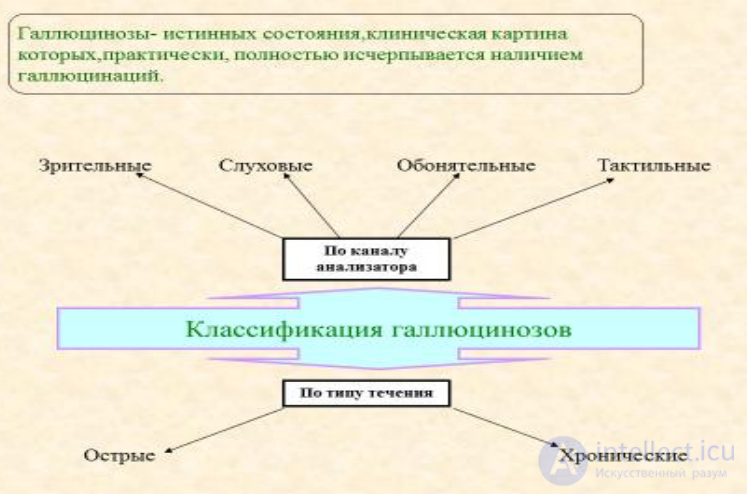
Classification of hallucinoses
Syndromes of emotional disturbances are a group of mental states characterized by disturbances in the sphere of emotions and mood. These states can include a wide range of emotional changes, including depression, anxiety, bipolar affective disorder, and others.
Some typical syndromes of emotional disturbances include:
Depressive syndromes: Characterized by lowered mood, loss of interest and pleasure, loss of energy, drowsiness, changes in appetite, and muscle weakness. Depressive syndromes can range in severity, up to severe depression with suicidal thoughts.
Anxiety syndromes: Distinguished by feelings of worry, fear, nervousness, and physiological arousal. A person may experience anxiety regarding various situations and events.
Bipolar affective disorder: Characterized by alternation of manic episodes (elevated mood, inflated ego, increased activity) and depressive episodes.
Emotionally unstable syndrome: People with this syndrome experience mood instability, ranging from elation to deep sorrow.
Reactive emotional syndromes: These are temporary emotional reactions to stressful events or situations, such as the loss of a loved one or other traumatic events.
Emotional exhaustion: This is a state in which a person experiences burnout and a feeling of emotional and physical depletion.
Syndromes of emotional disturbances can be caused by various factors, such as genetic predisposition, psychological factors, stress and traumatic events, changes in brain neurochemistry, and other psychosocial factors.
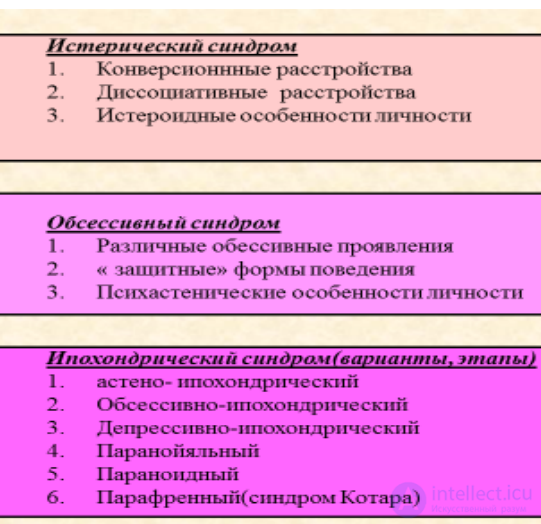
Treatment of syndromes of emotional disturbances depends on the specific diagnosis and severity of the condition. It may include psychotherapy, medication (for example, antidepressants, mood stabilizers), supportive measures, and lifestyle changes. It is important to seek help from qualified specialists for proper diagnosis and determination of the best treatment plan.
Syndromes of disturbed consciousness are a group of states characterized by disruption of a person's usual level of consciousness. Disturbance of consciousness can be temporary or permanent and can be caused by various factors, including medical, psychiatric, or traumatic factors.
Some typical syndromes of disturbed consciousness include:
Coma: This is a state of loss of consciousness in which a person does not respond to stimuli and is incapable of conscious perception of the surrounding world.
Drowsiness (somnolence): A person experiences a strong feeling of drowsiness and an inability to maintain wakefulness.
Sluggishness (stupor): This is a state in which a person is in a state of deep inhibition and responds to minimal stimuli or does not respond at all.
Intoxication: The use of alcohol or drugs can lead to disturbance of consciousness and changes in cognitive functions.
Delirium: This is a state characterized by altered consciousness, disorientation, impaired concentration, and possible hallucinations.
Epileptic seizure: In some cases, an epileptic seizure can lead to temporary loss of consciousness.
Catatonic syndrome: This is a state in which a person may be immobilized or exhibit unusual movements.
Syndromes of disturbed consciousness can be caused by various factors, including medical problems (for example, head injuries, stroke, epilepsy), psychiatric illnesses (for example, schizophrenia, depression), the use of narcotic substances or alcohol, infections, and other conditions.

Syndromes of loss of consciousness
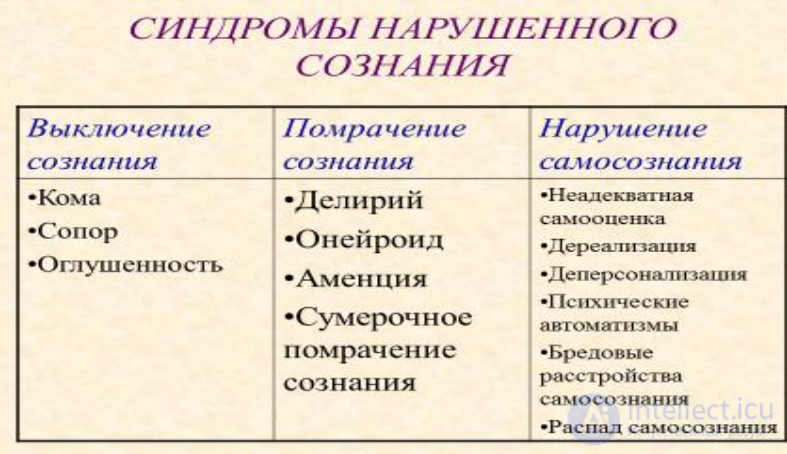
Syndromes of disturbed consciousness
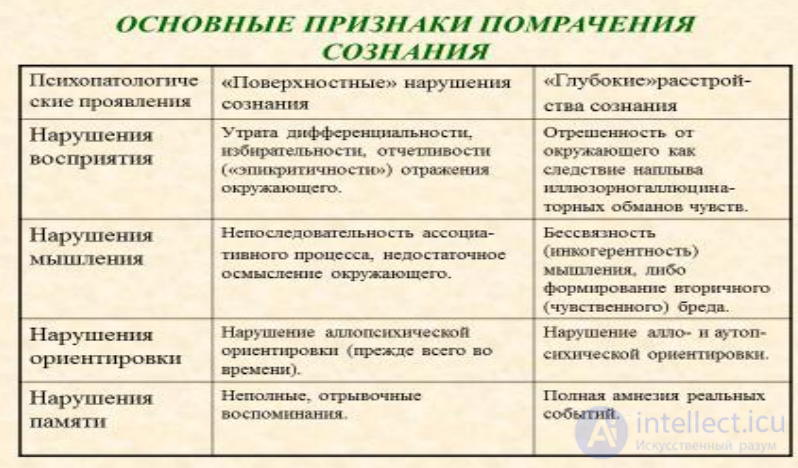
Signs of clouding of consciousness
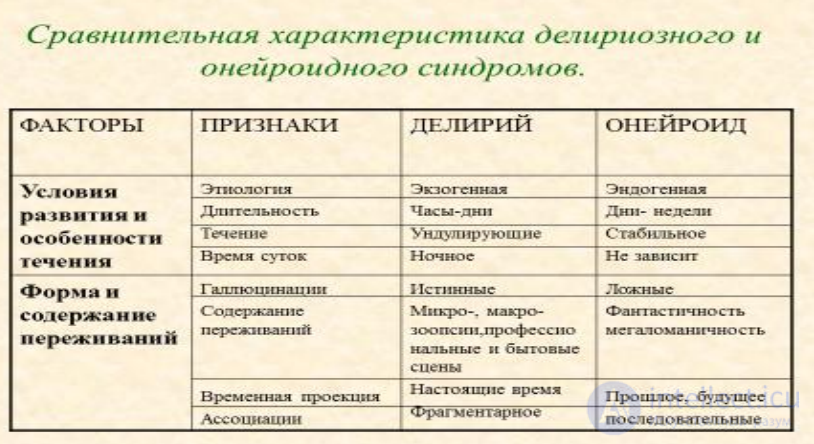
Comparison of delirious and oneiroid syndrome
Treatment of syndromes of disturbed consciousness depends on their cause. In some cases, such as medical emergencies or epileptic seizures, immediate medical attention is required. For psychiatric problems, psychotherapy and/or medication may be recommended. It is important to seek help from qualified specialists to determine the cause of the disturbance of consciousness and the best treatment plan.
Syndromes of motor-volitional disturbances are a group of mental states characterized by disturbances in a person's movement and volitional activity. These states may include various movement disorders and disturbances of volitional behavior.
Some typical syndromes of motor-volitional disturbances include:
Motor abulia: The person experiences difficulty initiating and sustaining movements, with weakness and difficulty appearing in performing everyday tasks.
Catalepsy: This condition is characterized by a temporary loss of muscle tone and the ability to maintain posture, which may persist unchanged for a prolonged period of time.
Motor agitation: The person experiences restlessness and an inability to sit still, constantly moving, fidgeting, and so on.
Stereotyped movements: People with this syndrome perform repetitive movements or gestures that may be inappropriate or meaningless.
Catatonic syndrome: Characterized by repetitive movements or slowed movement.
Uncoordinated movements: The person experiences difficulty coordinating movements and may display clumsiness and uncertainty.
Syndromes of motor-volitional disturbances may be caused by various factors, including neurological, mental, or physiological problems. For example, they may be associated with neurological diseases such as Parkinson's disease, schizophrenia, or other mental disorders.

Fig. catatonic syndromes
Treatment of motor-volitional disturbance syndromes depends on the specific diagnosis and cause of these conditions. It may include drug therapy, physiotherapy, psychotherapy, and other approaches depending on the problems identified. It is important to seek help from qualified specialists to determine the cause of the disturbances and to determine the best treatment plan.
Syndromes of intellectual-mnestic disorders belong to a group of mental states characterized by disturbances in the area of intellectual functions and memory. These states may include various cognitive disorders that affect a person's ability to think, learn, and remember information.
Some typical syndromes of intellectual-mnestic disorders include:
Dementia: A condition characterized by a progressive loss of cognitive functions, such as memory, attention, thinking, and orientation in space and time. The main forms of dementia are Alzheimer's disease, vascular dementia, and dementia with Lewy bodies.
Amnesia: A condition in which a person experiences a memory impairment, which may be related to head trauma, epilepsy, alcohol intoxication, or other causes.
Cognitive dysfunctions in mental illness: Some mental illnesses, such as schizophrenia, may be accompanied by cognitive dysfunctions that affect the ability to think and learn.
Mild cognitive impairment (MCI): A condition that lies between normal aging and dementia. People with MCI have some cognitive impairments, but they are not severe enough to be diagnosed as dementia.
Syndromes of intellectual-mnestic disorders may be caused by various factors, such as neurological diseases, head trauma, mental illnesses, and other problems. They can have serious consequences for a person's quality of life and ability to function in daily life.
Treatment of intellectual-mnestic disorder syndromes depends on the specific diagnosis and cause of these conditions. It may include drug therapy, psychotherapy, rehabilitation, cognitive training, and other approaches depending on the problems identified. It is important to seek help from qualified specialists to determine the cause of the disorders and to determine the best treatment plan.

Psychoorganic syndrome
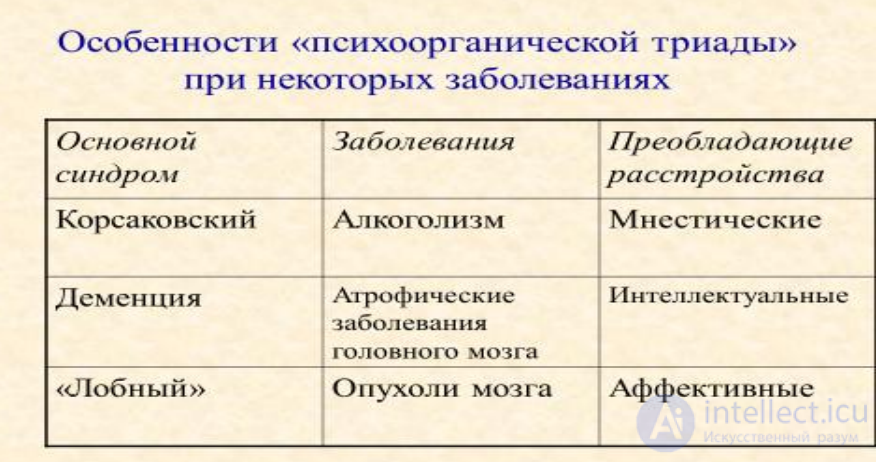
Psychoorganic triad

Korsakoff syndrome

Dementia syndrome

Comments