
Lecture
Human mnestic activity is a special ability of the brain to process, store, and reproduce information.
The phenomenology of mnestic disorders concerns the description and classification of symptoms manifesting in the area of memory. Mnestic disorders are characterized by problems with memorizing, storing, and reproducing information. The etiopathogenesis (etymology and pathogenesis) of mnestic disorders concerns the study of the causes and mechanisms underlying the development of these disorders.
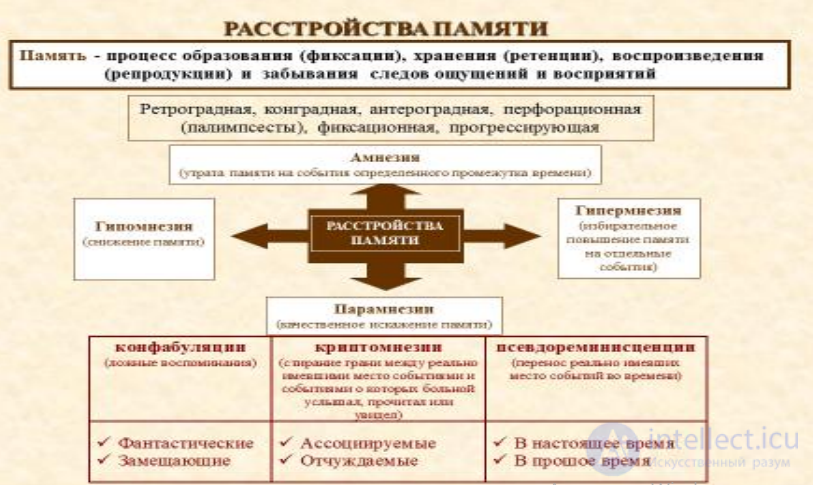
Phenomenology of mnestic disorders:
Amnesia: This is loss of memory or difficulty in memorizing and recalling past events, facts, or personal information. Amnesia is a partial or complete loss of memory. It can be retrograde (for events before the injury), anterograde (for events after it), or total.
Retrograde amnesia is the loss of memory for events that occurred before the moment of injury or the onset of illness. The person cannot recall the past, although they may still be able to memorize new events.
Anterograde amnesia is the inability to memorize new events after the onset of illness or injury. The past is preserved, but the formation of new memories is impaired.
Déjà vu: The person experiences a sensation that the current situation or event has already happened before, although in reality it is occurring for the first time.
Jamais vu: The opposite of déjà vu, this is a sensation of unfamiliarity with events or places that are already occurring or that are, in fact, familiar.
Cryptomnesia (as a false memory): This is a false memory in which a person mistakenly believes that recently reproduced information is new.
Recollection difficulty: This occurs when a person cannot recall specific information but remembers that they possess it.
Hypermnesia is a pathological strengthening of memory: excessive detail in memories, and sometimes intrusive resurfacing of information. It may be observed in manic states, intoxications, and schizophrenia.
Pseudo-reminiscences are false memories that fill gaps in memory. The person recounts events that actually took place, but at a different time or in a different context.
Confabulations are fabricated memories that are nonetheless sincerely perceived as real. The person is not aware that they are speaking falsely and fills the gaps in memory with fantasies. These are often observed in organic brain lesions, for example, in Korsakoff's syndrome.
Cryptomnesias are forgotten memories that are perceived as new ideas. For example, a person may believe they invented a melody, when in fact they had heard it before. This is a disturbance in the source attribution of a memory.
Hyperthymesia, or highly superior autobiographical memory syndrome, is a person's ability to remember and reproduce an extremely large amount of information about their own life — an exceptional autobiographical memory. The status of this term in medical terminology is currently unclear: in various sources it is used interchangeably with the concept of "hypermnesia." The probable causes that may give rise to hyperthymesia are conventionally divided into two groups: psychological and biological. Hypotheses of the first kind were put forward by the researchers themselves; they suggested that the mechanism of this memory disorder is semantic in nature. Other specialists, however, drew attention to a number of characteristic findings obtained through magnetic resonance imaging of patient AJ; in particular, it was noted that the temporal lobe and caudate nucleus were enlarged. The resulting picture turned out to be similar to that usually observed in patients with obsessive-compulsive disorder; taking this fact into account, a number of scientists propose considering hyperthymesia a specific variant of OCD. A corresponding case was depicted in one of the episodes of the medical television series "House, M.D.," where the patient's exceptional memory was explained by a pathological preoccupation with her own life. In addition, the emergence of hyperthymesia is sometimes hypothetically linked to an impairment in the brain's ability to forget information.
Etiopathogenesis of mnestic disorders:
Mnestic disorders can be caused by various factors:
Physiological causes: Memory impairments may be caused by physiological problems such as traumatic brain injuries, strokes, tumors, or degenerative brain diseases such as Alzheimer's disease.
Psychological causes: Some mnestic disorders may be associated with mental illnesses such as depression, anxiety disorders, or dissociative disorders.
Medications and substances: Certain medications, narcotic substances, or alcohol can affect memory function.
Aging: With age, some people may experience certain normal age-related changes in memory.
Treatment of memory disorders depends on their cause and may include psychotherapy, rehabilitation measures, medication, and training in compensatory strategies to improve memory. It is important to seek medical care for proper diagnosis and to determine the best treatment plan.
The phenomenology and etiopathogenesis of attention disorders relate to the description and classification of symptoms manifesting in the domain of attention, as well as to the study of the causes and mechanisms underlying the development of these disorders.
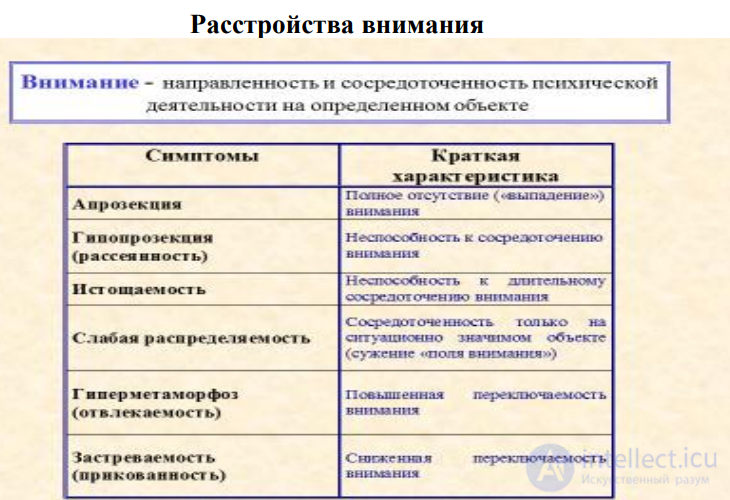
Phenomenology of attention disorders:
Attention deficit: The person has difficulty concentrating on a task or activity. Attention may become scattered, and the person finds it hard to stay focused on a single task.
Impulsivity: A lack of control over impulses can lead to uncontrolled behavior and reactions.
Hyperactivity: An elevated level of activity, especially in children, which may be associated with an inability to sit still and concentrate.
Errors due to inattention: The person may make unintentional errors due to insufficient attention to details and rules.
Etiopathogenesis of attention disorders:
The exact causes of attention disorders are not always known, but it is thought that they may be caused by a combination of genetic, environmental, and neurological factors:
Genetics: Attention disorders, such as attention deficit hyperactivity disorder (ADHD), have a strong genetic predisposition, and family history often plays an important role in the development of these disorders.
Neurological factors: Attention disturbances may be related to uneven functioning of neurotransmitters (for example, dopamine and norepinephrine) and brain structures responsible for regulating attention.
Environmental factors: Exposure to toxic substances (for example, alcohol, nicotine) and other environmental factors (for example, early trauma, stress) can affect the development of attention disorders.
Development and upbringing: Some attention disorders may be related to developmental and upbringing factors, such as insufficient stimulation or inappropriate parenting methods.
Distractibility — the inability to maintain attention on the current task; frequent switching to extraneous thoughts or stimuli, even without an external cause.
Increased distractibility — a tendency to quickly shift attention to external stimuli, even minor ones; often observed in attention deficit syndrome.
Inertia — slowness of mental processes, difficulty switching attention or transitioning from one activity to another; may result from organic brain lesions.
Pathological concentration — excessive fixation of attention on a single object or action, with an inability to switch; may occur in epilepsy, autism, and obsessive disorders.
Aprosexia — complete loss of the ability for voluntary attention; the person cannot concentrate even with effort, often in cases of severe organic brain lesions.
Treatment of attention disorders usually involves a comprehensive approach and may include psychotherapy, behavioral therapy, educational approaches, lifestyle changes, and, in some cases, medication. It is important to seek help from qualified specialists for proper diagnosis and the prescription of optimal treatment.
The phenomenology and etiopathogenesis of volitional disorders relate to the description and classification of symptoms manifesting in the domain of volition (will), as well as to the study of the causes and mechanisms underlying the development of these disorders. Volitional disorders are associated with impairments in the ability to control one's thoughts, emotions, and behavior, as well as with difficulties in setting and achieving goals.
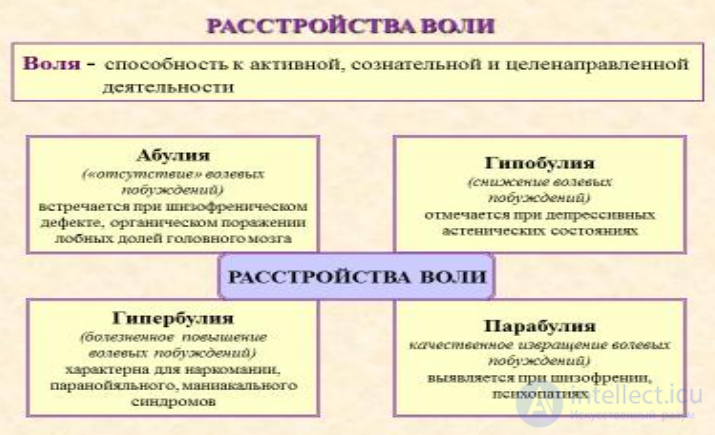
Phenomenology of volitional disorders:
Reduced capacity for self-control: The person may have difficulty managing their behavior and emotions.
Loss of motivation: The person may experience a loss of interest and motivation to achieve goals or complete tasks.
Procrastination: The person may struggle with constantly putting off tasks or refusing to carry them out.
Impulsivity: A lack of control over impulses can lead to abrupt reactions and behavior without reflection.
Etiopathogenesis of volitional disorders:
The exact causes of volitional disorders can be complex and multifaceted, and often include a combination of factors:
Neurological factors: Some volitional disorders may be associated with changes in the structure and functioning of the brain, including diseases or damage to the brain.
Psychological causes: A number of mental illnesses, such as depression, anxiety disorders, or personality problems, may be accompanied by volitional disorders.
Genetic factors: Some studies show a link between genetic factors and the development of volitional disorders.
Sociocultural factors: The environment, upbringing, support, and behavioral models can influence the development of volitional disorders.
Personality characteristics: Certain personality traits may predispose a person to develop volitional disorders, such as low self-esteem or heightened anxiety.
Hypobulia — a decrease in volitional activity: the person loses initiative, becomes passive, and is unable to make decisions.
Hyperbulia — excessive volitional activity, impulsivity, and a tendency toward action without sufficient motivation or justification.
Abulia — a complete absence of will, an inability to act independently or make decisions; often found in schizophrenia, depression, and organic brain lesions.
Parabulia — distortions of volitional activity: actions become illogical, contradictory, and inappropriate to the situation; may occur in psychoses.
Treatment of volitional disorders usually involves a comprehensive approach and may include psychotherapy, cognitive behavioral therapy, time-management training, and strategies for improving motivation. It is important to seek help from qualified specialists for proper diagnosis and to determine the best treatment plan.
The phenomenology and etiopathogenesis of affective disorders relate to the description and classification of symptoms manifesting in the emotional sphere, as well as to the study of the causes and mechanisms underlying the development of these disorders. Affective disorders encompass a wide range of mental illnesses associated with changes in mood, emotional reactivity, and feelings.
Phenomenology of affective disorders:
Depressive state: The person experiences a persistent and prolonged depressive mood, accompanied by loss of interest, disturbed sleep and appetite, and feelings of helplessness and despair.
Manic state: The person experiences a period of elevated mood, energy, and activity, along with an inflated sense of self-importance.
Bipolar affective disorder (manic-depressive): Characterized by alternating episodes of depression and mania.
Single episodes of depression or mania: Episodes occur only once in a lifetime or during a specific period.
Anhedonia: Loss of interest and pleasure in previously enjoyable things and activities.
Etiopathogenesis of affective disorders:
The precise causes of affective disorders can be complex and involve many factors:
Genetic factors: Genetic predisposition may play an important role in the development of affective disorders.
Neurochemistry: Changes in the levels of neurotransmitters (for example, serotonin, dopamine, norepinephrine) in the brain can affect mood and emotions.
Psychosocial factors: Stress, trauma, loss, low support from others, and other psychosocial factors can contribute to the development of affective disorders.
Environmental factors: Exposure to environmental influences, including climatic conditions, can contribute to the development of seasonal affective disorders.
Treatment of affective disorders usually involves a comprehensive approach and may include psychotherapy, medication (for example, antidepressants, mood stabilizers), and supportive measures. Seeking help from qualified specialists early on will help establish the correct diagnosis and determine the best treatment plan for each patient.
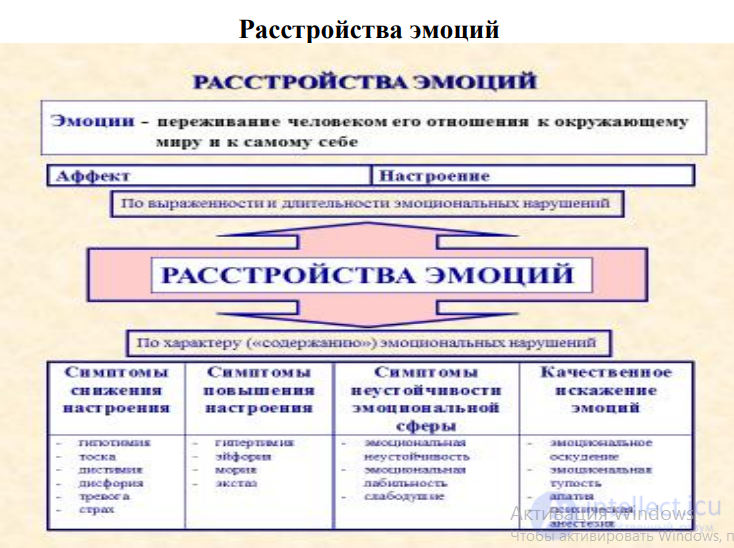
Hypothymia — pathologically decreased mood, accompanied by dejection, apathy, and slowed thinking and motor activity. Often observed in depression.
Hyperthymia — persistently elevated mood, accompanied by optimism, activity, talkativeness, and sometimes reduced critical judgment. May be a personality trait or a manifestation of manic syndrome.
Dysphoria — a hostile, gloomy, irritable mood with inner tension and aggressive readiness. Often found in epilepsy and organic brain lesions.
Euphoria — an excessively joyful, carefree mood that does not correspond to the actual situation. May be a symptom of intoxication, organic brain lesions, or manic states.
Moria — pathologically elevated mood with silliness, flat humor, and reduced critical judgment and social appropriateness. Often observed in frontal lobe pathology.

Comments