
Lecture
Key concepts and terms: acceleration, slowing of thinking, tempo, coherence, purposefulness of thinking, reasoning tendency, mentism, perseveration, delusional ideas, overvalued ideas, obsessive ideas, diagnostic methods.
Questions for consideration:
Disorders of the dynamic aspect of thinking belong to a group of mental disturbances that affect the quality and character of a person's thought processes. The dynamic aspect of thinking is connected with the processes of motivation, emotional coloring, and the directedness of mental acts.
Some disorders of the dynamic aspect of thinking include:
Apathy: This is a state of reduced interest and emotional response to the surrounding world. A person with apathy may experience difficulties with motivation and showing initiative.
Anhedonia: This is a disorder in which a person loses the joy and pleasure previously derived from activities and interests.
Depersonalization of thinking: A person with this disorder loses connection with their own thoughts, as though they belong to someone else, and loses their sense of self.
Catathymic thinking: This disorder involves thought shifting from one topic to another without a clear logical connection, or inconsistency of mental acts.
Contagion of thinking: This is a phenomenon in which one idea or emotional state "infects" other thoughts and moods, leading to the mass spread of emotional reactions.
Optimistic or pessimistic thinking: Disturbances may manifest as a shift in thinking toward an overly optimistic or, conversely, pessimistic perception of reality.
Disorders of the dynamic aspect of thinking may be associated with various mental illnesses, such as depression, schizophrenia, bipolar disorder, and others. They can have a significant impact on a person's emotional state, behavior, and quality of life.
Treatment of such disorders usually includes psychotherapy, medication, and supportive measures aimed at alleviating symptoms and improving the patient's functioning. It is important to seek help from qualified specialists in psychiatry and psychology for proper diagnosis and prescription of optimal treatment.
Disorders of the logical-grammatical aspect of thinking are mental disorders associated with impaired ability to understand and use the grammatical rules and logical structure of language. This can affect a person's ability to formulate their thoughts, express them clearly, and understand messages coming from others.
Some disorders of the logical-grammatical aspect of thinking include:
Dysphasia: This is a developmental speech disorder in children associated with difficulties in understanding and using the grammatical rules of language. Children with dysphasia may experience difficulties forming sentences and conveying their thoughts in words.
Aphasia: This is a speech disorder that usually occurs after brain damage, for example after a stroke. People with aphasia may have difficulty understanding and expressing speech, a limited vocabulary, and difficulties with grammar.
Syntactic disorders: These are disturbances associated with incorrect sentence construction and the use of the grammatical structures of language.
Logical errors in speech: Some people with mental disorders or neurological problems may make logical errors in speech, such as inconsistency in arguments or difficulty following a logical sequence of thoughts.
Language shifts: Some mental illnesses can lead to unusual or incomprehensible language shifts that make it difficult to perceive the meaning of speech.
Treatment of disorders of the logical-grammatical aspect of thinking may include speech therapy, psychological support, training in communication strategies, and medication (in the presence of accompanying mental illnesses). Early detection and support of such disorders are especially important for successful correction and improvement of patients' communication skills

Classification of delusional ideas
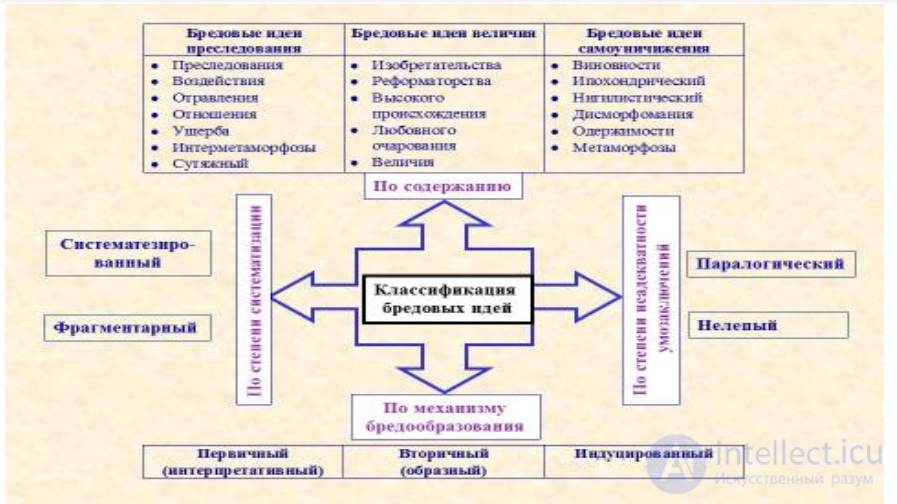
Disorders of the content aspect of thinking belong to a group of mental disturbances associated with the content of a person's thoughts. These disorders can affect what and how a person thinks, and can lead to unusual, incorrect, or disorganized thought processes. Disorders of the content aspect of thinking may be characteristic of various mental illnesses. Some of them include:
Obsessive-compulsive disorder (OCD): People with OCD experience intrusive and distressing thoughts (obsessions) and often repeat certain actions or rituals (compulsions) to relieve anxiety. The thoughts may be implausible, but they feel real to the person and cause suffering.
Delirium: This is a state in which a person experiences vague, confused, and disorganized thoughts, which may be caused by physical problems, infections, toxic conditions, or other mental disorders.
Paranoid personality disorder: People with this disorder have a deep-seated suspiciousness and unfounded distrust of others, which can lead to irrational thoughts and experiences.
Schizophrenia: This is a severe mental illness characterized by disturbances in thinking, including disorganized thinking, hallucinations, and delusional beliefs.
Depression: People with depression may experience negative, hopeless, and gloomy thoughts about themselves, others, and the future.
Manic-depressive disorder (bipolar disorder): In this disorder, shifting between depressive and manic episodes can lead to changes in the content of thinking.
Treatment of thought content disorders depends on the underlying mental illness. It may include psychotherapy, medication, supportive measures, and other approaches aimed at reducing symptoms and improving the patient's functioning. It is very important to seek help from qualified psychiatric and psychological specialists for an accurate diagnosis and to determine the best treatment plan.

Comments