
Lecture
The psychopathology of sensory-perceptual processes is a field of psychiatry and psychology that studies disturbances in the perception, processing, and interpretation of sensory information in humans. Sensory-perceptual processes are complex mechanisms that allow us to perceive the outside world through our sense organs (vision, hearing, smell, touch, and taste).
Disturbances in sensory-perceptual processes can be related to various factors, such as:
Neurological problems: Some psychopathologies may be caused by neurological disturbances in brain structures or in the transmission of nerve impulses. This may include, for example, migraine, neuropathies, or traumatic brain injuries.
Mental disorders: Some mental illnesses can affect sensory and perceptual processes. For example, schizophrenia may be accompanied by hallucinations, which represent the perception of sensory stimuli that are not actually present.
Psychoactive substances: Some narcotic substances or medications can cause changes in sensory-perceptual processes, which can lead to hallucinations or distorted perception of the surrounding world.
Development and childhood pathology: Some sensory-perceptual disorders may be caused by developmental factors or childhood conditions, such as autism or attention deficit hyperactivity disorder (ADHD).
Psychosocial factors: Stress, anxiety, and other psychosocial factors can also affect sensory-perceptual processes and lead to perceptual disturbances.
Some of the common symptoms of sensory-perceptual psychopathology include hallucinations, distortions in the perception of reality, agnosia (inability to recognize objects or faces), anosognosia (inability to be aware of one's own pathology), and perceptual distortions.
Treatment depends on the underlying disorder and may include psychotherapy, medication, and other approaches aimed at coping with sensory-perceptual problems and improving patients' quality of life. It is important to seek help from qualified specialists in psychiatry and psychology for accurate diagnosis and determination of optimal treatment.

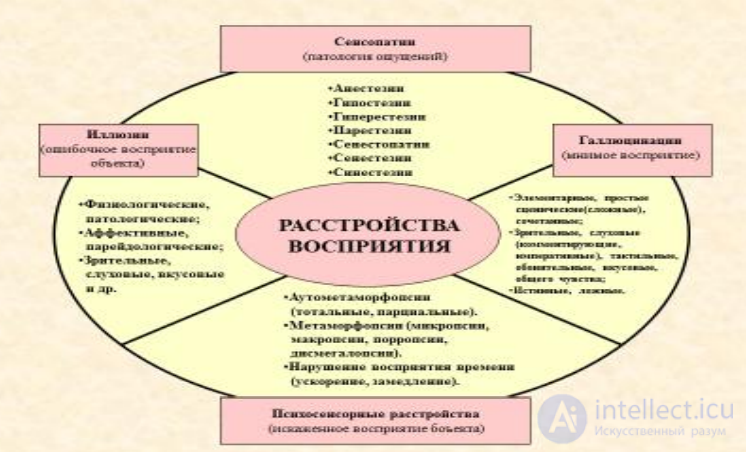
Perceptual disorders are pathological changes in a person's ability to perceive and interpret information received through the sense organs. These disorders can be related to various factors, including neurological, mental, and physical problems. Some of the most common perceptual disorders include:
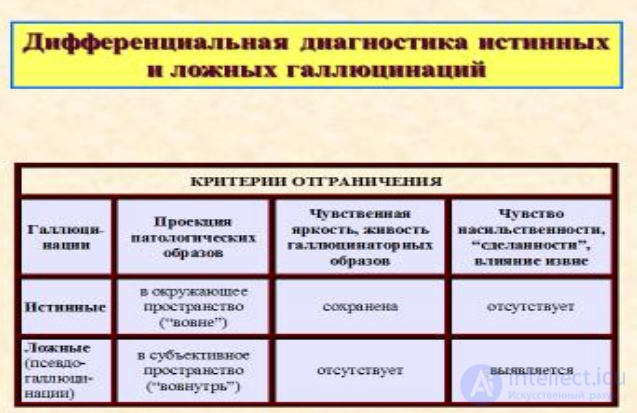
Hallucinations: These are sensory perceptions that occur in the absence of a real stimulus. A person may hear, see, feel, taste, or smell things that do not actually exist. Hallucinations are often associated with mental illnesses such as schizophrenia or with narcotic substances.
Perceptual distortions: People with this disorder may perceive real stimuli but distort their meaning. For example, they may feel that the surrounding world is unreal or unnatural (depersonalization/derealization).
Agnosia: This is a disorder of recognizing objects or faces, in which a person cannot recognize familiar objects even though their sensory perception remains normal. Agnosia may be related to neurological problems or mental illnesses.
Anosognosia: This is the inability to acknowledge or become aware of one's own illness or pathology. A person with anosognosia may deny the presence of any ailments or disturbances, even when they are clearly present.
Synesthesia: This is an unusual phenomenon in which one of the sense organs triggers associations or perceptions related to other sense organs. For example, a person may see colors while hearing music, or perceive taste based on visual or auditory stimuli.
Agnosia: This is a disorder of the ability to recognize and identify familiar objects or people, even when the senses themselves remain intact.
Perceptual disorders can have significant consequences for a person's psychological and social functioning. Diagnosing and treating these disorders requires a professional medical approach, usually involving psychiatrists, neurologists, and psychologists. It is important to identify the source of the problem and develop an individualized treatment plan for each person suffering from a perceptual disorder.

Comments