
Lecture
Attention Deficit Hyperactivity Disorder (ADHD), also known as attention deficit disorder with hyperactivity, or hyperactive disorder with attention deficit (attention deficit hyperactivity disorder, ADHD), is a behavioral and psychological developmental disorder that begins in childhood. It manifests through symptoms such as difficulty concentrating, hyperactivity, and poorly controlled impulsivity.
In ICD-10, ADHD was classified among hyperkinetic disorders — a group of emotional and behavioral disorders that usually begin in childhood — while in ICD-11 it is classified among neurodevelopmental disorders. From a neurological standpoint, ADHD is regarded as a persistent, chronic syndrome for which no cure has been found. It is believed that some children — about 30% — either "outgrow" this syndrome or adapt to it in adult life[.
DSM-5 identifies 3 main types of the disorder and 2 additional ones ("other specified" and "unspecified"):
In ICD-11 (2018), attention deficit hyperactivity disorder appeared as a separate diagnosis (code 6A05). The following subtypes of the disorder are distinguished:
According to data for the population of the United States, this disorder is present in approximately 12.1% of boys and 5.5% of girls. ADHD is diagnosed more often in boys. The relative prevalence among boys and girls ranges from 3:1 to 9:1, depending on diagnostic criteria, research methods, and study groups (children referred to a doctor; schoolchildren; the general population). Estimates of ADHD prevalence also depend on these same factors (from 1–2% to 25–30%).
Currently, the basis for establishing a diagnosis is a phenomenological psychological characterization. Many signs of ADHD appear only from time to time.
According to the criteria in effect (as of early 2007), ADHD can be diagnosed starting from late preschool or school age, since meeting the requirements for a diagnosis requires assessing the child's behavior in at least two different settings (for example, at home and at school). The presence of learning and social functioning impairments is a necessary criterion for establishing an ADHD diagnosis.
One of the main signs of ADHD, along with attention impairments, is impulsivity — a lack of behavioral control in response to specific demands. Clinically, these children often react to tasks too quickly, without waiting for instructions on how to complete them, and also assess task requirements inadequately. As a result, they are very careless, inattentive, reckless, and thoughtless. Such children are often unable to predict the potentially negative, harmful, or destructive (and even dangerous) consequences that may be associated with certain situations or their own actions. They often expose themselves to unjustified, unnecessary risk to display their courage, whims, and quirks, especially in front of peers. As a result, accidents involving poisoning and injury are not uncommon. Children with ADHD carelessly and recklessly damage or destroy other people's property significantly more often than children without signs of ADHD.
One of the difficulties in diagnosing ADHD is that it is often accompanied by other problems. A small group of people with ADHD also suffer from Tourette syndrome, which causes combined vocal and multiple motor tics .
According to DSM-5 (2013), a diagnosis of attention deficit hyperactivity disorder cannot be established before age 12 (according to the 1994 DSM-IV edition, from age 6). Symptoms must be observed in different situations and settings. To establish a diagnosis, 6 symptoms are required (from the "inattention" and/or "hyperactivity and impulsivity" group), and from age 17 onward, 5 symptoms. Symptoms must be present for at least six months, and patients must not lag behind the developmental level of most adolescents their age. To establish a diagnosis, symptoms must also have been present before age 12, and they cannot be explained by other mental disorders.
Inattention
- Often fails to give close attention to details or makes careless mistakes in schoolwork, at work, or during other activities (e.g., overlooks or misses details, work is inaccurate).
- Often has difficulty sustaining attention in tasks or play activities (e.g., has difficulty remaining focused during lectures, conversations, or lengthy reading).
- Often does not seem to listen when spoken to directly (e.g., mind seems elsewhere, even in the absence of any obvious distraction).
- Often does not follow through on instructions and fails to finish schoolwork, chores, or duties in the workplace (e.g., starts tasks but quickly loses focus and is easily sidetracked).
- Often has difficulty organizing tasks and activities (e.g., has difficulty managing sequential tasks; has difficulty keeping materials and belongings in order; work is messy and disorganized; has poor time management; fails to meet deadlines).
- Often avoids, dislikes, or is reluctant to engage in tasks that require sustained mental effort (e.g., schoolwork or homework; for older adolescents and adults, preparing reports, completing forms, reviewing lengthy papers).
- Often loses things necessary for tasks or activities at school and at home (e.g., school materials, pencils, books, tools, wallets, keys, documents, glasses, mobile telephones, umbrellas, gloves, rings or bracelets taken off temporarily).
- Is often easily distracted by extraneous stimuli (for older adolescents and adults, this may include unrelated thoughts).
- Is often forgetful in daily activities (e.g., doing chores and running errands; older adolescents and adults may forget to return calls, pay bills, keep appointments).
Hyperactivity and Impulsivity
- Often fidgets with or taps hands or feet, or squirms in seat.
- Often leaves seat in situations when remaining seated is expected (in the classroom, in the office or other workplace, or in other situations that require staying in place).
- Often runs about or climbs in situations where it is inappropriate. (Note. In adolescents or adults, this may be limited to feeling restless.)
- Often unable to play or engage in leisure activities quietly.
- Is often «on the go,» acting as if «driven by a motor» (e.g., is unable to or uncomfortable being still for extended time, as in restaurants, meetings; may be experienced by others as restless or difficult to keep up with).
- Often talks excessively.
- Often blurts out an answer before a question has been completed (e.g., completes people's sentences, cannot wait for their turn in conversation).
- Often has difficulty waiting their turn (e.g., while waiting in line).
- Often interrupts or intrudes on others (e.g., butts into conversations, games, or activities; may start using other people's things without asking or receiving permission; adolescents and adults may intrude into or take over what others are doing).
One of the methods for diagnosing ADHD symptoms according to the DSM-5 classification is the MOXO continuous performance test
MOXO is a computerized test for diagnosing ADHD symptoms in children, adolescents, and adults. The test comes in two versions, designed for a children's audience (ages 6—12) and an adult audience (ages 13—70)
The test is a program consisting of eight levels. While taking the test, target and non-target stimuli appear on the screen, to which the subject must respond accordingly by pressing the space bar, or, conversely, by taking no action.
A distinctive feature of the test is that, over the course of taking it, stimuli identical to real-life stimuli appear on the screen through visual animations and sound effects. The use of such stimuli makes it possible to achieve a high accuracy of ADHD symptom diagnosis (90%) .
The results of the test are numerical values of ADHD symptoms, as well as activity graphs of the subject at each of the 8 testing stages. The activity graphs allow a specialist to decipher the influence of auditory, visual, and combined stimuli on the subject's overall attention profile and on each of the four DSM-5 ADHD criteria: attentiveness, consistency of actions, impulsivity, and hyperactivity .
| Presentations | DSM-5 and DSM-5-TR Symptoms | ICD-11 Symptoms |
|---|---|---|
| Inattention | Six or more of the following symptoms in children and five or more in adults, unless these symptoms are better explained by another psychiatric or medical condition:
|
Multiple symptoms of inattention that directly and negatively affect occupational, academic, or social functioning. Symptoms may be absent when performing highly stimulating tasks with frequent rewards. Symptoms generally fall into the following clusters:
The person may also show signs of hyperactivity-impulsivity, but symptoms of inattention predominate. |
| Hyperactivity-Impulsivity | Six or more of the following symptoms in children and five or more in adults, unless these symptoms are better explained by another psychiatric or medical condition:
|
Multiple symptoms of hyperactivity/impulsivity that directly and negatively affect occupational, academic, or social functioning. They are typically most evident in settings that have structure or that require self-control. Symptoms generally fall into the following clusters:
The person may also show signs of inattention, but symptoms of hyperactivity and impulsivity predominate. |
| Combined | Meets the criteria for both inattentive and hyperactive-impulsive ADHD. | Criteria are met for both inattentive and hyperactive-impulsive ADHD, with neither type clearly predominant. |
Girls and women with ADHD tend to show fewer symptoms of hyperactivity and impulsivity, but more symptoms of inattention and distractibility.
In the International Classification of Diseases, 10th Revision (ICD-10), attention deficit hyperactivity disorder falls under the diagnostic category «disturbance of activity and attention» (F90.0).
To establish a diagnosis of attention deficit hyperactivity disorder, the general criteria for hyperkinetic disorder (F90) must be met, but not the criteria for conduct disorder (F91).
In summary, some symptoms from the following groups must be present (general criteria for «hyperkinetic disorders» — F90): inattention (inability to attend closely to details, sustain attention on tasks or in play, inability to follow instructions or complete schoolwork, frequent distraction by external stimuli, etc.), hyperactivity (restless movements of body parts, fidgeting in one's seat, inability to remain seated, running or climbing in inappropriate situations, excessive noisiness in play, etc.) and impulsivity (answering before questions have been completed, inability to wait in line, excessive talkativeness without adequate regard for social restrictions, frequently interrupting others and intruding on conversations or games) .
The onset of the disorder must occur before age 7, its duration must be at least 6 months, and the patient's intelligence quotient (IQ) must be above 50 .
Many adults in whom ADHD was not identified in childhood do not realize that this is precisely the cause of their inability to sustain attention, their difficulties in learning new material, in organizing the space around them, and in interpersonal relationships.
A 2006 American study (the so-called Harvard study), which included just over three thousand people, allowed its authors to estimate the expected prevalence of ADHD at 4.4% in the adult population (diagnosed according to DSM-IV criteria). A higher prevalence of ADHD was found if the subject was male, of European ethnicity, unemployed, and previously married ][17]. In a somewhat earlier study (also in the USA, 966 adults surveyed), the prevalence of ADHD among adults was established at 2.9% for ADHD in the narrow sense (Narrow ADHD, diagnosed according to DSM-IV criteria) and 16.4% for ADHD in the broad sense (the diagnosis was made taking into account a number of additional, subthreshold criteria) The prevalence of ADHD in adults decreases with age .
The prevalence of ADHD in adults depends significantly on the presence of co-occurring psychological problems and disorders: according to a 2007 Mexican study, ADHD was established in 5.37% of subjects from the general population (149 people examined) and in 16.8% of outpatients of psychiatrists with non-psychotic psychiatric conditions (161 people examined). Among psychiatric patients, the sex differences in ADHD prevalence turned out to be «reversed» relative to ADHD in the general population and among children: ADHD was established in 21.6% of female patients and only 8.5% of male patients .
American psychiatrist Allen Frances, who led the creation of the DSM-IV classification of mental disorders, has spoken extremely negatively about the diagnosis of ADHD in adults. In his view, the boundaries of the diagnosis are so blurred that it can be inappropriately applied to a great many ordinary people who are dissatisfied with their ability to concentrate on tedious and uninteresting work. The situation is made worse by the fact that diagnosis is based on a person's subjective opinion of their own ability to concentrate and complete tasks. In addition, Allen Frances expressed concern that people who complain of ADHD symptoms sometimes actually have bipolar affective disorder or depression. In such cases, prescribing the psychostimulants typically used in ADHD therapy may only worsen the condition
British psychiatrist Joanna Moncrieff argues that the usual criteria for illness and disorder are not suited to defining ADHD in adults, since the condition itself is indistinguishable from the psychological norm. Moncrieff believes that behind the rise in ADHD diagnoses among adults lie the financial interests of pharmaceutical companies promoting their drugs. The effect of psychostimulants is usually experienced by people as pleasant, and for this reason some are inclined to claim that they have ADHD in order to gain access to these drugs .
Approaches to the treatment and correction of ADHD, and the methods available, may differ from country to country. In many countries the first line of treatment is educating parents in proper child-rearing techniques. Methods of behavior modification, psychotherapy, and pedagogical and neuropsychological correction are used. Medication therapy is prescribed on an individual basis in cases where behavioral and cognitive impairments cannot be overcome by pedagogical methods.
In the United States, the WWK3 protocol is used for treating children, and the WWK10 protocol for treating adults. This includes the approved use of Ritalin (methylphenidate) in children — a controversial drug with a high addictive (narcogenic) potential .
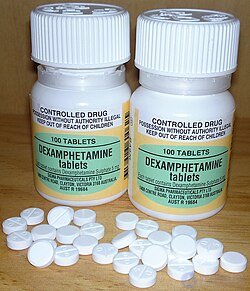
Dextroamphetamine in 5 mg tablets.
As an adjunctive method for correcting ADHD, psychostimulants such as methylphenidate, amphetamine, and dextroamphetamine are used primarily in the United States and Western Europe.
The mechanism of action of psychostimulants is well studied. It temporarily suppresses normal spontaneous behavioral responses in both experimental animals and children. In particular, methylphenidate inhibits a child's communication with peers, independence, and play skills, which allows behavior to be controlled at school and at home. This kind of behavioral control using methylphenidate limits the development of self-discipline .
One of the drawbacks of these stimulants is the need to take them several times a day (duration of action about 4 hours). Long-acting forms of methylphenidate and dextroamphetamine (lasting up to 12 hours) have now appeared. A long-acting form of methylphenidate (trade name — "Concerta") is widely used in treating ADHD[30]. The efficacy of dextroamphetamine, methamphetamine, and sustained-release methylphenidate for treating ADHD has not been fully proven[30]. Previously , the psychostimulant pemoline was used, but its use has become limited due to hepatotoxicity. Drugs from other groups are also used, for example atomoxetine (a norepinephrine reuptake inhibitor, from the adreno- and sympathomimetic group). Antidepressants are also effective: desipramine in low doses, bupropion . Several open-label studies and three double-blind studies have shown the efficacy of venlafaxine . Clonidine may be combined with psychostimulants, as it softens side effects (eliminates insomnia and impulsivity) and enhances the effect on hyperkinesis and hyperactivity .
As of April 2015, the U.S. Food and Drug Administration (FDA) had approved the following psychostimulants for treating ADHD: amphetamine (levamphetamine and dextroamphetamine), methylphenidate, dexmethylphenidate, methamphetamine, lisdexamfetamine, and atomoxetine (not classified as a psychostimulant)[34].
Double-blind randomized controlled trials have demonstrated the efficacy of modafinil for ADHD , but this drug is not approved by the FDA and is not used in American medical practice to treat ADHD due to dermatological toxicity (Stevens–Johnson syndrome occurred in patients during clinical trials)[37]. The European Medicines Agency has also recommended prescribing this drug exclusively for narcolepsy to treat drowsiness .
Special caution is required when prescribing psychostimulants to children, since a number of studies have shown that high doses (for example, methylphenidate exceeding 60 mg/day) or improper use can cause dependence and may prompt adolescents to use higher doses to achieve a narcotic effect . According to a study conducted in the United States among cocaine addicts, individuals with ADHD who used stimulants during adolescence were twice as likely to develop a cocaine addiction as those who were also diagnosed with ADHD but did not use stimulants[42].
A study published in 2003 noted that brain volume in children diagnosed with ADHD is smaller than in children without this diagnosis. It is unclear whether the reduction in brain volume is caused by the disorder itself or by the medications used to treat ADHD .
The benefit of psychostimulants for ADHD has been confirmed in more than 170 randomized controlled trials involving about 5,000 children. However, this applies only to short-term effects of treatment, for the duration of the drug's action. In 2010, a study was published in Australia reporting the absence of long-term beneficial effects from psychostimulant therapy for ADHD. The study covered 2,868 families who were followed for 20 years].
Usually, children's condition improves significantly while taking psychostimulants (more so in behavior; there is no long-term improvement in academic performance), and only a few show no improvement. Poor academic performance, distractibility, and manifestations of aggression partially disappear while taking psychostimulants and reappear when the drug is discontinued or replaced with a placebo.
There is evidence that the short-term improvement from taking ADHD medications is followed, with long-term treatment, by apparent lasting harm, and animal studies show that these drugs can cause damage to the brain.
The number of children in the United States who are prescribed psychostimulants has risen significantly since the 1990s. Between 1990 and 1993 alone, the number of outpatient psychiatric visits for ADHD rose from 1.6 to 4.2 million per year, and at a certain stage of treatment 90% of children received psychostimulants, with methylphenidate accounting for 71% of cases. By 1996, physicians in the United States had written more than 10 million prescriptions for methylphenidate]. It remains unclear whether the increase in psychostimulant prescriptions is due to overprescribing or to improved diagnosis of ADHD. In all likelihood, both factors are involved.
The United Nations Committee on the Rights of the Child issued recommendations stating the following:
«The Committee expresses concern at reports that attention deficit hyperactivity disorder (ADHD) and attention deficit disorder (ADD) are being misdiagnosed and, as a result, psychostimulants are being overprescribed, despite growing evidence of the harmful effects of these drugs.
The Committee recommends that further research be conducted into the diagnosis and treatment of ADHD and ADD, including the possible adverse effects of psychostimulants on the physical and psychological well-being of children, and that other forms of management and treatment be used to the greatest extent possible when addressing behavioral disorders».
— United Nations Committee on the Rights of the Child[50][non-authoritative source]
An approach widespread in the CIS is the use of nootropic drugs — substances that, in the opinion of some specialists, improve brain function, metabolism, and energy supply, and increase cortical tone. Preparations consisting of amino acids are also prescribed, which, according to manufacturers' claims, improve brain metabolism, although there is no evidence of the effectiveness of such treatment. According to one Russian study, in which results were assessed through parent questionnaires using the structured Conners questionnaire, overall improvement in the behavior of children with ADHD was achieved with the following nootropic agents: cerebrolysin (60% of children), piracetam (48%), phenibut (50%), instenon (59%)[23]. During therapy with the antipsychotic thioridazine (sonapax) at a dosage of 1 mg/kg (20—30 mg), positive dynamics were noted in 22% of children, compared with only 10% in the control group receiving multivitamin preparations[23].
Drugs used for treatment:
At present there are several non-pharmacological approaches to ADHD treatment methods, which can be combined with pharmacological correction or used independently of it:
To support children within the education system, applied developments based on behavioral methods are used, such as systems of intervention and support for desired behavior, which set a working framework for the functional assessment of students' difficult behavior and the restructuring of learning conditions to address these problems[51].
The above set of psychocorrective methods and medication treatment, given timely diagnosis, can reduce the severity of ADHD symptoms in children, compensate for disorders that have already arisen, and help the child fully realize their potential in life later on.
The exact cause of ADHD is unknown , but several theories exist. The causes of organic disorders may include:
Specialists at the Medical Genetics Research Center of the Russian Academy of Medical Sciences and the Faculty of Psychology of Moscow State University have established that «most researchers agree that a single cause of the disorder cannot be identified and, it seems, never will be». Scientists from the USA, the Netherlands, Colombia, and Germany have proposed that genetic factors account for 80% of ADHD occurrence. Of more than thirty candidate genes, three were selected — the dopamine transporter gene and two dopamine receptor genes. However, the genetic predispositions to ADHD development manifest through interaction with the environment, which can either strengthen or weaken these predispositions.
ADHD is one of the most questionable and controversial mental disorders. ADHD and its treatment have been questioned since at least the 1970s. The existence of this syndrome is doubted by many physicians, teachers, high-ranking politicians, parents, and the media. The range of opinions on ADHD is quite broad — from those who do not believe the disorder exists to those who believe there are genetic or physiological predispositions for this condition. Some researchers even insist on the influence of climatic factors in the development of ADHD in children.
Researchers from Canada's McMaster University identified five main points around which the debates develop:
Insufficient clarity about what can be classified as ADHD, and changes in diagnostic criteria, have led to confusion. Ethical and legal issues of treatment have been the main areas of disagreement — especially the use of psychostimulants in therapy, as well as the advertising of ADHD stimulants by groups and individuals who receive money from pharmaceutical companies.
Professional physicians and news agencies have argued that the diagnosis and treatment of this disorder deserve more thorough investigation.
British child psychiatrist Professor Sami Timimi, one of the leaders of the «Critical Psychiatry» community, considers ADHD to be a social construct that attempts to explain a child's normal behavior by the presence of an allegedly genetically determined mental illness
Alternative theories have been proposed to explain ADHD symptoms, including the hunter-farmer theory, neurodiversity, and the social construct theory of ADHD.
Some individuals and groups completely deny the existence of ADHD. These include Thomas Szasz, Michel Foucault, and groups such as the Citizens Commission on Human Rights . However, most medical institutions and U.S. courts consider ADHD diagnoses legitimate (see Ritalin class action lawsuits).

Comments