
Lecture
Panic attacks
The central place among anxiety-phobic disorders is occupied by panic disorder (episodic paroxysmal anxiety).
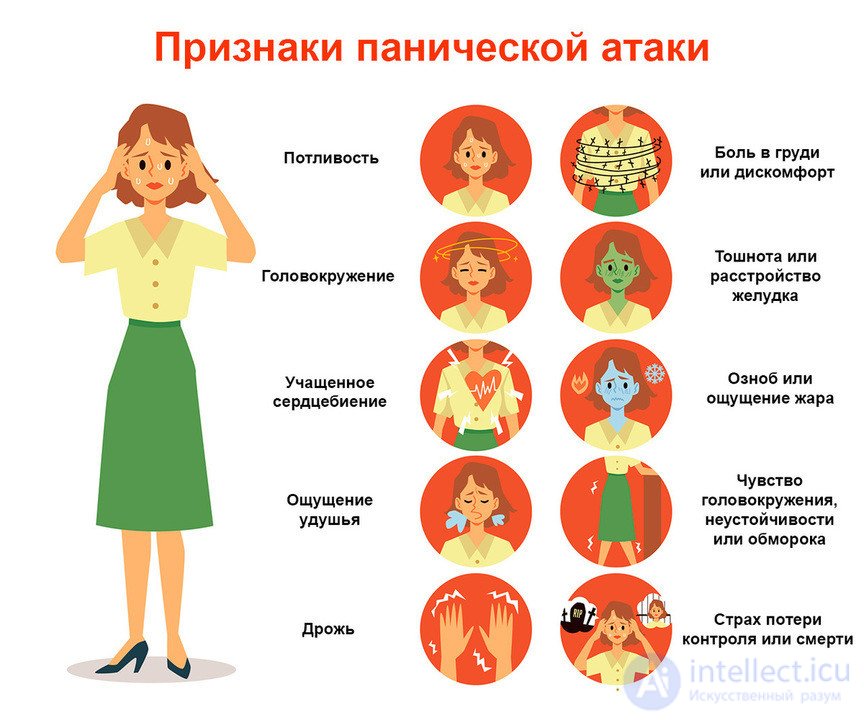
Panic disorder most often marks the onset of the illness. In this connection, three variants of the dynamics of anxiety-spectrum psychopathological disorders manifesting as panic attacks can be distinguished.
First variant (6.7% of all patients)
The clinical picture is represented solely by panic attacks. The panic attacks present as an isolated symptom complex with a harmonious combination of features of cognitive and somatic anxiety (hypertypical panic attacks), with minimal comorbid links, and are not accompanied by the formation of persistent mental disorders.
The clinical picture expands only through transient hypochondriacal phobias and agoraphobic phenomena of a secondary nature.
Once the acute period has passed and the panic attacks have subsided, the accompanying psychopathological disorders also undergo reverse development.
Second variant (33.3% of all patients)
The anxiety disorders include panic attacks and persistent agoraphobia.
In these cases panic attacks develop along the lines of an existential crisis; cognitive anxiety predominates, with a sense of a sudden, life-threatening bodily catastrophe developing amid apparent full health (with minimal expression of autonomic disturbances); agoraphobia is added rapidly.
Panic attacks occur suddenly, without any warning signs, and are characterized by vital fear, generalized anxiety, and the rapid formation (sometimes already after the first attack) of phobophobias and avoidant behavior.
As the panic attacks undergo reverse development, complete reduction of the psychopathological disorders does not occur.
Agoraphobic phenomena come to the fore in the clinical picture; agoraphobia not only fails to diminish but acquires a persistent character independent of the panic attacks.
Comorbidity: hypochondriacal phenomena predominate - a distinctive variant of overvalued hypochondria.
The dominant idea, to which the entire way of life is subordinated, is the elimination of the conditions that give rise to panic attacks.
Measures to prevent panic attacks, gradually becoming more elaborate, are transformed into a complex hypochondriacal system.
A set of protective and adaptive measures is developed, including a change of job (up to and including resignation), moving to an «ecologically clean» area, and so on.
The hypochondriacal attitudes that have formed (a sparing lifestyle, restriction of contacts, avoidance of certain forms of activity, including professional activity) sustain and aggravate such phobic manifestations as fear of travel by transport, fear of crowds, and fear of being in public places.
Agoraphobia not only fails to diminish but acquires a persistent character.
Third variant (60% of the total number of patients)
Disorders with panic attacks developing along the lines of an autonomic crisis (Da Costa syndrome) and culminating in hypochondriacal phobias.
Distinctive features: a prolonged prodromal stage — subclinical manifestations of anxiety combined with algias and conversion symptoms; psychogenic provocation of attacks (in 50% of cases the attacks are provoked); predominance of somatic anxiety with symptoms from the cardiovascular and respiratory systems predominating, without vital fear; the picture broadens through hypochondriacal phobias, with minimal expression of phobic avoidance and agoraphobia.
+Once the full-blown panic attacks have passed (the acute period), complete reduction of the anxiety-spectrum psychopathological disorders does not occur.
Hypochondriacal phobias come to the fore (cardiophobia, stroke phobia, thanatophobia), determining the clinical picture for months or even years.
The formation of such persistent fears is closely linked to hypochondriacal phenomena increasing from the moment the panic attacks manifest — heightened introspection and constant hypochondriacal preoccupation with one's health (neurotic hypochondria).
The actualization of hypochondriacal phobias occurs both in connection with psychogenic (iatrogenic) and somatogenic provocations and spontaneously, and is accompanied by frequent visits to doctors and the resumption of medication use.
Panic disorder usually begins at a young age, less often in childhood or adulthood. According to research findings, about 1.7% of the adult population of the USA has had symptoms of panic disorder (women are affected 2—3 times more often). The illness follows an undulating course; about half of patients recover completely, while the rest lead relatively normal lives despite persisting symptoms and the occurrence of relapses.
The prolonged course of panic disorder is fostered by inadequate and untimely treatment measures. Anxiety disorders, including panic disorder, are diagnosed in only 50% of patients with obvious symptoms. Fewer than 50% of patients receive any treatment at all, and fewer than 30% receive adequate therapy.
Despite the obligatory presence of autonomic dysfunction during an attack and the often subtle nature of the emotional disturbances, the main treatment methods for panic disorder are psychotherapy and psychopharmacology.
SSRIs are used long-term, for at least 6 months, along with short courses of tranquilizers (alprazolam, clonazepam) lasting up to 14 days.
For some time, highly active benzodiazepines such as alprazolam and clonazepam were considered first-choice drugs for the treatment of panic disorder. However, their lack of efficacy against depressive symptoms, which often co-occur with panic attacks, and their pronounced side effects reduced their popularity. SSRIs became the first-line drugs of choice.
In patients with a history of manic states, benzodiazepines are preferable, since, unlike antidepressants, they do not provoke mania .
The use of so-called vegetotropic drugs (anaprilin, pyroxan, belloid, bellaspon) in combination with vascular-metabolic therapy (cinnarizine, cavinton, trental, nootropil, piracetam, cerebrolysin) is ineffective, which undermines faith in the possibility of recovery and contributes to the chronicity of the disorder.
Not all classes of psychotropic drugs are equally effective against panic. With the right approach, panic disorder responds well to treatment. An individualized treatment plan is needed for each patient, which should be developed by the patient together with their attending physician.
Psychotherapeutic assistance (help from a psychotherapist or psychologist) for panic disorder can help the patient become aware of the underlying psychological problem, see ways to resolve it, and work through the psychological conflict.
The effectiveness of cognitive behavioral therapy in treating panic disorder has been proven (including cognitive behavioral therapy delivered via the Internet ). According to meta-analysis data, in the treatment of panic attacks cognitive behavioral therapy had a higher effect size compared with pharmacological treatment and combined treatment (that is, psychopharmacotherapy combined with psychotherapy). With cognitive behavioral therapy, fewer patients discontinued treatment compared with pharmacological and combined treatment . There is evidence of greater anti-relapse activity of cognitive behavioral therapy in panic disorder compared with pharmacotherapy . Cognitive behavioral therapy also helps patients with panic disorder successfully discontinue benzodiazepines and helps them maintain the therapeutic effect without resorting to medication .
In particular, within cognitive behavioral therapy, the "thought stopping" technique can be used to eliminate the anxious thoughts that trigger a panic attack . Another technique that may be applied is symptom replication under laboratory conditions . The technique of symptom replication under laboratory conditions consists of reproducing, through various methods (Clark's hyperventilation of the lungs, caffeine intake, or rapidly climbing stairs), some of the physiological components of a panic attack — sweating, rapid heartbeat, and others. The interpretations that arise in the patient regarding these physical sensations, as well as the emotional reactions, are then identified. If the patient correctly interprets the resulting sensations, the therapist draws their attention to the connection between the interpretation and the emotional state ("You are now explaining your heartbeat by running up the stairs, not by a heart attack, and you are completely calm"). The therapist also invites the patient to look for an alternative explanation for heart palpitations in everyday life, instead of being certain that a rapid heartbeat is an unambiguous sign of a heart attack, drawing on this laboratory experience .
Within cognitive behavioral therapy, the patient may also be taught relaxation skills and Clark's controlled breathing techniques during therapy sessions, after which the patient is advised to use these skills between sessions, during episodes of intense anxiety.
Psychoanalysis is also used in the treatment of panic disorder. From the point of view of psychoanalysts, the main cause of panic disorder is considered to be repressed psychological conflicts that find no outlet and cannot be recognized and resolved by the person for various reasons.

Comments