
Lecture
The highest moral values – the meaning of life, freedom, happiness – represent ideas that organize the moral world of the individual as a whole and exert a regulative influence on his behaviour.
Values – are conceptions of what ought to be, a “conception of the desirable” (according to Parsons). It is precisely this area of human consciousness that is hardest of all to subject to external regulation and depends on the personal preferences of the individual. A person is compelled to labour regardless of whether he considers labour a value, although he may avoid such a fate, like Socrates, who, as is well known, regarded leisure as the most important possession of a human being.
Labour becomes a moral value if it is perceived not only as a source of the means of subsistence but also as a way of forming human dignity.
The word “profession” (from the Latin, "I declare as my own business") means that for every person labour takes the form of a limited sphere of activity requiring particular training. Among the various factors that determine the choice of profession – the presence of abilities and an individual inclination toward a particular kind of activity, high pay, the prestige of the profession, family traditions, the social environment – any one may prove decisive, while the concept of “vocation” is a synthetic characteristic expressing the degree of satisfaction with one's occupation. Max Weber defined vocation as that frame of mind in which labour becomes an absolute end in itself… Such an attitude to labour is not, however, a property of human nature. Nor can it arise as a direct result of high or low pay for labour; such an orientation can take shape only as the result of a lengthy process of upbringing”.
At a certain stage, in accordance with the direction of activity within it, three relatively independent elements emerged: the sphere of labour, the sphere of daily life and the sphere of «civic relations». This was bound to entail (and did entail!) a more complex moral disposition. The process of this increasing complexity is a lengthy one, spanning centuries, but inevitable. For in different spheres of life-activity, the behaviour prescribed by duty «for the good of oneself and of all» required different manifestations from people. These manifestations were reflected in the human psyche as dissimilar but positively coloured behavioural models and became fixed in social practice in the form of labour, everyday and civic customs. In the end they became conscious, adding to the original moral disposition three new blocks of prescriptions that gave it concrete form.
In the consciousness of society, the content of the increasingly complex moral dispositions was generalized, fixed, became overgrown with corresponding criteria and standards of behaviour, and was elaborated down to concrete norms. In this way the beginnings of new, relatively independent links in the moral relations of society were laid. These links came to be known in ethics as «labour morality», «everyday morality», «civic morality». (see Diagram 1)
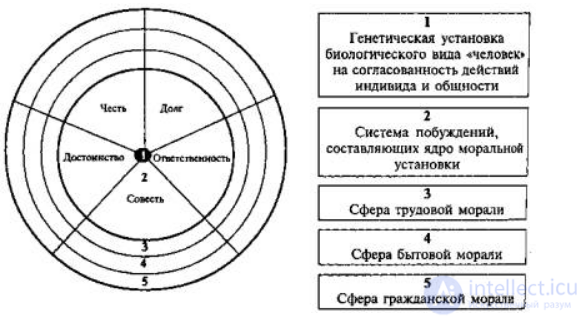
Diagram 1. The structure of the individual's enriched moral disposition
The concept of “vocation” in its secular sense was first applied by Martin Luther in his translation of the “Book of the Wisdom of Jesus, Son of Sirach”. Here there is no talk at all of a free choice of profession and of responsibility for that choice, which is a matter of divine providence. For Luther, an attitude to labour as a vocation is the opposite of meaningless ascetic monastic exercises. “Everyone must be obedient in that labour with which the Lord has afflicted him”. Vocation, however, is not merely resignation to one's lot but above all conscientious labour, and responsibility for one's attitude to labour rests entirely with the person himself. From this point of view there is no fundamental difference between the labour of the capitalist, the hired worker, the administrator, the manager and anyone else. The definition of vocation undoubtedly contains an irrational element, and it is this that gives the profession its ethical meaning. Vocation simultaneously characterizes the choice of profession from the standpoint of its significance for the individual and sanctifies that choice by orienting it toward a certain absolute lying outside individual consciousness. In the 16th century this could only be divine providence; in the 20th century – universal humanistic values.
Individual morality in the professional sphere also presupposes an awareness of professional duty.
The original content of this ethical category, which took shape historically within the framework of Protestant ethics, although it differs from the content it has in secular ethics, is nonetheless profoundly connected with it through the requirement of self-renunciation. In contrast to monastic asceticism, Protestantism affirms the principle of worldly asceticism, resolutely rejecting the direct enjoyment of wealth. This ethic found its most consistent embodiment among the followers of Calvin in England – the Puritans, who condemned as unforgivable pursuits idle chatter, excess, vain conceit and sleep exceeding the necessary time, and who considered the useless waste of time a grave sin. Without accepting the extremes of Puritan asceticism, which borders on hypocrisy, one must nonetheless recognize that achieving success in any profession is inevitably bound up with a certain self-restraint, without which the professional self-realization of the individual is impossible.
Self-restraint is expressed in the striving to develop in oneself such qualities as discipline, orderliness, honesty, businesslike efficiency, perseverance, and self-control. In the 16th century, the followers of the practical ethics of Calvinism were called Methodists for creating a strict method for the whole of behaviour, which pursued two tasks: liberation from irrational instincts, from the influence of nature and the world of things, subordinating life to a planned striving; and constant self-monitoring and active self-possession.
If the categories of vocation and professional duty express a person's attitude to his own occupation, then the problem of the meaning of professional activity arises out of the interaction of people in society and, in simplified form, can be formulated as the question “For whom should a person labour?” Possible answers:
Adam Smith represented the interaction of personal and social interests, regulated by market mechanisms, as follows:
In other words, objectively any activity in demand in bourgeois society takes into account someone's interests in one way or another; however, an indication of the addressee of the activity cannot in itself give it moral meaning. Only the awareness of the universal, general-cultural significance of the goals set, however abstract, idealistic or unattainable that may sound, makes professional activity morally meaningful.
Duty — is an internally accepted (voluntary) obligation, «a person's obligation, sanctified by his conscience». This is one of the foundational concepts of ethics, implying that a person's actions are performed on the basis of morally motivated pressure or justification. Duty is a moral necessity that becomes fixed as a subjective principle of behaviour. In philosophy, duty is regarded as the imperative form of morality.
Duty may refer to the obligation of a subject or group of subjects toward another subject or subjects (for example, people, a country or God). Most often what is treated as duty is moral obligation (moral duty, ethical duty) — the voluntary moral obligation of an individual toward other people.
Other kinds of duty: civic duty, patriotic duty, military duty.
Duty is studied by the philosophical discipline of deontology.
It is believed that Zeno of Citium, the founder of Stoicism, introduced the term «the proper» (καθῆκον), giving it the following definition: «fittingness in life, an action having convincing justification». In his understanding, a person must rationally justify any action, since rational human nature is manifested when a person exercises his capacity to make a rational choice.
According to Diogenes Laertius, «Zeno was the first to use the word "duty", for he derived it from the words "that which is fitting": duty is an action proper to natural creatures. Of actions performed by impulse, some are consonant with duty, others are contrary to duty, and still others are neither one nor the other. Consonant with duty is that which reason prompts, for example, to honour one's parents, brothers, one's fatherland, to yield to friends. Contrary to duty is that which reason does not prompt...»
In Ancient Greek, several different words were used to designate right (due) actions, including δέον (literally: a forcible binding). Using this term, Jeremy Bentham introduced the new concept of deontology to designate the doctrine of the right (the due).
Democritus, speaking of the personal character of moral mechanisms in his ethics, points to shame and the sense of duty as internal regulators of human behaviour.
Moral (ethical) duty – is a special kind of duty, distinct in certain respects from official, civic, professional, religious duty, and so on. Besides the concept of «duty», which fixes the imputed, or obligatory, character of a given action or experience, the markers of the sphere of moral evaluations are those concepts that fix the specific nature of the actions and experiences imputed to the moral person. These paired evaluative terms are used to express one's conviction that a duty has been fulfilled or not fulfilled, that an act is moral or immoral in character, that a person shows himself to be a personality of greater or lesser moral quality. Such are the oppositions «honest (just) – dishonest (unjust)», «cruel» – «merciful (compassionate)», «worthy» – «unworthy». The last pair acquires independent significance when actions that violate duty cause no harm to another person but nonetheless testify to the low moral quality of the person acting.
Civic duty — is a category defining the obligation of a citizen of society to fulfil requirements of a moral and legal character laid down in the Constitution, legislative acts and the norms of universal human morality, and also to bear full responsibility for his actions. Civic duty is a person's own conception of his moral obligations. In becoming aware of his civic duty, a person orients himself toward the moral requirements of society. The basis of due behaviour can be considered in two aspects:
a) from the side of the principles on which the content of society's requirements for due behaviour rests;
b) from the point of view of the reasons that motivate a person to fulfil these requirements.
Duty is regarded in Stoicism, within the framework of the principle of obligation, as a central category denoting something «fitting», «proper» or «imposed by nature». It relates to the «natural» expediency of any action directed toward preserving and maintaining one's own being, that is, it lies within the sphere of «primary inclination». In the view of the Stoics, a sense of duty is characteristic of a human being, and it manifests itself in the virtuous act of the sage. The sage himself exists as an ideal, embodies all the virtues, and acts only in accordance with duty for the common good. Seneca held that a person, being a social being, must seek ways to fulfil his duty. Marcus Aurelius reinforced this idea by putting forward a series of categorical postulates as to how a person should behave and what qualities he should possess. Since the Stoics regard the purpose of life as a striving toward the good, that is, toward living in accordance with nature, the very word duty acquires the dimension of a relation between man and the world. From the point of view of the internal (subjective) factor, there is that which lies within the sphere of a person's active activity — his choice, and it is important that a person have a moral intention to act, that is, his behaviour should depend on his own values. And it is on this plane that the concept of duty appears — a person does good, as befits his station. The Stoic concept of duty (the «fitting») is not identical to moral duty, which is «action in accordance with virtue», «perfect fittingness».
It is generally held that Cicero was the first to present the term for «the fitting» in Latin, translating it as «officium». Cicero had a practical orientation in moral philosophy, so for him this word meant the obligations of a citizen of the Roman community, that is, it was no longer the abstract, universal, original duty of the Stoics. Borrowing ideas from this school of philosophical thought, he reworked them, selecting what seemed to him most interesting (Cic. De off. I 6). In his book «On Duties» (De officiis) he discusses duty as something conditioned by a person's ties within society and his relations with other people. Cicero identified four virtues by which a valiant citizen ought to be guided — knowledge of the truth, justice together with the generosity bound up with it as a twin virtue, greatness of spirit, and moderation. Cicero's teaching on obligation (duty) is inseparably linked to the conception of the highest good (summum bonum) as that which is morally beautiful (honestum). In his view, every sphere of life and field of activity has its own corresponding obligations, and by fulfilling them a person fulfils the moral meaning of his whole life (honestas omnis vitae). In reflecting on human duty, Cicero touches on such spheres as public obligations, the concept of the inviolability of property, military morality, and obligations toward various levels of society (fatherland and parents, children and family, and so on). Cicero identifies the Stoic concept of duty, «katekon», with «ordinary» obligation, which concerns all people, which made it possible to give a moral qualification to a person's various concrete obligations. Kant regarded Cicero's teaching on obligations as a continuation of the teaching on morality (ethics), and it served as a kind of canon until the appearance of Kant's own teaching.
In the Middle Ages, Ambrose of Milan drew on Cicero's teaching, reworking it in his work «On the Duties of the Clergy» from the standpoint of Christian morality. Duties are divided into «perfect» and «intermediate», which he explains using the examples of the Sermon on the Mount and the Decalogue respectively. That is, the deeds of the first category are the Ten Commandments, and those of the second are works of mercy. «Intermediate» duties are precepts (praecepta); they have a strictly obligatory character and serve to overcome sin and to prepare for «eternal life». Drawing on Cicero's book, Ambrose of Milan also sought confirmation that the word officium (obligation) is found in Holy Scripture as well, and not only among the philosophers. A «perfect» duty, on the other hand, is absolute; it pertains to the perfection of the Heavenly Father. As a result of his work he came to interpret duty as actions directed toward the good and toward benefit. This theme was subsequently developed further within religious philosophy by Thomas Aquinas, who grounded duties «within the framework of the hypothetical imperative» , whereby, when a goal connected with God and the divine is necessary, the actions directed toward its fulfilment become duty.
The concept of duty acquires its greatest significance in the modern era, especially in the ethics of Kant. According to Kant, duty is the necessity of an action out of respect for the moral law. Duty enables the individual to be moral.

Comments