
Lecture
ENVIRONMENTAL ETHICS — is the doctrine of the ethical relations between human beings and nature, based on perceiving nature as a member of the moral community, a moral partner (subject), the equality and equal worth of all living things, and also on the limitation of human rights and needs.
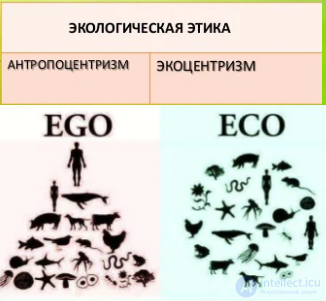
ENVIRONMENTAL ETHICS — is an ethics of caution, care, respect for nature and ecological self-restraint.
Ecocentrism likewise bears the mark of anthropocentrism, only with a negative sign, where the human being appears as the culprit and the one answerable for ecological violations
Environmental ethics, sometimes also called green ethics, nature-protection ethics, environmentalist ethics or eco-ethics, proposes and defends a systematic and comprehensive conception of the moral relations between people and nature. Environmental ethics presupposes that human behaviour toward nature can be, and is, guided by moral norms. The theory of environmental ethics must in this case:
Environmental ethics is aimed not only at judgment but also at prescribing action.
As the father of environmental ethics A. Leopold wrote — environmental ethics is a limitation of freedom of action in the struggle for existence. E. Abbey said that environmental ethics can be regarded as nature's claim to its own rights. Roughly the same was stated by another founder of environmental ethics
A. Schweitzer: «Self-renunciation for the sake of life out of reverence for life».
The foundation of environmental ethics is eco-biocentrism, which directs people toward preserving species and individual living creatures and areas of wilderness regardless of any benefit to humans, or even to their detriment.
Environmental ethics motivates nature-protection actions in two respects: 1) people act or refrain from acting for the sake and for the good of nature itself, protecting nature for its own sake; 2) these actions are performed out of moral principle without any self-interested motives on the part of humans, or even to their own detriment.
As a rule, environmental ethics is divided into two component parts: philosophical environmental ethics and normative environmental ethics. Normative (prescriptive) ethics deals with practical questions, developing ethical judgments, rules and principles governing our relations with nature, as well as ethical evaluations. Most ethical judgments that include «bad–good», «should», «must» or «need to» — are normative requirements. They prescribe behaviour, for example: «endangered species should be protected», «hunting animals for entertainment is bad». Normative judgments explicitly or implicitly appeal to certain norms or standards of ethical behaviour.
Normative environmental ethics is of great importance in the development of special ethical rules and ethical principles of behaviour. Ethical rules are more particular in nature and can sometimes contradict one another. In such a case one turns to ethical principles, which are generalizations of a higher order. Principles are far more universal than rules, and in any system of morality there are never many of them. Moreover, they can be difficult to apply to a specific situation without intermediate links such as rules.
Philosophical environmental ethics presupposes a higher level of generalization and abstraction, at which normative judgments and evaluations, as well as the arguments advanced in their favour, are analysed and assessed. This is the level of general concepts, ideas and theories on the basis of which normative judgments are explained and defended. Philosophical environmental ethics develops such important concepts as «the value of nature», «the rights of nature», «human duties toward nature», «the good of nature», and the like.
Environmental ethics is not yet a strictly scientific discipline. It is an interdisciplinary, complex field of research that has taken shape at the intersection of the natural sciences and the social sciences. Environmental ethics is an applied ethics, and is therefore concerned with practical relations, as a result of which it amounts to an ethical evaluation of specific actions. In this connection
THE SUBJECT OF ENVIRONMENTAL ETHICS is the justification and development of ethical principles and rules governing the moral relations of human beings to nature and its representatives.
Environmental ethics uses a variety of general-scientific and specific-scientific methods: theoretical and empirical. These are the dialectical, systemic, interval, evolutionary methods, extrapolation, observation, experiment and other methods, depending on the specific situations.
Environmental ethics has two main functions: a destructive one and a constructive one. The first is aimed at destroying old, consumerist-utilitarian stereotypes of human relations with nature, numerous anthropocentric myths and values, and at abandoning wasteful and inhumane forms of nature use. Anthropocentrism, egoism and pragmatism are precisely what environmental ethics opposes. The constructive function of environmental ethics is aimed at working out a new, ecological worldview that allows both humans and nature to coexist successfully.
The principles and provisions of environmental ethics, given the generally resource-based, consumerist approach to nature that currently prevails, seem to many people very radical. But the radical, avant-garde role of environmental ethics consists precisely in proclaiming ideas that are at first rejected by the majority as absurd or ridiculous, but which eventually become the property of traditional environmental organizations and, in time, are accepted by the majority of the population. In addition, another important task of environmental ethics is the development of the theoretical foundations of nature conservation.
If we attempt to consider the role of environmental ethics from a historical standpoint, it can be represented as a set of special restraining valves, created by human beings themselves, that prevent them from destroying nature. No species on Earth, apart from humans, is capable of completely destroying its own habitat, for its activity is held in check by ecological laws. And only the human being, thanks to reason and advanced technology, has practically escaped the power of ecological necessity. Therefore human activity, so as not to become all-destructive, requires special ethical restrictions expressed in morality (the will toward ethical self-limitation). The development of such «taboos» is the principal task of environmental ethics.
To make our relations with nature ethical means admitting into the sphere of our morality not only «those like ourselves», such as mammals, but also «those largely, or even entirely, different» — plants, microbes, rivers, mountains, stars and the like. All of them are self-sufficient, valuable in themselves and for themselves, and are therefore morally significant. Environmental ethics extends its concern not only to wild, agricultural and domestic species of living creatures, wild and cultivated ecosystems, the Earth, and the stars, but also to a single tree, a mountain, a butterfly.
As S.D. Deryabo rightly holds, the development of consciousness on the basis of environmental ethics «represents a fundamental change in the picture of the world, one that can perhaps be compared to the revolution in consciousness brought about by Copernicus — the replacement of the geocentric model of the solar system with the heliocentric one. Just as the Earth then lost its status as the center of the universe and the sun took its place, so too must the human being now abandon the notion of himself as the «center» of nature, of the world, and this place must be taken by the principle of ecological expediency, the «ecological imperative» (146).
By focusing attention on the problems of the biosphere and of all living things, environmental ethics creates the preconditions for actions oriented toward the preservation and development of both natural and human existence. Thus the subject of environmental ethics is, above all, the relation of Man to Nature, which at the same time presupposes his relation to himself. This concerns human self-awareness: the opposing of oneself to the surrounding environment, or one's inclusion within it. Environmental ethics signifies the emergence of a new form of consciousness — environmental consciousness, synthesizing a global vision of the world with genuinely humanistic values. Owing to this, such abstract-theoretical propositions as the unity of humankind and the common destiny of all people acquire practical significance. Environmental ethics is not the ethics of a single individual, or even of a society, based on the ecological imperatives of culture. It is a universal ethics of human activity.
The emergence of environmental ethics inevitably gives rise to a number of questions. Some of them are of a general axiological and worldview character, for example: to what extent is the emergence of a new — environmental — direction in ethics justified, and how will such concepts as the value of nature, humanism, and so on relate to it? Other questions are aimed at identifying the conceptual foundations of environmental ethics, and at defining its principles and conceptual apparatus. The point is that traditional ethics reflects moral phenomena and processes within the system «human being — human being», «human being — society». In what form, then, should moral relations be reflected within the system «human being — society — nature»?
The justification of the axiological and worldview foundations of environmental ethics rests on the need to reject «egocentrism» and to recognize the existence, at the foundations of the universe, of natural forces «well-disposed» toward the human being. Such a «spiritualized» attitude to the world is inseparably linked with a spiritualized understanding of nature itself, and therefore only the «spirituality» of the world makes a morally human attitude toward nature possible. The argument for this idea runs as follows: if we accept that the human being was created by nature, which endowed him with a bodily-psychic-spiritual organization, then we must also allow that the planet-wide organization of life may possess rationality and psychism — if not in a pronounced (personal) form, then at least in a diffuse one. Of course, this assertion is not beyond dispute. Yet neither can one agree with the opposite extreme: that the meaning-forming side of human life and activity excludes an independent meaning of existence and value in nature itself.
Environmental ethics, in essence, draws attention to the eternal ethical-worldview problem: what is the meaning of the existence of man in the Universe, and of the Universe in man. Particular questions are a concrete refraction of this fundamental problem: should the principles of eco-ethics be based on recognizing the independence and intrinsic self-worth of natural wholes, or should they be determined in dependence on the human being and his needs, with the sole object of moral evaluation and regulation being our «human» attitude toward it?
As Aldo Leopold, one of the founders of environmental (ecological) ethics, held, its meaning is the formation of moral values and criteria around two pillars: a feeling of love and compassion for nature, and a sense of time reaching beyond the boundary of a single human generation and entailing concern for the natural conditions of existence of future generations.
This orientation toward the future, which also presupposes concern for the present, radically distinguishes environmental ethics from traditional directions in ethics. Analysis of the concept of «duty to posterity» shows that an action performed in accordance with moral duty is the most valuable of all possible actions. Our duty to posterity is characterized by three groups of problems:
- problems within which the very existence of such a duty toward future generations, whose presence cannot be made actual in present-day life, is determined;
-normative-ethical questions, concerning the specific features of the presumed rights of posterity in relation to us, the ideal of the social environment we strive to create for them, and the justification of the priority of obligations to the future in the event of their conflict with our present-day needs;
-practical problems connected with the present-day implementation of social programmes of responsibility toward future generations.
In this connection, an important task of environmental ethics is the creation of clear and precisely articulated values that must underlie our obligations to future generations, who have a right to a dignified life. These obligations are expressed in principles, the most important of which is the principle of chronological objectivity. Its essence is as follows: the interests of individuals cannot be ignored on account of their temporal, spatial or ideological remoteness.
Environmental ethics can already propose the following imperatives for a dialogue with the future: to refrain from any actions that could undermine the possibility of existence for future generations; the measure of responsibility toward posterity must take priority in decisions concerning human health and the state of the natural environment; it is impermissible, in the interests of people living today, to inflict harm on the interests of future generations.

Comments