
Lecture
An unmanned aerial vehicle (UAV) (or uninhabited aerial vehicle, commonly known as a drone) is an aircraft without a human pilot on board. UAVs are a component of an unmanned aircraft system (UAS), which includes the UAV itself, a ground-based controller, and a communication system between the two. UAV flight may be carried out with varying degrees of autonomy: either under remote control by a human operator, or autonomously with the help of onboard computers known as an autopilot.
Compared with crewed aircraft, UAVs were initially used for tasks too “dull, dirty, or dangerous” for people. Although drones were initially used mainly for military purposes, their use is quickly finding much broader application, including aerial photography, product delivery, agriculture, security and surveillance, infrastructure inspection, science, smuggling, [10] and drone racing.
Several terms are used for unmanned aerial vehicles, usually referring to the same concept.
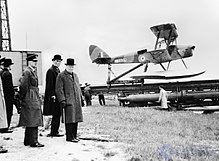
The term drone, more widely used by the public, was coined in reference to early remotely flown target aircraft used for battleship gunnery practice, and the term was first used starting with the 1920s Fairey Queen and the 1930s de Havilland Queen Bee target aircraft. These were followed by the similarly named Airspeed Queen Wasp and Miles Queen Martinet, and eventually by the final replacement, the GAF Jindivik. [11]
The term “unmanned aircraft system” (UAS) was adopted by the US Department of Defense (DoD) and the US Federal Aviation Administration in 2005 as part of their Unmanned Aircraft Systems Roadmap for 2005–2030. [12] The International Civil Aviation Organization (ICAO) and the UK Civil Aviation Authority adopted this term as well, also used in the EU’s Single European Sky (SES) Air Traffic Management (ATM) Research (SESAR Joint Undertaking) roadmap for 2020. [13]This term emphasizes the importance of elements other than the aircraft itself. It includes elements such as ground control stations, data links, and other support equipment. A similar term denotes the unmanned aerial vehicle (UAV), remotely piloted aerial vehicle (RPAV), and remotely piloted aircraft system (RPAS). [14] Many similar terms are in use.
A UAV is defined as “a powered aircraft that does not carry a human operator, uses aerodynamic forces to provide vehicle lift, can fly autonomously or be remotely piloted, can be expendable or recoverable, and can carry a lethal or non-lethal payload”. [15] Accordingly, missiles are not considered UAVs, because the vehicle itself is a weapon that is not reused, although it is not unscrewed either and in some cases has remote guidance. That said, UAV is a term usually applied for military purposes. [16]
The terms autonomous drone and UAV are often mistakenly used as synonyms. This may be because many UAVs are automated, meaning they carry out automated missions but still rely on human operators. An autonomous drone, however, is “a UAV that can operate without human intervention”. [17] In other words, autonomous drones take off, carry out missions, and land completely autonomously. Thus an autonomous drone is a type of UAV, but a UAV is not necessarily an autonomous drone.
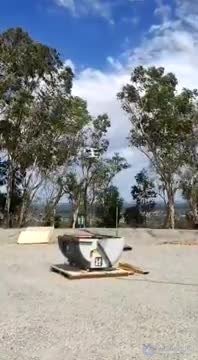
Because autonomous drones are not piloted by humans, the ground control system or communication management software plays an important role in their operation, and for that reason it is also considered part of the UAV. In addition to software, autonomous drones also use a range of advanced technologies that allow them to carry out their missions without human intervention, such as cloud computing, computer vision, artificial intelligence, machine learning, deep learning, and thermal sensors. [18]
In recent years, autonomous drones have begun transforming various commercial industries, since they can fly beyond visual line of sight (BVLOS) [19], while increasing output, reducing costs and risks, ensuring on-site safety, security and regulatory compliance [20], and protecting human resources during a pandemic. [21] They can also be used for consumer-related tasks such as package delivery, as demonstrated by Amazon Prime Air, and for critical deliveries of medical supplies.
Drone-in-a-Box (DIB) is an autonomous drone that deploys to carry out a programmed list of missions and returns to an autonomous landing pad, which also serves as the drone's charging base.
According to new regulations that took effect on June 1, 2019, the term RPAS (remotely piloted aircraft system) was adopted by the Government of Canada to mean “a set of configurable elements consisting of a remotely piloted aircraft, its control station, the command and control links, and any other system elements required during flight operations”. [22]
The relationship between UAVs and remote-controlled model aircraft is unclear. UAVs may or may not include model aircraft. Some jurisdictions base their definition on size or weight; however, the US Federal Aviation Administration defines any unmanned aircraft as a UAV regardless of its size. For recreational use, a drone (as opposed to a UAV) is a model aircraft that has first-person-view video, autonomous capabilities, or both. [23]
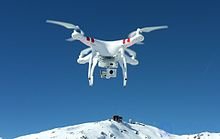
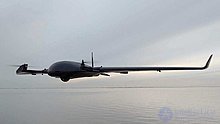
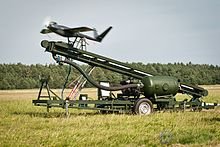
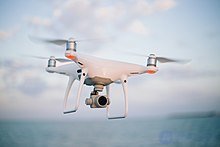
A quadcopter or quadrotor is a type of helicopter with four rotors.
Although quadcopter helicopters and convertiplanes have long been operated experimentally, their configuration remained a curiosity until the advent of modern UAVs, or drones. The small size and low inertia of drones make it possible to use a particularly simple flight control system, which has greatly increased the practicality of the small quadcopter in this application.
Each rotor generates lift and torque around its center of rotation, as well as drag opposite to the vehicle's direction of flight.
Quadcopters usually have two rotors turning clockwise (CW) and two turning counterclockwise (CCW). Flight control is achieved by independently varying the speed, and thus the lift and torque, of each rotor. Pitch and roll are controlled by changing the net center of thrust, while yaw is controlled by changing the net torque.
Unlike conventional helicopters, quadcopters usually do not have cyclic pitch control, in which the blade angle changes dynamically as the blades rotate around the rotor hub. In the early days of flight, quadcopters (then called either “quadrotors” or simply “helicopters”) were seen as a possible solution to some of the persistent problems of vertical flight. Control problems caused by torque (as well as efficiency problems arising from the tail rotor, which produces no useful lift) could be eliminated by rotating in opposite directions, and relatively short blades are much easier to build. A number of crewed designs appeared in the 1920s-1930s. These aircraft were among the first successful heavier-than-air vertical takeoff and landing (VTOL) aircraft. However, early prototypes suffered from poor performance , and later prototypes required too great a pilot workload due to insufficient stability and limited control authority.
If all four rotors spin at the same angular speed, with two spinning clockwise and two counterclockwise, the net torque about the yaw axis is zero, meaning there is no need for a tail rotor as on conventional helicopters. Yaw is caused by an imbalance in the aerodynamic moments (i.e., an offset in the cumulative thrust commands between pairs of blades rotating in opposite directions).
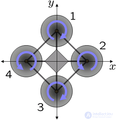
Diagram of the reaction torques on each motor of a quadcopter due to the rotating rotors. Rotors 1 and 3 spin in one direction, while rotors 2 and 4 spin in the opposite direction, producing opposing torques for control.
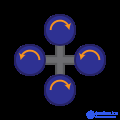
A quadcopter hovers or adjusts its altitude by applying equal thrust to all four rotors.
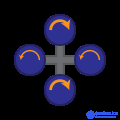
A quadcopter adjusts its yaw angle by applying greater force to the rotors spinning in the same direction.
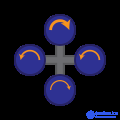
A quadcopter adjusts its pitch or roll by applying greater thrust to one rotor (or two adjacent rotors) and less thrust to the diametrically opposite rotor.
All quadcopters are subject to the normal aerodynamics of a rotary-wing aircraft, including vortex ring state.
The main mechanical components are the fuselage or frame, four rotors (either fixed-pitch or variable-pitch), and the motors. For better performance and the simplest control algorithms, the motors and propellers are spaced equally apart.
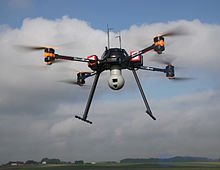
To provide greater power and stability at a lower weight, a quadcopter, like any other multicopter, can use a coaxial rotor configuration. In this case each arm has two motors running in opposite directions (one pointing up and the other pointing down).
The quadcopter configuration is relatively easy to program for autonomous flight. This has made it possible to carry out experiments with complex swarming based on the basic sensing of neighboring drones.
The longest flight time achieved by a battery-powered quadcopter is 2 hours 31 minutes 30 seconds. The record was set by Ferdinand Kickinger of Germany in 2016. In setting the record, Kickinger used high-capacity lithium-ion batteries with a low discharge rate and stripped the airframe of non-essential weight to reduce power consumption and extend flight time. [10]
Alternative power sources, such as hydrogen fuel cells and hybrid gas-electric generators, are used to significantly increase flight time due to the higher energy density of hydrogen and gasoline, respectively. [11]
Over the past few decades, the quadcopter layout has become popular for small unmanned aerial vehicles, or drones. The demand for aircraft with greater maneuverability and hovering capability has driven growth in quadcopter research. The four-rotor design allows quadcopters to be relatively simple in construction while still being very reliable and maneuverable. Research continues aimed at expanding quadcopter capabilities through advances in inter-vehicle communication, environmental sensing, and maneuverability. If these emerging capabilities can be combined, quadcopters will be able to carry out complex autonomous missions that are currently impossible with other vehicles. [18]
Roughly from 2005 to 2010, advances in electronics made it possible to produce cheap, lightweight flight controllers, accelerometers (IMUs), global positioning systems, and cameras. This led to the quadcopter configuration becoming popular for small unmanned aerial vehicles. Thanks to their small size and maneuverability, these quadcopters can be flown both indoors and outdoors
The earliest recorded use of an unmanned aerial vehicle for combat took place in July 1849 [25], when it was used as a balloon carrier (a forerunner of the aircraft carrier) [26] during the first offensive use of naval aviation. [27] [28] [29] Austrian forces besieging Venice attempted to launch about 200 incendiary balloons into the besieged city. The balloons were launched mostly from the ground; however, some were launched from the Austrian ship SMS Vulcano.. At least one bomb fell within the city; however, due to a change in wind after launch, most of the balloons missed their target, and some blew back over the Austrian lines and the launch ship «Vulcano». [30] [31] [32]
Innovation in UAVs began in the early 1900s and was initially focused on building training targets for teaching military personnel. UAV development continued during the First World War, when the Dayton-Wright Airplane Company invented an unmanned aerial torpedo that exploded at a set time. [33]
The earliest attempt to build a powered UAV was A. M. Low’s “Aerial Target” in 1916 [34]. Low confirmed that a Geoffrey de Havilland monoplane was the only one that flew under control on March 21, 1917, using his radio system. [35] Nikola Tesla described a fleet of unmanned combat vehicles in 1915. [36] During and after the First World War further advances followed, including the British Hewitt-Sperry Automatic Airplane (1917) and the RAE Larynx (1927). These developments also inspired the Kettering Bug, built by Charles Kettering of Dayton, Ohio. It was originally conceived as an unmanned aircraft that would carry explosives to a designated target. The first scalable remotely piloted aircraft was developed by film star and model-aviation enthusiast Reginald Denny in 1935. [34] Even more appeared during the Second World War - used both for training anti-aircraft gunners and for carrying out combat missions. Nazi Germany produced and used various UAVs during the war, such as the Argus As 292 and the jet-propelled V-1 flying bomb. After the Second World War, development continued with such vehicles as the American JB-4 (using television/radio command guidance), the Australian Air Force’s Jindivik, and the Teledyne Ryan Firebee I of 1951, while companies such as Beechcraft offered their Model 1001 to the US Navy in 1955. [34] Nevertheless, these were little more than remote-controlled aircraft until the Vietnam War.
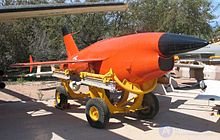
In 1959, the US Air Force, concerned about the loss of pilots over enemy territory, began planning the use of unmanned aircraft. [37] Planning intensified after the Soviet Union shot down a U-2 in 1960. A few days later, a highly classified UAV program codenamed "Red Wagon" was launched. [38] The August 1964 clash in the Gulf of Tonkin between US naval forces and the North Vietnamese Navy marked the start of the first American UAV combat sorties of the Vietnam War (Ryan Model 147, Ryan AQM-91 Firefly, Lockheed D-21). [39] When the Chinese government [40] displayed photographs of a downed American UAV via Wide World Photos, [41] the official US response was "no comment".
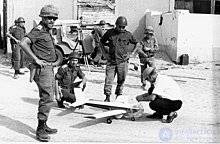
During the War of Attrition (1967-1970), the first tactical UAVs with reconnaissance cameras were tested by Israeli intelligence, successfully delivering photographs from across the Suez Canal. This was the first time that tactical UAVs, which could be launched from and landed on any short airstrip (unlike heavier jet-powered UAVs), were developed and tested in combat. [42]
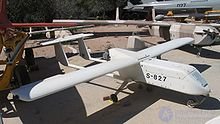
During the 1973 Yom Kippur War, Israel used UAVs as decoys to induce opposing forces to waste expensive anti-aircraft missiles. [43] After the 1973 Yom Kippur War, several key people from the team that had developed this early UAV joined a small startup company that sought to turn the UAV into a commercial product, which was eventually acquired by Tadiran and led to the development of the first Israeli UAV. [44] [page needed]
In 1973, the US military officially confirmed that it had used UAVs in Southeast Asia (Vietnam). [45] More than 5,000 American airmen were killed and more than 1,000 went missing or were taken prisoner. The US Air Force’s 100th Strategic Reconnaissance Wing flew about 3,435 UAV sorties during the war [46], with about 554 UAVs lost to all causes. According to US Air Force General George S. Brown, commander of Air Force Systems Command, in 1972, "the only reason we need (UAVs) is that we don’t want to needlessly expend the man in the cockpit". [47] Later that year, General John C. Meyer, commander-in-chief of Strategic Air Command, stated: "We are letting the drone fly the high-risk missions ... the loss rate is high, but we are willing to risk more losses ... they save lives!" [47]
During the 1973 Yom Kippur War, Soviet surface-to-air missile batteries in Egypt and Syria inflicted serious damage on Israeli fighter jets. As a result, Israel developed the first UAV with real-time surveillance capability. [48] [49] [50] The imagery and radar decoys provided by these UAVs helped Israel completely neutralize the Syrian air defense system at the start of the 1982 Lebanon War, with the result that no pilot was shot down. [51] Unmanned aerial vehicles were first used as a proof of concept for super-maneuverable post-stall controlled flight in combat flight simulators, using a tailless, stealth-based, three-dimensional thrust-vectoring flight control system and jet-powered UAVs in Israel in 1987. [52]
As the technologies involved matured and became more compact during the 1980s and 1990s, interest in UAVs grew within the upper echelons of the U.S. military. In the 1990s, the U.S. Department of Defense contracted with AAI Corporation together with the Israeli company Malat. The U.S. Navy procured the AAI Pioneer UAV, which AAI and Malat had developed jointly. Many of these UAVs took part in the 1991 Gulf War. UAVs demonstrated the ability to build cheaper and more effective combat vehicles that could be deployed without risk to crews. The initial generations mainly consisted of reconnaissance aircraft, but some carried weapons, such as the General Atomics MQ-1 Predator, which launched AGM-114 Hellfire air-to-ground missiles..
CAPECON was a European Union project for UAV development [53], which ran from May 1, 2002 to December 31, 2005. [54]
As of 2012, the U.S. Air Force operated 7,494 UAVs - almost one in every three U.S. Air Force aircraft. [55] [56] The Central Intelligence Agency also operates unmanned aerial vehicles. [57]
In 2013, at least 50 countries used UAVs. China, Iran, Israel, Pakistan, Turkey, and others [ which? ] designed and built their own variants.
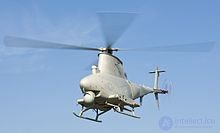
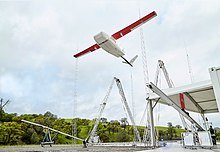
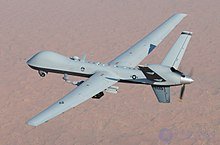
UAVs generally fall into one of six functional categories (although multi-purpose airframe platforms are becoming increasingly common):
The U.S. military's multi-tier unmanned aircraft system is used by military planners to designate the various elements of individual aircraft within the overall plan of use.
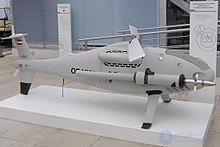
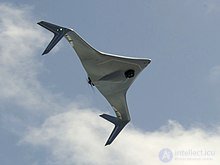
Vehicles can be categorized by range/altitude. The following has been proposed [ by whom? ] and is current at industry events such as the ParcAberporth unmanned systems forum:
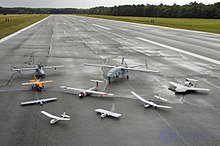
Other categories include: [58] [59]
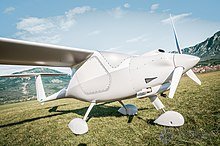
Classification by aircraft weight is fairly straightforward:
продолжение следует...
Часть 1 Unmanned Aerial Vehicle (UAV, Drone). The Quadcopter
Часть 2 - Unmanned Aerial Vehicle (UAV, Drone). The Quadcopter
Часть 3 Autonomy - Unmanned Aerial Vehicle (UAV, Drone). The Quadcopter
Часть 4 - Unmanned Aerial Vehicle (UAV, Drone). The Quadcopter
Часть 5 Basic principles - Unmanned Aerial Vehicle (UAV, Drone). The Quadcopter
Часть 6 - Unmanned Aerial Vehicle (UAV, Drone). The Quadcopter
Часть 7 Capabilities - Unmanned Aerial Vehicle (UAV, Drone). The Quadcopter
Часть 8 - Unmanned Aerial Vehicle (UAV, Drone). The Quadcopter
Часть 9 Applications of unmanned aerial vehicles - Unmanned Aerial Vehicle (UAV,

Comments