
Lecture
Justice is a category not only of moral consciousness, but also of legal, economic, and political life. It is no coincidence that the great philosophers of antiquity (Plato and Aristotle) singled out this category as fundamental for assessing the condition of society as a whole. Nevertheless, to the extent that political decisions and laws are regarded as just or unjust, this is always ultimately a matter of their moral evaluation - that is, of whether people agree to live in a society that pursues a given policy, or reject it as unjust, inhumane, degrading the dignity of a person or of particular groups of people.
Justice — is as necessary a product for life as bread.
Ludwig Börne - German writer
The concept of justice reflects not only the relations of people among themselves but also their relation to a certain whole. Justice is a systemic quality that promotes the common good.
For Plato, justice is a quality of the state as a whole, unlike the other virtues (courage, temperance, wisdom), which characterize particular social groups.
Aristotle said that justice does not express any single virtue but embraces them all. Justice is therefore a special, "complete virtue".
Justice is a principle governing relations among people with regard to the distribution of social values (these include wealth, prestige, respect, freedom).
Justice is giving each person their due according to their merits, while injustice is arbitrariness that violates human rights.
Justice is a principle governing relations among people as members of society who possess a certain social status and are endowed with duties and rights.

Many philosophers, beginning with Plato and Aristotle, regarded justice as the chief social virtue. As the contemporary philosopher J. Rawls writes, justice is the first virtue of social institutions.
Aristotle already distinguished several kinds of justice: distributive and corrective.
The first is concerned with the distribution of honours, property and other goods among members of society according to the principle of each person's worth - that is, in proportion to their merits.
Corrective justice is concerned with the attempt to equalize the parties; here worth is not taken into account.
Justice presupposes a certain level of agreement among members of society regarding the principles by which they live. These principles can change, but the specific understanding of justice depends on what rules and customs have become established in a given society.
The simplest understanding of justice consists in the demand for equality to be observed. That is why the first formulation of the principle of justice as a moral norm was the golden rule of morality: "Treat others as they treat you".

The concept of justice is an ethico-legal concept; it has its own specificity in morality (as a sphere of potential equality) and in law (as an area of actual inequality).
The legal aspects of the concept of justice were already elaborated in ancient Rome. The cornerstone of Roman law is the principle of individualism - the freedom of the individual, democracy.
Meanwhile, in the age of the kings the greatest rights were vested in the monarch as the supreme ruler of the state. Beside the king stood the senate (performing advisory functions). Further, there was the popular assembly, which also discussed laws and other problems of domestic and foreign policy. The inhabitants of the Roman Empire had different civic status and were endowed with different rights depending on their group.
Thus Roman law entrenched the social inequality of its inhabitants, conditioned by natural factors (territorial, geographical, political). Roman justice is the right of the strong.
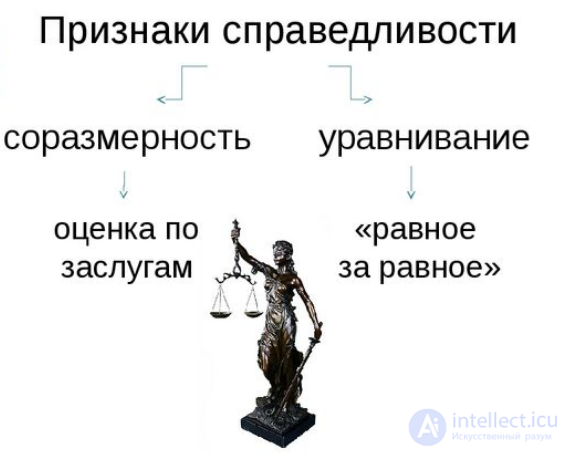
fig. features of justice
What distinguishes justice from other human qualities?
The features of justice - are agreement and reciprocity. Where there is agreement – there is always justice too; the same holds for reciprocity.
Social order – care for the infirm, for the elderly and children is a manifestation of social justice
Family way of life – in olden times a large family would gather round the table and all its members would take turns dipping a spoon into food from a shared dish: this too was a manifestation of justice.
A completely different conception of justice (one gravitating toward morality rather than law) is found in Marxism, a socio-political doctrine that arose on the basis of social utopianism, the critical analysis of the political economy of capitalism, and also moralistic ideas of universal equality and happiness.
The idea of equality is a moral idea inherent in many religious and eschatological conceptions. Karl Marx believed that it was possible to create a society in which there would be no violence, crime, or war. He held that, to this end, "humane" conditions must be created for creative labour as a way of self-realization of the individual. This theory is in many ways connected with the concept of "labour education" as a method of combating crime.
Social justice, according to Marx, consists in creating equal access for all people to the means of production, distribution and consumption (both material and spiritual). This theory of justice is criticized today as an attempt to artificially level people, erasing the differences that exist between them, crudely and primitively dividing everything equally ("take it all and divide it up", as the hero of Bulgakov's novel "Heart of a Dog" put it).
Nevertheless, it was precisely the presence in Marxism of the moral idea of justice, as liberation from social, economic and political oppression, that created the conditions for its extraordinary popularity in many countries of the world.
Among contemporary theories of justice, the best known is the conception of John Rawls:
Justice is a measure of equality and a measure of inequality. People should be equal in the distribution of social values. However, inequality too can be just, when it is an unequal distribution that provides an advantage to everyone.
Rawls's definition of justice breaks down into two principles:
1. Each person must possess an equal right to the most extensive system of equal basic liberties compatible with similar liberties for other people.
2. Social and economic inequalities must be arranged so that (a) they can reasonably be expected to be to everyone's advantage, and (b) access to positions and offices is open to all.
Thus, just today is considered to be equality in the distribution of rights and duties, and the accessibility of justice to all people, but constructive inequality - in the distribution of goods - is also considered just.
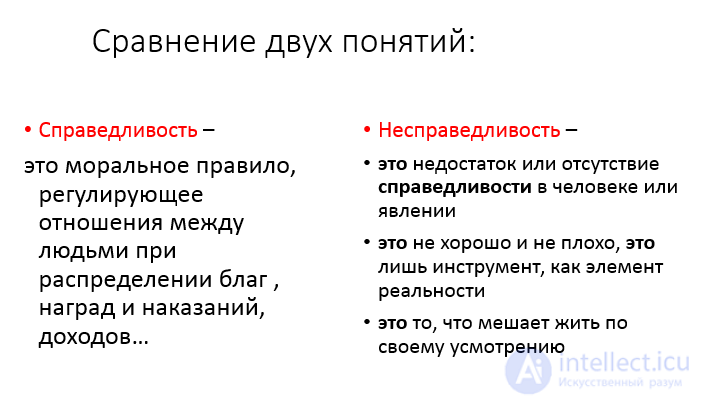
Fig. comparison of justice and injustice
Justice requires respecting the rights of another person and not encroaching on someone else's person or property.
The principle of justice is given concrete form in moral commandments: do not kill, do not steal, do not commit adultery, do not violate others' rights. These principles are actualized in ethical norms and rules of etiquette.

Fig. justice and injustice in life
Justice consists in a person's fulfillment of their duties, bearing in mind that duties are a form of obligation. Duties can be of different kinds: a) based on obligations assumed by private individuals or legal entities upon concluding a contract; b) determined by the constitution and corresponding laws; c) determined by universal moral notions of human dignity and the individual's right to respect.
Equality of citizens - one of the fundamental principles of constitutionalism and elements of democracy, meaning the officially recognized equality of citizens (subjects) before the state, the law, and the courts, i.e. the equality of the rights, freedoms and duties of citizens of one state regardless of sex, race, nationality, language, property and official status, place of residence, attitude to religion, convictions, etc.
The principle of equality of citizens was advanced in the era of the bourgeois revolutions, replacing the estate relations of feudal society. The constitutional doctrine of modern states nonetheless recognizes the possibility of certain differences in the rights and duties of citizens that are natural in character: for example, the duty to perform military service is imposed in most states only on male citizens, while special constitutional rights have in recent decades come to be secured for the disabled, children, representatives of small indigenous peoples, and so on.
Equality of rights places the emphasis on human rights and their limitations. Particular attention is devoted to the legislative protection of rights and equal access for all citizens to the legal system.
In the Russian Federation, equality before the law is declared in Article 19 of the Constitution:
1. All are equal before the law and the courts.
2. The state guarantees equality of human and civil rights and freedoms regardless of sex, race, nationality, language, origin, property and official status, place of residence, attitude to religion, convictions, membership of public associations, and other circumstances. Any forms of restriction of citizens' rights on grounds of social, racial, national, linguistic or religious affiliation are prohibited.
3. Men and women have equal rights and freedoms and equal opportunities to exercise them.
Equality before the law includes an equal duty of citizens to obey the law and equal treatment by law-enforcement bodies of different violators of the same norms. The latter is closely connected with the principle of the rule of law, since it requires that laws apply equally to those who issue them and who hold supreme power. Justice must not take into account the origin, power, wealth or social position of those who appear before it. The jurisdiction of the courts that rule on the cases of ordinary citizens must extend to all citizens.
The rights of a citizen — is a legally protected measure of possible conduct, aimed at satisfying the interests not of any person whatsoever, but only of one who is in a stable legal relationship with a specific state. Unlike the rights of citizens, human rights do not always act as legal categories. They can be moral and social categories as well, and can exist independently of their recognition by the state and their legislative consolidation, apart from any connection between the person and a specific country.
1) each person must have an equal right to the most extensive scheme of basic liberties compatible with similar liberties for others.
2) social and economic inequalities are to be arranged so that:(a) the greatest advantage from them would accrue to the least advantaged members of society in accordance with the principle of responsibility to future generations (just savings principle) and the principle of just inequality (the difference principle)
(b) access to jobs and public offices must be open to all on the basis of equality of opportunity.
Beginning with Aristotle, it is customary to distinguish two kinds of justice :
Corrective justice is a specific principle of private law, whereas distributive justice is a principle of public law, understood as the body of rules of the state as an organization
The requirements of corrective and distributive justice are formal, in that they do not define who is to be considered equal or different, nor indicate which rules to apply to whom. Different answers to these questions give rise to different conceptions of justice, which supplement the formal concept of justice with substantive requirements and values
Social justice — is one of the widespread social ideals. Some sources classify social justice among universal human ideals[10]. Its specific content, as well as its name, has changed over the course of history. According to some contemporary views, putting the principle into practice includes[11]:
In particular, implementing the principle of social justice should include[12]:
John Rawls's theory of social justice, set out in the book of the same name, is based on the idea that the most basic social goods should, as far as possible, be distributed equally among people. Inequality in distribution is possible only to support the poorest strata of society. From the outset, all people have, or should have, equal liberties, and, moreover, bear equal responsibility. The philosopher also set out the well-known claim that people's freedom can be limited only by the freedom of others. Furthermore, the state must strive to ensure equality of opportunity for its citizens, and the abilities of successful individuals should be redirected toward providing social goods and working for the benefit of the disadvantaged. Moreover, the redistribution of resources should ensure not merely equality of opportunity among different social strata, but should level out their very belonging to one stratum or another in the process of the struggle for success. Rawls saw the possibility of securing such principles of justice in the functioning of classical liberal democratic social institutions.[13]
the definition «social» appears to be applicable to everything associated with reducing or eliminating differences in income.[14]
Hayek considers the expression «social» to be contradictory[14]:
The adjective «social» <…> has probably become the most muddleheaded expression in our entire moral and political vocabulary. … it increasingly plays the role of the word «good» in designating everything highly moral.
Every call to be «social» <…> is a nudge toward yet another step in the direction of the «social justice» of socialism. As a result, the use of the term «social» becomes practically the same thing as a call for «distributive justice». Yet this is incompatible with a competitive market order, as well as with the growth and even the maintenance of the existing size of the population and the level of wealth achieved. In general, because of errors of this kind, people have come to call «social» («public») that which is the chief obstacle to the very maintenance of the life of «society». In essence, «the social» ought to be called «the antisocial».
Hayek considers it impossible to subjectively distribute the results of labour on the basis of the effort expended by the worker[14]:
No one is capable of what the market is capable of: establishing the value of an individual's contribution to the aggregate product. Nor is there any other way of determining a reward that induces a person to choose the activity in which, by engaging in it, they will contribute the most to increasing the flow of goods and services produced.
Polemicizing with Rawls, Hayek argues for the incompatibility of progress and justice. In Hayek's view, «evolution cannot be just». Since any change results in gains for some and losses for others, the demand for justice is tantamount to halting development[15].
There is an opinion that justice is a philosophical category and is evaluative in nature, which does not allow for its unambiguous interpretation or the creation of a compact and complete definition of justice. Scholars' views on the legal function of justice are contradictory[18].
There is an opinion that «in a just society there can be no crime if there are no victims»[19].
The prominent American economist and Nobel laureate Milton Friedman contrasts justice and freedom[20]:
I am not an advocate of justice. I am an advocate of freedom, and freedom and justice — are not the same thing. Justice implies that someone will judge what is just and what is not.
The prominent scholar of socialism Friedrich Hayek pointed to the impossibility of an objective distribution of goods, for example, in accordance with moral criteria[21]:
Reward is by no means given for merit (say, for observing the rules of morality). … According to Kant, there exists no general criterion for assessing merit and desert by which one could judge the various favourable opportunities open to different individuals possessing different information, different abilities and different desires.
According to neuroscientists, a number of areas of the brain associated with the emotional sphere of a person are responsible for the sense of justice[22].
It is claimed that the drive toward justice formed at the genetic level in the course of the tribal development of humankind, since it gave more «just» tribes an advantage in survival[23].
Studies show that a sense of justice is characteristic not only of humans but also of chimpanzees[24].

Justice is usually associated with questions of rights, impartiality and equality. A just act presupposes respect for your rights.
A fair deed implies impartial treatment of you. The principles of justice can be divided into three categories: distributive
(distributive), retributive (punitive) and compensatory.
Distributive justice.
Society has many goods and burdens that must be distributed among its members. Goods include income, jobs, wealth, education,
free time; burdens – labour, taxes, social and civic duties. The specific distribution of goods and burdens raises questions of
distributive justice. Goods and burdens can be distributed in various ways, including: equally among everyone; according to need; according to effort; according to merit; according to social contribution.
Although strong arguments can be made in favour of each of these ways of distributing goods and burdens, most people agree that equals should be treated equally, while treatment of unequals should differ depending on the degree of their inequality. This inequality must be based on meaningful differences. This conception is called the formal principle of justice. In the USA the use of
confidential information is a crime. In Germany, a country that previously relied on self-regulation, transactions based on
confidential information were only recently prohibited by law. If the use of confidential information does not violate hypernorms, it should be considered a norm accepted in particular communities.
Retributive (punitive) justice.
Retributive (punitive) justice is focused on responsibility or punishment for wrongful acts. However, there are
problems in applying retributive justice: under what conditions is punishment just (?) and what is the nature of punishment (?).
According to Aristotle: a person bears moral responsibility for their deeds only if they are not compelled to commit those deeds and if they are not aware
of their negative consequences. A person cannot be held responsible if they are unable to stop doing wrong owing to personal
inadequacy or the influence of a powerful external force. If a person could not possibly have known that some act was wrong, ignorance becomes
excusable and can serve as a justification. For example, farmers cannot be punished for killing wild birds through the use of the insecticide
DDT. When at the end of the Second World War farmers began to use DDT, they simply could not have known about the harm that DDT does to the food chain.
For punishment to be just, the fact of the crime must be reliably known and established. Compliance with this condition can
be guaranteed by a proper legal system. Just punishment must also correspond to the gravity of the crime, and the severity of the punishment must be
proportionate to the gravity of the crime. For punishment to be just, it must be the same for all who have committed the same
crimes.
Compensatory justice.
Compensatory justice is focused on compensation to the party that has suffered harm from unjust actions. Most people
tend to agree that the injured party is entitled to redress. Redress is meant to restore the state that existed before
the harm occurred. Compensation must be equal to the loss suffered by the injured party, but not exceed it. Problems arise when
full compensation cannot be provided. A lost life cannot be restored. Confidential information that was in the
exclusive possession of some person will no longer be their personal property once it has been disclosed to competitors. In such cases the most that remains
is the hope that the wrongdoer will compensate for the harm they have caused, insofar as that harm lends itself to fair assessment.
3. In ethics, justice is a category
a) denoting a state of affairs that is regarded as what ought to be, corresponding to notions of the essence of the human being and their inalienable rights, proceeding from the recognition of equality among all people and the necessity of correspondence between an act and its reward for good or evil;
b) a specifically moral category;
c) a specifically legal category.
4. Where, in Plato's view, is the existence of goodness, justice, and honesty possible?
5. Which Christian idea reconciled the emerging social antagonisms in medieval (and not only medieval) society?
6. In civil society, according to the Russian philosopher A.A. Guseinov, there occurred «the elevation of _____ into the morality of the state»
7. In what form is justice most often expressed?
8.:The feeling of injustice is associated with the emotion of ___
9 . The first reaction to injustice is
Courage

Comments