
Lecture
"Braitenberg vehicle" (English: Braitenberg vehicle) is a concept devised as a thought experiment by the Italian-Austrian cybernetician Valentino Braitenberg.
The vehicle's movement is directly controlled by certain sensors (for example, photocells). However, the resulting behavior may appear complex or even intelligent.
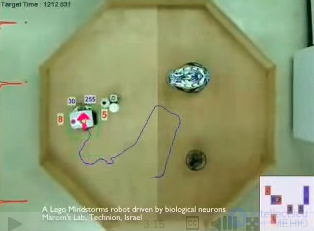
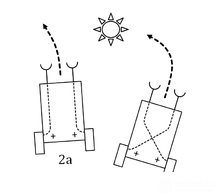
The Braitenberg vehicle is an agent that can move autonomously based on its sensor inputs. It has primitive sensors that measure some stimulus at a point, and wheels (each driven by its own motor) that function as actuators or effectors. In the simplest configuration, a sensor is directly connected to an effector, so that the perceived signal immediately triggers movement of the wheel.
Depending on how the sensors and wheels are connected, the vehicle exhibits different behavior (which can be goal-directed). This means that, depending on the sensor-motor wiring, it tends to seek out certain situations and avoid others, changing course as the situation changes.
The connections between sensors and actuators for the simplest vehicles (2 and 3) can be ipsilateral or contralateral, and either excitatory or inhibitory, producing four combinations with different behaviors — fear, aggression, love, and liking.
The following are some of the simplest examples of Braitenberg vehicles.
The first vehicle has a single sensor (for example, a temperature sensor) that directly stimulates its single wheel in a directly proportional manner. The vehicle can stand still or move forward at variable speed. The effect of friction will cause the vehicle to move unpredictably at low speeds (that is, at low temperatures), in the same way as Brownian motion.
Such behavior might be understood by a human observer as "alive," insect-like, and "restless," never stopping in its motion.
A somewhat more complex agent has two (left and right) symmetric sensors (for example, light sensors), each of which stimulates the wheel on the same side of the body. This vehicle represents a model of negative tropotaxis, a behavior found in animals. It obeys the following rule:
This is a more effective behavior for escaping a light source, since the creature can move in different directions and tends to orient itself toward the direction from which the least light is coming.
In another variant, the connections are negative, or inhibitory: more light → slower movement. In this case, the agents move away from darkness and toward the light.
The agent has the same two (left and right) symmetric sensors (for example, light sensors), but each of them stimulates the wheel on the opposite side of the body. It obeys the following rule:
As a result, the robot follows the light; it moves closer to the light.
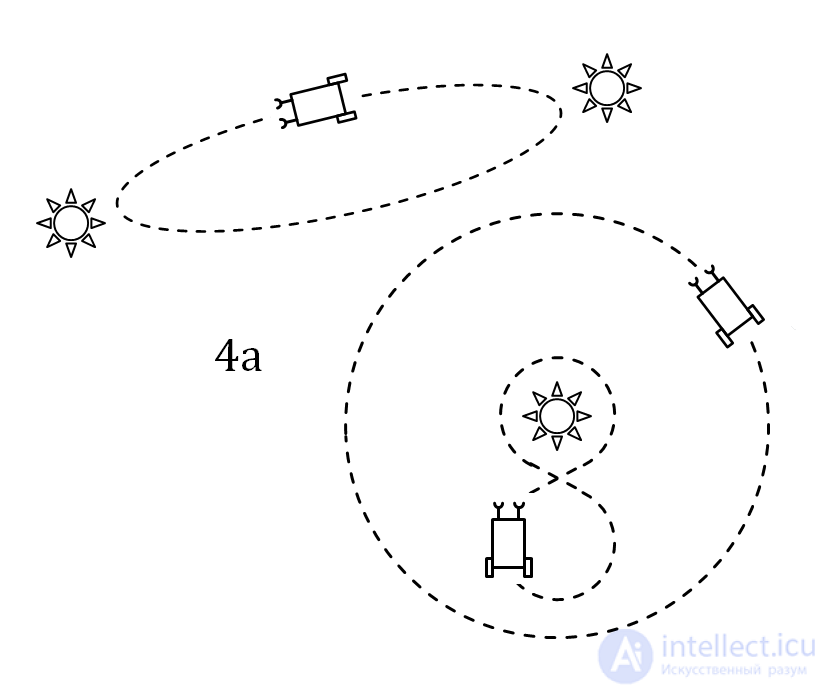
In a complex environment with multiple sources of stimuli, Braitenberg vehicles will exhibit complex and dynamic behavior.
Depending on the connections between the sensors and actuators, a Braitenberg vehicle can move close to a source without touching it, quickly flee, or trace circles or figure-eights around a point.
Such behavior is undoubtedly goal-directed, flexible, and adaptive, and may even appear intelligent, in the same way that minimal intelligence is attributed to a cockroach. Nevertheless, the agent's functioning is purely mechanical, without any information processing or other, obviously cognitive, processes.
BEAM robotics often implements similar kinds of behavior.

Comments