
Lecture
Political ethics — one of the branches of ethics and a problem in politics. At the center of attention of political ethics is the problem of morality and power.
Political ethics (also known as political morality or public ethics) is the practice of making moral judgments about political actions and political agents. It covers two areas. The first is procedural ethics (or official ethics), which concerns civil servants and their methods. The second area is the ethics of policy (or ethics and public policy), which concerns judgments regarding policy and laws.
The concept of political morality can be easily understood if one considers the roots of this term and its gradual development. The core values and expectations of political morality have historically derived from the principles of justice. However, John Rawls advocates the theory that the political conception of justice is ultimately based on the common good of the person, rather than on values that a person is expected to follow.
In trying to make moral judgments on political issues, people also draw on their own perception of morality. The very concept of morality has several moral foundations. Morality, viewed through the lens of these foundations, shapes people's judgments about political actions and political agents.
Plato and Aristotle paid great attention to political ethics. Thus, Plato argued that a state would only be just if its citizens were just; otherwise, the state system was prone to decay. Aristotle drew a connection between the level of morality in a society and the political system that had become established within it. Moreover, the philosopher believed that a true citizen could only be one who possessed virtue, that is, who was honest, just, and acted for the sake of the common happiness.
In the modern era, Niccolò Machiavelli, in his famous work «The Prince», pointed to the autonomy of politics from morality, thereby laying the foundation of a strong tradition known as «Machiavellianism».
The well-known sociologist of the late 19th and early 20th centuries, Max Weber, identified two types of political ethics. The first is the «ethics of ultimate ends». In this worldview, the highest value is placed on the final goal of political action, the image of which is determined by one ideology or another. The other type of ethics is the ethics of responsibility. In this case, emphasis is placed on observing legal and other norms in the process of political activity, whose goal may be rejected if it contradicts these norms.
Already by the second quarter of the 20th century, many democratic countries had reached a new level of development, and the values of Machiavellianism ceased to play their former role. The value of ethics in the political sphere began to rise noticeably, the ethicality of politicians' actions was highly valued by society, and it contributed to increasing the legitimacy of power. Developed countries began adopting various Codes of Ethics (for example, in the USA in 1958 and later), which regulated the activity of both politicians and political institutions as a whole. Today, ethical norms are inseparably linked with the fundamental values of democracy and underlie many international declarations and laws of various countries.
Contemporary research in the field of political ethics has been strongly influenced by game theory, since it concentrates on the problem of justice. For example, the works of the American philosopher John Rawls have gained great renown.
In addition, today the ethical theory of J. Habermas, known as the «theory of universal consensus», enjoys popularity. This approach is one of the most optimal for contemporary political reality. Its essence lies in the fact that the parties to a given interaction establish certain rules and norms in advance, which leads to a mutually advantageous position for all sides, whose interests are taken into account directly before the resolution of any problem begins.
According to K. S. Gadzhiev, «political ethics is the normative basis of political activity, touching on such fundamental problems as the just social order of society and the state, the mutual rights and duties of leaders and citizens, the fundamental rights of the person and citizen, and a reasonable correlation of freedom, equality, and justice, etc.»
Political ethics investigates a whole range of different questions within the political sphere, in which an ethical problem arises regarding the choice of the most optimal course of action.
This is one of the most important problems of this branch of ethics. For a long time, politics and morality were considered mutually exclusive; Machiavelli's ideas prevailed, according to which a good ruler could go against moral values for the benefit of the state. Today, however, there are many approaches to assessing the place of morality in political activity:
— morality must serve as the sole criterion of political action. Within this approach, moral values are treated as the foundation of politics, inseparably linked to it, and any political actions and processes are evaluated from the standpoint of moral norms;
— morality as the main guideline in choosing a political strategy. This approach is less categorical than the previous one, and is often applied in resolving acute, conflict-laden issues, when the most correct solution will be precisely the one that conforms to the norms of morality;
— the development of a specific political morality. Also not the least important is the solution to the problem of the relationship between politics and morality, which consists in developing a «moral code of the politician» as a set of professional norms based on a specific «professional morality» that should function only in the political sphere, within the professional milieu;
— the separation of politics and morality. In this, by now classic, resolution of the question, it is accepted that politics and morality are incompatible categories, and it seems necessary to recognize their parallel existence.
One of the pressing problems is also the introduction of ethical norms into the activity of state bodies, the officialdom, the bureaucracy. With the development of market relations and the increasing complexity of state structures, state bodies are diverging ever further from society, and the bureaucracy is conforming ever less to universal human values. Therefore, one of the problems of political ethics today is the introduction of moral norms into the functioning structure of the state apparatus, and its possible de-bureaucratization where necessary and possible.[10]
In the contemporary world there are a number of directions in the development of political ethics, both as a science and as a set of practical principles.
Within political ethics as a scientific discipline, two main approaches to its study have formed: proponents of the first tend to refuse to present this discipline as a unified body of knowledge, in favor of studying it as a set of various views and theories. However, within this approach the problem arises of developing certain basic propositions and norms that would make it possible to systematize the whole variety of ethical teachings. Within the second approach, it is proposed, on the contrary, to systematize the knowledge accumulated by the relevant theories, to select the most suitable and correct ones from among them, and to develop a unified theoretical basis for political ethics.
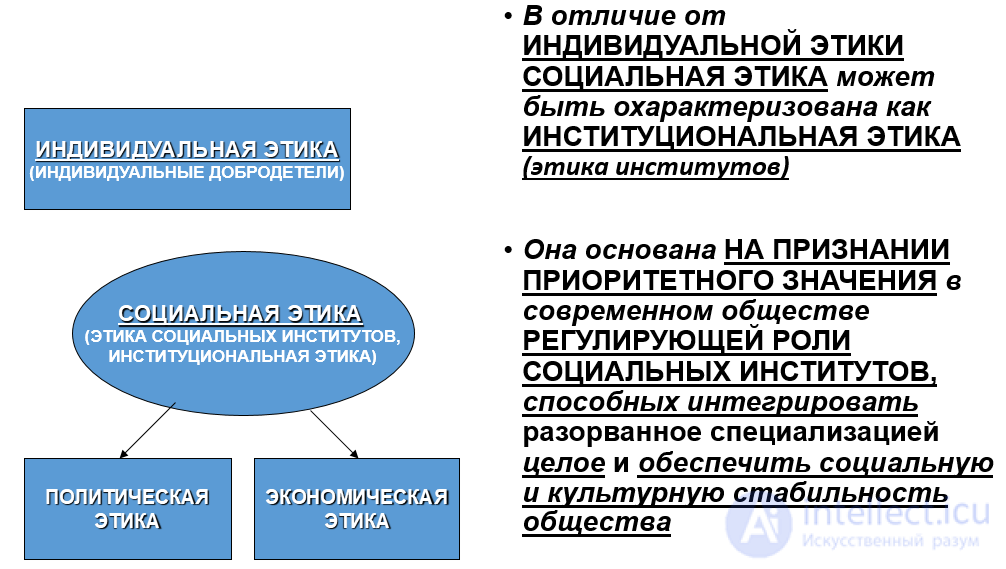
There is also disagreement in defining what constitutes the subject matter of political ethics. Thus, a number of scholars include in the field of research the political motives and goals of actors and political activity institutions, while others speak directly of the values of politics, as well as of the institutions and constituent parts of politics, its structure.
The value of ethical actions is increasing today also because ethical choice confronts contemporary man ever more acutely. The automation of production and the computerization of many processes provide people with a wide range of possible solutions, some of which correspond to the norms of morality, and others do not. The introduction of ethical mechanisms into computer processes appears impossible, and therefore it is the human being who bears the full responsibility for moral choice under conditions of expanded possibilities.[10]
For a long period in the history of humanity, the political elite was presented as a closed group that made decisions without discussion with the broad masses of the people. This led to the formation of the «individual-state» dichotomy, in which confrontation prevails over cooperation. However, within the framework of the contemporary direction of development, democratic deliberation and the active participation of the individual in politics are becoming ever more necessary. This makes it necessary to create new norms that would link the state and citizens, replacing the value of struggle with cooperation, and it also raises the problem of forming a new type of person in politics, one who possesses critical thinking, is capable of perceiving and being aware of various norms, and of making decisions independently.
With the changes taking place in society, the features of state service and the character of politicians' activity are also changing. The significant increase in the complexity of the structure of society, and the differentiation of norms and rules, lead to the existence of multiple interpretations of what is «ethical» and its opposite. In contemporary politics, state service has lost its former values of serving the country and bearing a duty, and has largely become merely one of the social elevators. Therefore, the most important area of development for contemporary social ethics is precisely the formation of a new professional political ethics, the identification of new moral norms, and the highlighting of values suited to the present day.[11]
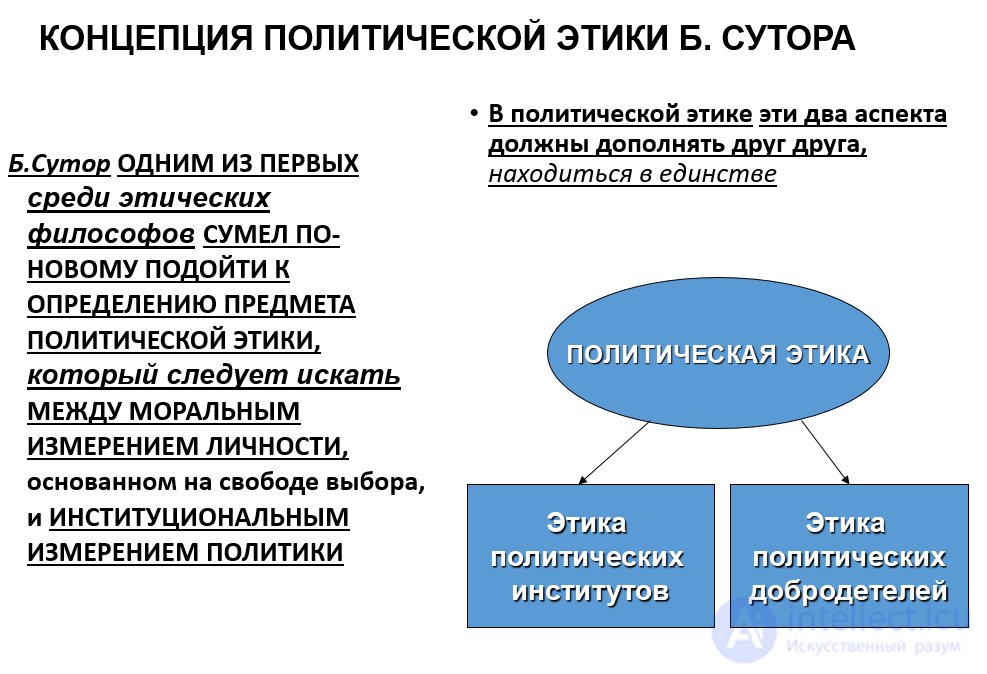
The question of the relationship between politics and morality is one of those questions called "eternal." As B. Sutor rightly observes, even those little interested in politics instinctively sense that this is the sphere of action in which people hold special power to make decisions affecting everyone. Therefore, the suspicion and fear that "those up there" are using their power for their own benefit and to our detriment are always latently present and easily find fertile ground. At the same time, politicians themselves constantly use moral concepts and categories in political discussions, appealing to such lofty values as freedom, justice, and the common good. Very often, in doing so, politically contentious issues are reduced to abstract moralizing slogans, and open discussion of the real problems and political arguments are replaced by moral judgments, frequently with the aim of morally disqualifying political opponents.
On the other hand, beginning with the Italian Renaissance thinker and political figure N. Machiavelli, there has existed in philosophical scholarship and political practice a tendency toward the separation of politics from morality, justifying the use of any means to achieve political ends. However, the use of unscrupulous means in political struggle, the deliberate distortion of information, and political lies have never contributed to the moral improvement of society, leading either to double standards of morality or to more serious consequences (whether the contradictory justifications of U.S. policy toward Vietnam in the 1960s, or the "Chechen problem" in contemporary Russia).
Indifference to questions of morality reveals itself and grows in a pluralistic society, which cannot help but raise the question: must a free political order be founded on basic values of a general order, or should it be oriented toward the amorality of politics?
These problems constitute the main subject matter of political morality (political ethics).
In the broad philosophical sense, political ethics is called upon to explain how politics is connected with morality, to what extent moral judgments are applicable to politics, and how moral notions of good and evil are reconciled with real political activity, which, as Machiavelli already pointed out, is based on the principles of expediency, political practicality, and state advantage.
In the narrower, applied sense, political ethics, as a particular type of professional ethics, is the normative basis of political activity. It is called upon to formulate moral principles and norms regulating people's behaviour in the sphere of politics, and to set guidelines for political decisions and actions. In this sense, political ethics regulates not only the actions of people connected with politics, but also those of all citizens, whenever "big" or "small" politics is concerned. It also affects citizens when they are called upon to exercise their electoral rights.
The problem of the moral (ethical) justification of politics, and of the necessity and possibility of applying moral criteria to political activity, has occupied philosophical and political thought since the ethical teachings of ancient thinkers, and has found its reflection in the works of Aristotle, Plato, Confucius, in Christian social teaching, and in the ethics of Kant. Even the ancient thinkers turned not only to the universal human aspects of morality that characterize the ethical realm, but also attempted to construct a model of an ideal just state and state governance, and were the first to raise the question of the relationship between politics and morality. The comprehension of the significance of the moral-ethical aspect in political activity occupied a central place in Confucianism, which gave priority to moral-ethical regulators of social life over formal-legal ones. This point of view was most consistently substantiated already in the modern era in the philosophy of Kant, who believed that morality must stand above politics, since politics by its very nature must serve the humane ideals of justice. Kant's name is associated with a reconsideration in ethics of the problem of the relationship between ends and means in political activity. An undoubted merit of the German philosopher is his consistent defense of the intrinsic worth of the human person, based on the conviction that no one has the right to manipulate a human being as a means, either in his own name or in the name of society, including for the sake of achieving the loftiest goals.
At the same time, from the very beginning, serious disagreements emerged in ethical thought regarding the interpretation of the question of the relationship between politics and morality, and these deserve special attention. Thus, whereas Aristotle, in his projects for an ideal state, sought to orient himself toward the political practice of his own time and was concerned above all with the stability of political institutions, Plato, unlike him, linked the best structure of the state with the rule of the best people, and considered the worst to be that rule in which material rather than moral values prevailed.
These differences in the views of the two outstanding philosophers on the structure of the state are of fundamental significance from the standpoint of the particulars of contemporary political development. In essence, it is precisely from Plato and Aristotle that two opposing traditions in world political thought and political practice take their origin, concerning the understanding and interpretation of the nature of the state and state power. For one of them (proceeding from Plato and further through Rousseau's idea of the "general will" to the conception of the state and power worked out by the founders of Marxism), the main question in understanding the nature of the state and power was the question, "who rules?". In contrast to this, proponents of the other tradition (proceeding from Aristotle) built their position on the question "what rules?" – does the law rule in the given state, and is that law the same for everyone, including for those in power themselves? Naturally, for representatives of this tradition of political thought, what mattered most was how to properly organize state power and its institutions so that they would serve the interests of the individual and of society as a whole. Conversely, attempts to construct, after the manner of Plato's "republic of philosophers," an ideocratic model of the state built on the power of a single idea, were doomed to failure in advance, since they transposed the real human being into a world of utopia contrary to human nature. It is no accident that in the 20th century Plato's utopia did not stand the test of time. Ideocracies degenerated into totalitarian regimes. But even earlier, in the modern era, this problem was at the center of attention of American theorists and practitioners of state-building – the "founding fathers" of the American nation, who believed, as, for example, A. Hamilton did, that in politics, as in religion, it is unwise to convert people to a faith by fire and sword, since persecution rarely rids one of heresies, in either case.
All of this brings us to the main idea, namely that in such a complex question as the relationship between politics and morality, it is necessary to avoid two extremes•.
1) underestimating the significance of the moral aspect in politics;
2) overestimating it in the domain of politics as a special, specific sphere of social life.
The task of political ethics, as the comprehension of the principles and norms of political orders and actions, consists precisely, as B. Sutor writes in the book we have mentioned, in the fact that it must recognize the moral untenability of that politics and those politicians who, on the one hand, underestimate the role of ethical norms in political activity, and, on the other hand, impose excessive moral demands upon it.
Politics, of course, cannot do without morality, and still less can it be indifferent to it. This obvious fact is confirmed, among other things, by the frequent examples of the use of moral evaluations in political discussions mentioned above, which would be impossible if political questions were not, at the same time, to a considerable degree moral questions as well. This is explained by the fact that politics deals with problems of relationships among people, which cannot be morally neutral, with clashing interests and their possible reconciliation on the basis of the principles of good and justice. Therefore, the methods of politics must fit within the framework of existing conceptions of good and evil. Moreover, politics in principle cannot be free from moral responsibility, for people engaged in politics, and thereby taking upon themselves the function of speaking on behalf of the whole of society, already place upon themselves responsibility for the fate of society and its citizens. On the other hand, given that politicians possess power and real means of coercion, there always exists the danger of their abuse of power to the detriment of many people. This also proves the importance of the moral aspect in politics, and the necessity of understanding its moral foundations, its constructive goals, its permissible means, and the desirable modes of people's behaviour in politics.
In the opinion of specialists, under present-day conditions the position of rejecting moral criteria in politics is unacceptable for many reasons. First, the "price" of political decisions has increased many times over, from the standpoint of their impact on people's fates. Second, under conditions of democratization, the dependence of politicians on public opinion increases sharply. Thirdly, people's awareness of various aspects of political decision-making has grown considerably.
However, while the danger of freeing politics from moral criteria is well known and much discussed and written about, far less attention is paid to another extreme, or another danger – the overestimation of moral aspects in the sphere of political activity. Such a danger always exists, and we most often encounter it in two forms: 1) when politics seeks to claim the role of a guide to moral attitudes, to determine the moral core of the individual; 2) when excessive moral demands are placed on politics itself, seeking to subordinate politics to morality.
First of all, politics should in no way engage in excessive moralizing; it must not encroach on the moral autonomy of the individual, on their freedom of choice, or attempt to take on functions of implementing moral prescriptions that are not proper to it. Such a practice is known from the history of many undemocratic regimes, and especially from the totalitarian ideologies and systems of the twentieth century, when politicians, using their position, sought to become the "conscience of the people" and to decide for people how they ought to act. At best this led to a distortion of the very essence of politics; at worst – to tyranny, to moral despotism. The experience of history has shown that politics cannot directly improve people's morality, cannot create a "new man". Its main task is to help create and improve the external conditions of human interaction, to teach people to live together, and in this way to make moral behaviour easier for people.
This applies especially to modern democratic states, whose essential features are the autonomy of the individual, political, economic and ideological pluralism, and a developed civil society. In such societies, politics should not and cannot take upon itself the task of directly implementing morality or determining the system of values and interests of people. As the experience of developed democracies shows, politics that is free and appropriate to a pluralistic society establishes only the framework conditions for social development and does not claim to do what it cannot and should not do.
Here we need to return to the concept of "political ethics" as it is understood by contemporary scholarship. In the view of researchers, political ethics as such could arise only under the conditions of a modern democratic society. Elements of political ethics that oriented political activity toward the need to observe morality, requiring morals, moderation and tolerance in politics, were of course also used in the ancient Greek polis and were introduced into the political context by Greek sages. However, applying the concept of "political ethics" to that period is possible only with a considerable degree of qualification, given that neither society nor the individual in the ancient polis possessed autonomy, being totally absorbed into the state. Therefore a genuine need for political ethics arose only in the modern and contemporary era, with the liberation of the individual and society from the tutelage of the state, in the transition from a subject-based, paternalistic culture to a culture of political participation. It was then that political activity began to need special regulation.
The political ethics of modern society, by its very definition, cannot allow moral dictatorship or excessive moralizing; it must claim nothing other than to be a regulator of the general democratic principle of freedom in political activity, serving to place state power under the control of civil society by means of the institutions of representative democracy, the principle of the separation of powers, and the mechanism for legitimizing conflicts. Its main goal should be not to put an end to political confrontation, but to bring culture into it. Its main requirements should come down to demands for the self-limitation of power, the establishment of the rule of law, the autonomy of the individual, tolerance, and the protection of citizens' rights and freedoms. Without freeing politics from moral responsibility – on the contrary, revealing the extent of such responsibility – political ethics must at the same time, as B. Sutor observes, free it from an excessive moral burden, and free moral consciousness from the inappropriate tutelage of politics.
It is a dangerous misconception, one that has become habitual, to regard as morally best the political order that places the highest and most exacting moral demands on citizens. An order in which citizens are induced to perform their duty through morality rather than through law and institutions is a bad political order. What is morally justified is rather a social system which, proceeding from the ambivalence of human character, imposes the necessary restrictions on people's bad inclinations while at the same time opening up maximum scope for the realization of their capacity for good. On the whole, this means that politics should regulate political relations by moral means, helping to ensure that law and political institutions shape a politically thinking and politically acting citizen. In everything else, a person should be given the freedom to make use of, guided by the promptings of their own conscience, for moral self-determination and personal self-improvement.
So far we have discussed how inappropriate excessive moralizing on the part of politics is in modern society. No less a danger is posed by the absolutization of the moral demands placed on politics itself, which takes the form of ethical rigorism, and not infrequently the form of moral fundamentalism.
However important the moral side of political decisions and actions may be, one must not forget that politics has always been and remains a specific sphere of human relations, significantly different from the sphere of non-political moral relations. It cannot be denied that, by their very nature, politics and morality have different foundations. In morality the ideal categories of "good" and "evil", "justice" and "injustice" prevail, whereas politics must reckon with real circumstances and be oriented toward a concrete result. Special laws and rules operate within it, along with the struggle of various social forces and political parties defending one position or another depending on their interests and values. For this reason alone, the concept of justice, like the very question of the relationship between ends and means in political activity, cannot be considered in exactly the same way as in the sphere of non-political relations and, at the very least, must not be treated simplistically.
Politics, as already noted above, never has been and cannot be free of values; it will always appeal to morality, since otherwise it is impossible to connect a concrete, personified interest of power with the impersonal common good. However, another statement is also true: although politics must conform to ethical criteria, it cannot be determined by them alone. In Sutor's view, it is precisely this proposition that should serve as the starting point if we wish to bring culture into the political confrontation that is inevitable for politics. Many political questions cannot be resolved by moral means alone, and the quality of politics cannot be determined solely by the morality of politicians. It therefore seems more fruitful to hold the view that the morality of politics depends on how successful it is, on whether it manages to apply its means reasonably for the peaceful settlement of conflicts, the securing of freedom, and the enhancement of social justice.

Comments