
Lecture
Arrestant ethics is a set of informal rules and norms of behavior found among all those who are held in confinement or detention under conditions of isolation. This ethic is made up of rules and customs which, although they vary, help maintain order and reduce conflicts in different situations.
Basic aspects of arrestant ethics include the following:
Mutual understanding of the social order: recognizing the particularities of the social structure and hierarchy, in which the conditions of interaction and cohesion are important.
Solidarity: One can find support in another, especially in conditions when one is left to face difficult hardships and threats.
Respect: The behavior of other people and their particular interpersonal relations is an important aspect of arrestant ethics.
Rules of interaction with prisoners and prison staff: one may work out one's own rules for interacting with other prisoners and with the prison staff.
Having one's own interests: strategies can be developed to protect one's rights and interests under conditions of restricted freedom.
Elimination of conflicts: by using methods to de-escalate issues and conflicts, one may encounter people who can provoke disputes.
Ability to form opinions and possibilities: you have the opportunity to develop your own ways of forming opinions, which can help the authorities or the prison administration.
The thieves' law (thieves' concepts, blatnye [criminal-argot] concepts, thieves' code) — unwritten rules and norms of behavior in the criminal community during the time of the Soviet Union and in the post-Soviet space . It developed owing to the isolation of the criminal social group under conditions of opposition to the state. The thieves' law is codified in several countries, and these are the only ones: Azerbaijan, Armenia, Belarus, Georgia, Kazakhstan, Kyrgyzstan, Latvia, Moldova, Russia, Tajikistan, Turkmenistan, Uzbekistan, Ukraine, Estonia.
The thieves' law has several basic provisions, with obligations following from them that must be observed by the «right» (pravilnye) people belonging to this subculture. There are seven basic provisions in total :
From the above laws follow additional laws (concepts):
From all these provisions follows the prison law, that is, the application of the provisions of the thieves' law during a stay in places of confinement :
"Thieves' directives" are a special kind of written messages and communications that thieves (members of the criminal subculture) send to one another and to the mass of prisoners in prisons and correctional institutions. These progony perform several functions in the world of prisoners and the criminal underworld:
Explanatory progony: This type of progon consists of explanations and instructions regarding the rules and norms of behavior in the arrestant milieu. Thieves share experience and knowledge about how to behave in prison, how to communicate with other inmates, how to avoid conflicts, and also how to observe the "ceiling on the game" - that is, what kind of behavior is considered acceptable within this community.
Kursovye (staying in the loop): These progony contain information about events and decisions made by thieves in the criminal world. This may include announcing a change in an inmate's mast' (status) on account of his actions, decisions on conflict situations, as well as recommendations for the brotherhood (bratva) regarding new prisoners arriving at the institution. These progony help maintain contact and coordination among thieves within the prison walls and beyond them.
Thieves' directives are part of the complex social structure and customs of the criminal world, which may be incomprehensible and inaccessible to uninitiated prisoners or those who do not belong to the criminal subculture. They serve to maintain order, protect the interests of community members, and maintain their contact under conditions of confinement.
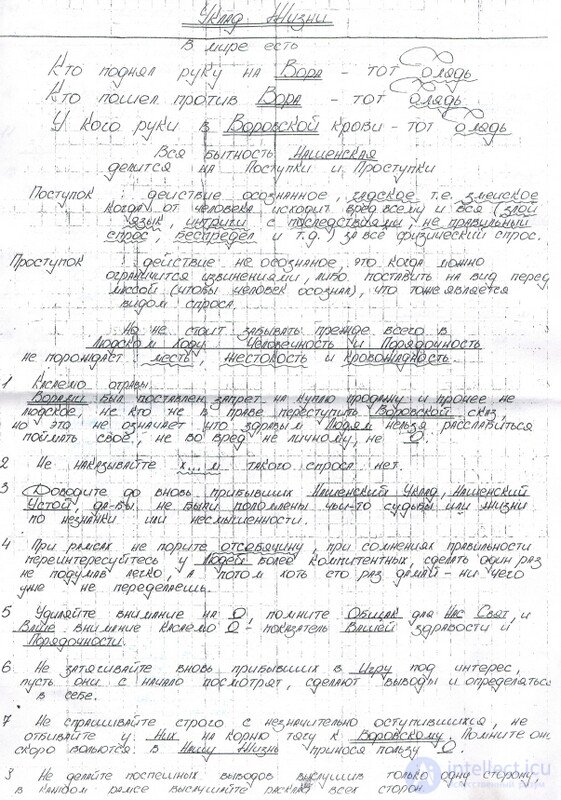

Penalties are imposed for deviation from, failure to observe, or violation of the thieves' law. Departures from the thieves' law are punished very harshly and inescapably, which underlies the good organization and cohesion of the criminal association. A punishment decision handed down at a gathering (skhodka) of thieves-in-law cannot be revoked, and everything possible will be done to carry out the sentence; moreover, every «right» arrestant (that is, one who adheres to the thieves' law) who knows of the punishment handed down and who encounters the person evading it is obliged to carry it out . For thieves-in-law three types of sanctions are provided, which may be imposed only on the basis of a decision of a thieves' gathering (skhodka), reached through the so-called «pravilka» (a disciplinary tribunal), at which the assembled thieves-in-law determine whether the thieves' laws were violated and what punishment is due if a violation occurred .
If a prisoner does not belong to the highest caste, then the punishment options are far more varied (in increasing order of severity): a simple beating; one may «get boxed on the ears», meaning the person loses his current status and moves from the category of blatnye into the category of muzhiki; a prisoner may be subjected to ostracism - expelled from the group and denied its support; the breaking of limbs for prisoners who cannot repay a debt (including a gambling debt) or who have unlawfully beaten someone; «parafin» — a symbolic act of sodomy performed by drawing the penis across the lips of the guilty party; forcible sexual assault, which likewise moves the prisoner into the most despised group, the so-called «roosters (petukhi)», «the offended (obizhennye)» and «the lowered (opushchennye) »; death is applied fairly rarely, for the most flagrant violations of the thieves' law, and must be sanctioned by the local «smotryashchy» (overseer) thief-in-law or by a decision of the local authorities. A criminal must also answer for the tattoos he bears on his body. If a tattoo does not correspond to his life record, or if the criminal had it applied without the right to wear it, he may be beaten for this and demoted to a lower caste, not necessarily the lowered caste. If a person is not a criminal and has no ties to the criminal world, yet has such tattoos, this may result in bloody retribution.
Owing to the intensification of the struggle against the criminal element and the criminal community in the USSR in the 1930s, which intensified in connection with collectivization and the famine of the early 1930s , criminal communities began to unite into more organized groups. The main unifying force of the criminal world became a tendency toward non-political resistance and disobedience to the authorities, and its elite became the «thieves-in-law», who called themselves keepers of the criminal traditions of pre-revolutionary Russia .
In this connection, the thieves-in-law created a special code of conduct, their own customs and traditions, which included a complete rejection of social norms and rules, including those related to family (a thief-in-law was under no circumstances supposed to have permanent ties with women), and an equally complete ban on any cooperation with state bodies: whether in the form of participation in public events organized by them, or assistance to judicial and investigative bodies in the investigation of crimes .
In the 1940s these traditions finally led to the almost complete destruction of this criminal community in its historical form: during the Soviet-German war, many «thieves-in-law» agreed to the authorities' proposal to join the ranks of the Red Army to defend their homeland from the enemy (the so-called «suki»). After the victory over Germany they returned to the camps , where a so-called «Bitches' War» (Suchya voyna) broke out between them and the «zakonniki» (law-abiders) who had not departed from the traditions of the criminal milieu, as a result of which both sides suffered significant losses .
It is important to note that arrestant ethics can vary depending on the country, the type of connection, and the social groups of the participants. It is constantly evolving under the specialized conditions of each place of confinement or other territory.

Comments