
Lecture
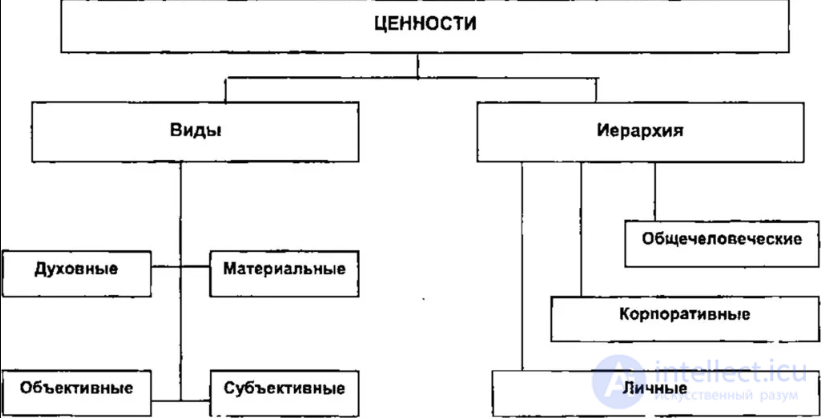
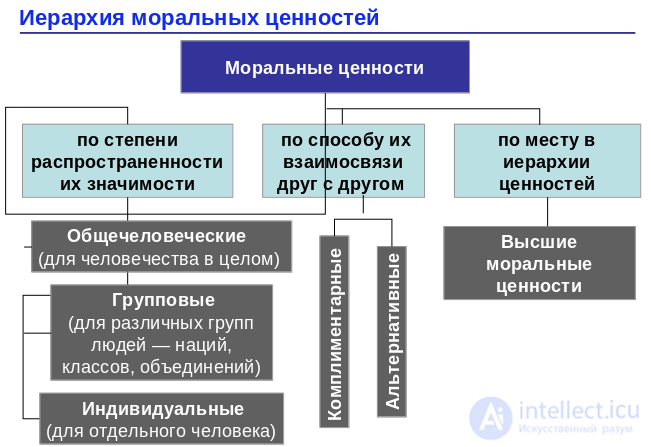
Moral values are social attitudes, imperatives, goals and projects, expressed in the form of normative conceptions of good and evil, justice and injustice, the meaning of life and the purpose of man, his ideals and principles. Moral values determine the norms of our obligation. The understanding of these norms differs in authoritarian and humanistic ethics: authoritarian ethics treats obligation as unambiguous submission to and observance of these norms, whereas humanistic ethics offers them as various options for the free moral choice and preferences of the individual. As a result of this choice a hierarchy of moral values is formed, which is built up as follows:
This division is quite conditional. First, it is subjective in character, since each person (and even more so a group of people) may, on the basis of their own preferences and interests, declare some values to be the highest and universally significant, while belittling or even denying others. Second, the hierarchy of values is relative in character, since it depends on specific historical conditions. Individual cultures and civilizations differ in their systems of values, which serve as criteria for shaping the specific norms of people's behaviour and activity.
On the basis of the hierarchy of values a system of value orientations takes shape — a stable attitude of the individual toward various phenomena of reality and toward the values themselves. The individual's subjective orientation does not always coincide with the generally accepted value orientation, and this can occur both in the form of conscious opposition and at an unconscious level of vague rejection.
In authoritarian ethics, moral values, regardless of the individual's attitude toward them, bear the character of moral obligation. Hence the drive toward the compulsory definition of good, happiness or the meaning of life in authoritarian ethics.
Humanistic ethics, proclaiming as the highest value not norms, principles and ideals, but Man himself, his life, rights and freedoms, his uniqueness and irreplaceability, relies on the reason, will and free choice of the human being, allowing him to build for himself a system of value orientations meaningful to him. And therefore the task of humanistic ethics is not to deny the objective content of values but to study the various models of understanding them. In other words, it does not impose on a person an unambiguous vision of, say, what happiness or love consists in — each person has the right to fill these concepts with individual content as he sees fit, but it does offer an analysis of what happiness and love are, helping a person make a competent choice.
At the same time, such moral phenomena as Good, Freedom, Duty, Honour, Dignity, the Meaning of life, Happiness and Love occupy a special place in the system of moral values. They belong to the highest moral values, for our morality — our actions, views, judgements — depends on their correct understanding. An analysis of the basic ethical categories that correspond to and reflect the features and content of the highest moral values will help you grasp their content and, on that basis, work out a strategy and tactics for «right living».
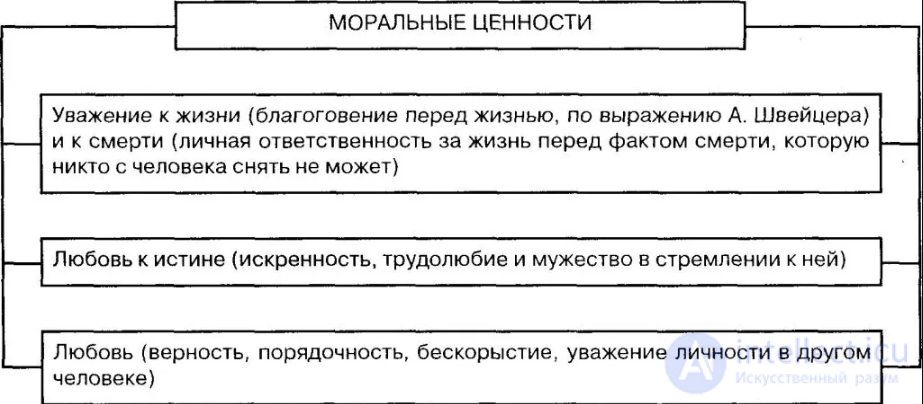
The sphere of moral values (according to V. Polishchuk)
In moral life there must be certain authoritative points of reference — moral values — which would cement and guide the moral life of society and the individual, serving as a kind of compass in everyday moral creativity.
In morality, alongside the most diverse norms, there exists a layer of the highest moral values — life, freedom, respect for the honour and dignity of every human person. It should be stressed that it is precisely moral values that fill our everyday life with fullness and spirituality, with a special meaning. Spirituality should be understood as a person's striving to relate his existence, finite in time and space, to Eternity, to go beyond the boundaries of his own being.
Moral value is a category reflecting the attitude of a given individual with respect to his moral choice, which determines the strategy of his own behaviour in any particular situation.
Good and evil. Good and evil as ultimate evaluative-imperative concepts, by means of which the moral aspect is singled out in human activity and
culture. The basic conceptions of good and evil in philosophy.
Justice. Justice as a principle regulating relations among people concerning the distribution of social values. Types
of justice. John Rawls's conception of justice.
Love. Love as the most important concept of religion and philosophy. Conceptions of love in philosophy. All-forgiving love as the central concept of Christian
ethics.
Happiness. Happiness as a category of philosophy and a fundamental value of human existence. The basic dilemmas connected with the concept of happiness.
The meaning of life. The meaning of a person's life as a central category of philosophy, the axis of a world view and a stimulator of the human will. The basic traditions of interpreting
the problem of the meaning of human life in philosophy. The life and death of a person as phenomena of his being. The moral meaning of a person's life.

Comments