
Lecture
Communicative ethics (the ethics of communication ) is a set of rules and principles that govern the behaviour and interaction of people in the process of communication. It defines the norms that help ensure politeness, respect, understanding and effectiveness in dealing with other people. Communicative ethics is an important aspect of interaction in modern society and is applied in various contexts, such as professional situations, personal communication, social media, and others.
The ethics of communication — is how a person uses language, the mass media and journalism and builds relationships, guided by human morality and values. These ethical principles presuppose an awareness of the consequences of one's Behaviour and its consequences; «respecting other points of view and tolerating disagreement». The principles of ethics include transparency and fairness, as well as honesty in one's own words. James Chesebro describes the ethics of communication as «ethical standards of communication that must reflect a more universal humanistic perspective of people ... in accordance with principles that ensure development and expanded opportunities for people». The ethics of communication may vary depending on one's worldview; any point of view may have «codes, procedures and standards [that] can conceptually and behaviourally frame communication in various contexts».
Scholars use a wide array of ethical theories about the good, applicable to all manifestations of communicative interaction. Every human interaction includes communication and ethics, explicitly or implicitly. Intentional and unintentional ethical dilemmas often arise in everyday life. Rhetoric, media studies, intercultural/international communication, relational and organizational communication, and all other areas of the discipline are permeated with ethical issues. Heterogeneity, interconnectedness and historicity — are the three main factors determining the ethics of communication. Integrity, power and otherness — are the three main issues of communicative ethics, and five different types of ethical reasoning are briefly discussed.
Some basic principles of communicative ethics include:
Politeness and respect: Always show respect for the interlocutor and their opinion. Avoid using offensive or obscene expressions.
Honesty and openness: Be honest in your statements. Avoid distorting facts or providing false information.
Listening: Actively listen to the interlocutor, show interest in their point of view and ask clarifying questions.
Tolerance: Respect the diversity of opinions and cultural characteristics. Avoid discrimination or the spread of intolerance.
Constructiveness: Try to be constructive in your comments and suggestions. Offer solutions and support positive dialogue.
Confidentiality: Respect the private life and information of other people. Do not disclose confidential data without their consent.
Approach to criticism: If it is necessary to voice criticism, do so tactfully and constructively, avoiding insults and humiliation.
Responsibility for words: Be mindful in your statements and be aware of the possible consequences of your words.
Ability to communicate: Strive for clarity and comprehensibility in your messages. Use appropriate communication means and style depending on the situation.
Positivity: Maintain a positive atmosphere in communication. Avoid rudeness and aggressiveness.
The ethics of communication represents a traditional branch of applied ethics devoted to developing the ethical norms and principles that govern interaction between people in the process of communication. Alongside it, both in scholarly consciousness and in the educational process, there has arisen an interest in communicative ethics, the specificity and status of which remain not fully clarified.
Traditional ethics of communication presupposes that communication, like other phenomena of human life, must be subject to the rules of morality, the source of which lies outside communication itself. Given by God or arising from nature, shaped by culture or derived from pure reason, moral norms find application in the sphere of communication, as in other areas of human life. Communication must take place on the platform of fundamental moral truths, in relation to which communication serves as the main sphere of application. Of course, it is precisely in communication that the moral qualities of a person are most clearly manifested, which is why every ethical system has devoted considerable attention to this problem area. Among the classical positions realized in the ethics of communication is the golden rule of morality and the idea of Christian love for one's neighbour. In addition, the theoretical foundation of normative regulation in the sphere of communication is provided by various humanistic theories of the twentieth century, the philosophy of dialogue, and humanistic psychology.
The main difference of contemporary communicative ethics lies in a new arrangement of priorities: moral norms are conceived as arising in the process of communication rather than preceding it, communication is posited as the primary source of moral norms, and the very significance of moral rules is conditioned by how they facilitate the process of communication. Communicative ethics is grounded in the philosophical ideas of J. Habermas and K.-O. Apel, who justified the relevance of precisely this approach to solving the moral problems of contemporary society and laid its theoretical foundations. In this context, communicative ethics appears not as a branch of ethical knowledge, but as a distinct direction within ethics, whose specificity is conditioned by a new interpretation of the essence of morality. For K.-O. Apel and J. Habermas, the source of morality is the real or ideal communicative community, which sets the discourse of moral argumentation.
Discourse ethics as a theoretical strategy has proven to be quite sought after in various spheres of public life, and in response to this social demand, corresponding courses have begun to be taught in universities. However, in their content, traditional ethics of communication and communicative ethics often turn out to be mixed together. A common tendency in their interpretation is that business relations turn out to be the main sphere of both communication and communicative interaction. All curricula of this kind devote no less than half of the course's volume to the rules of business communication. Meanwhile, far from all of them realize the specific approaches of communicative ethics, limiting themselves to traditional justifications of the rules of behaviour in the sphere of business relations.
In studying the ethics of communication, considerable attention should be paid to the ethics of dialogue and its representatives. The section «Ethics of Business Relations» links their effectiveness primarily to the formation of the moral qualities of the person, which will allow them to establish communication, both in everyday life and in the business sphere.
Communicative ethics as a form of interpersonal relations is based on such concepts as:
The most important principle in human relations is the «golden rule», «justice», «humanism», « tolerance».
The golden rule is a universal principle of moral treatment of another person regardless of the situation, obligatory for every person who is not devoid of morality. Only when you can put yourself in another person's position can you treat them as you would treat yourself.
Moral behaviour towards another person is the basis for recognizing the value of the individual, of human dignity. The principle of humanism is based on moral relations.
The golden rule, together with the principle of humanism, contributes to the formation of values in interpersonal relations, thereby influencing all spheres of human activity. These values are defined by such concepts as: tolerance, delicacy, correctness, tactfulness, politeness, leniency.
The concept of forgiveness, guilt, repentance is a derivative of moral life. A person is not always able to conform to moral principles; this happens when they find themselves in difficult life situations, or in situations of moral choice. A feeling of guilt is caused by non-fulfilment of moral duty and non-conformity of behaviour to moral principles. Failure to do what is due, the possibility of committing an immoral, unseemly act, is a source of the feeling of guilt. Ridding oneself of the feeling of guilt is precisely what forgiveness is.
Forgiveness includes such concepts as:
Tolerance – forbearance, is the ability to maintain communication with people who differ from others (in skin colour, physical differences, individual characteristics, styles of thinking, culture) and who do not hold generally accepted opinions.
Tolerance is the perception of other people as they are, a respectful attitude towards their customs, point of view, faith.
Accepting people as they are means recognizing other people's right to be different; not displaying hostility, not feeling irritation, means being tolerant.
Being an ethical communicator means being honest, accurate and truthful. This stems from a person's morality and values, as well as from how people define what is «good and bad». Scholars use a wide array of ethical theories about the good, applicable to all manifestations of communicative interaction. Every human interaction includes communication and ethics, explicitly or implicitly. Intentional and unintentional ethical dilemmas often arise in everyday life. Rhetoric, media studies, intercultural/international communication, relational and organizational communication, and all other areas of the discipline are permeated with ethical issues.
The ethics of communication affects not only the individual, but also businesses, corporations and professional organizations. A company that uses unethical methods of communication is less successful than a company that uses ethical methods. For example, a company with unethical communication methods may hide evidence that it is threatening the environment or breaking the law by being non-transparent, whereas a company with ethical communication methods must promptly publish a message for the affected parties. By notifying customers — future or current — providers and suppliers, as well as other affiliated parties, of a possible danger to the environment or violation of the law, transparency in this case increases the effectiveness of the firm. Transparency should foster trust and good faith, since it shows that a successful company will not hide what serves the interests of its customers. As a counterexample, there may be a time when censorship is a more effective business practice: take the case of a trade secret, when a design method or management tactic is not openly disclosed for the sake of competitive advantage; or when the terms of an agreement/terms of use that a company may have with a service provider prohibit transparency. In this latter counterexample, a business may use social media for advertising, but the social media service provider may restrict the behaviour of its users. Suppose a business considers social media a valuable advertising service. In this case, it may have to censor its product or service in order to preserve the agreement with the social media provider.
Historically, communicative ethics began with problems associated with the print media, and progressed towards digital technologies. Critics began assessing the harm of an unregulated press in North America and Europe in the 1890s, which led to the creation of principles in the United States in the 1920s. During that decade, four major books came out: «Who's Who among the luminaries of journalism: « The Ethics of Journalism» by Nelson Crawford (1924), «The Newspaper's Conscience» by Leon Flint (1925), « Newspaper Ethics » by William Gibbons (1926) and Ethics and the Practice of Journalism by Albert Henning (1932). These authors left a legacy regarding the meaning of the ethics of communication and grappled in their books with problems of ethics. The perennial problems have always been connected with issues of privacy and confidentiality, and were gradually discussed alongside freedom of speech.
Ethics can be traced back to the philosopher Socrates (circa 470–399 BC), who explored deep and broad concepts of good and justice. He believed that anyone, «given time to think and ask questions, can understand the generally accepted rules of moral conduct».
His student Plato (circa 428–348 BC) expanded the concepts of good and justice and argued that justice is achieved through wisdom. He also argued that «good» is the value of what is moral for attaining the highest good.
Aristotle (384–322 BC), who studied under Plato, developed a definition of virtue ethics, according to which a virtuous person will do the right thing primarily because they have good character.
Hannah Karolak - «a philosophy of communicative ethics based on three assumptions: (1) through the philosophy of communication one can distinguish, study and employ various communicative ethics; (2) there are multiple communicative ethics; and (3) at the postmodern moment, the philosophy of communicative ethics, characterized by multiple narratives, offers space for renewing research in the field of communicative ethics». [12] The first assumption explains that the ethics of communication can constantly change over time and with the development of society. The second assumption describes that there are several different views on the ethics of communication. The third assumption is the result of a combination of the first two assumptions of communicative ethics.
The ethics of communication provides an understanding of what communication is «right or wrong».
These philosophers defined the meaning of the words «good and justice», which is now integrated into the ethics of communication. In contemporary society, the media and the news discuss «good and justice», as well as what is considered right and what is wrong. Communication addresses these questions through everyday reports, interviews, professional situations and human morality in matters involving others.
Ethical communication is of crucial importance because of the emphasis on people's responsibility for maintaining civil society. Due to the fact that concern about fake news is becoming increasingly widespread in contemporary society, the importance of ethical communication is becoming significant. Fake news has always been widespread; this was shown on various news channels, such as radio stations. «Now that online platforms, especially social media, are becoming the primary sources of news for an increasing number of people, disinformation seems to have found a new channel». With the development of social networks, it has become easier to spread disinformation around the world.
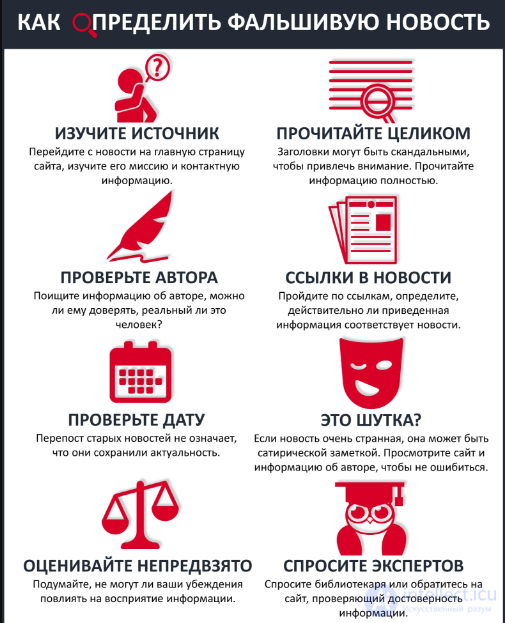
Fake news
Fake (counterfeit, «fake», false, faux) news — an informational hoax or the deliberate spreading of disinformation in social media and traditional media with the aim of misleading people in order to gain financial or political advantage . Authors of fake news often use eye-catching headlines or entirely fabricated stories to increase readership and citation counts. The resulting profit is formed on principles similar to clickbait and represents advertising revenue generated independently of the accuracy of the published material. Easy access to sources of advertising revenue, the intensification of society's political polarization, and the ubiquity of social networks have driven the spread of fake news . The possibility of anonymous website hosting, where anonymous or pseudonymous authors publish, makes it difficult to legally prosecute such sources for disinformation or libel .
Fake news can take various forms. Clickbait arouses curiosity with enticing headlines, usually to increase advertising revenue . Disinformation pursues the goal of misleading the public, but fake news can also simply be false information, regardless of motive. Fake news may also appear in the form of misconceptions, hoaxes, parodies, satire, rumors, or other forms .
Individual studies have found that difficulties in identifying fake news affect all people, regardless of age, gender, or education. Detecting fake news is usually possible through fact-checking. One of the reasons fake news spreads on social networks is the absence of any fact-checking by users, and assessing such information in these cases requires expert opinion. Educating people and raising their literacy plays an important role in combating the spread of fake news .
These basic principles help speakers and reporters disseminate information to the public without offending others. It focuses on respecting people's information and provides a framework for its ethical transmission.
The National Communication Association was founded in 1914 by 17 speech teachers who broke away from the National Council of Teachers of English . Today, thousands of scholars around the world work at the NCA, studying the teaching of communication. They believe that unethical communication can threaten society and run counter to civility in everyday conversations. The NCA promotes honest communication and focuses on educating others through effective dialogue, discussion, and debate.
The duty to tell the truth is not a legal matter, since no single code of ethics applies to everyone. An example of such a code is the 1996 SPJ Code of Ethics, which is based on four principles: seek truth, minimize harm, act independently, and be accountable. These principles reflect today's challenges of a growing online presence.
The Code of Professional Ethics for the Communication Scholar/Teacher, adopted in November 1999, includes the principles of integrity, fairness, professional and social responsibility, equal opportunity, confidentiality, honesty, openness, respect for self and others, freedom, and safety. These codes are established as disciplinary measures for people in professions related to communication practice.
Confidentiality is crucial for all professions, such as teachers, researchers, publications, and professional relationships. Ethics begins with individual people and determines how we interact with other people. One of these is the Code of Ethics of the American Sociological Association (ASA) — mandatory rules established by the American Sociological Association. Six principles and ethical standards were formulated to govern scientific and professional responsibilities.
Observing communication ethics helps build healthy and productive relationships with other people and helps prevent conflicts and misunderstandings. It fosters harmonious interaction and effective communication in various spheres of life.
Having conducted a detailed analysis of all kinds of communicative, human relationships, one can draw the unambiguous conclusion that any relationship is based on ethical norms, and the golden rule is the standard of human relationships.

Comments