
Lecture
The distinctiveness of morality as an effective factor in life is determined by the fact that it is the reference point of the value-world. It is the ultimate, highest authority in matters of norms, evaluations, and value representations that express the inner determination of the meaning of human life-activity.
People's actions and their relationships, as has already been emphasized, are always concrete and have their own particular, specific content, and behind them stand definite empirical motives that are entirely sufficient for the commission of these acts. The most difficult and most important question of human practice is how the substantively diverse, historically changeable, in each instance concrete, causally conditioned content of human actions is joined with their moral evaluation.
Let us first ask: what does the historically concrete, qualitatively distinctive form of morality depend on? It depends decisively on the understanding of the highest good. For morality is not the highest good itself, but rather an orientation toward the highest good, in which the latter is recognized as an unconditional value priority. Different people, in different societies, in different eras, have understood the highest good differently. It could be a religious idea, a social idea, a national idea, a clan idea, the idea of the individual, and so on. Moreover, each idea took its own form: the religious idea as Christianity, Islam and other confessions, the national idea as various forms of nationalism, the idea of the individual as rational egoism, human rights and other varieties of individualism, and so on. How these ideas take shape, interact, rise and degrade is a subject for the sciences that study society. Ethics is interested in them only insofar as they stand in need of moral approval and condemnation.
War, as a specific form of social relation, confronts a person with the necessity of overcoming the horror associated with death. When a person learns to do this, developing the corresponding skill within themselves, they are called courageous. Accordingly, courage is considered a moral virtue. Other types of behavior in the same situation, and above all cowardice as the inability to rise above the horror of death, are regarded as vices. Aristotle specifically emphasizes that behavior resembling courage may be caused by accidental and external motives (experience, overconfidence, ignorance of danger, and so on), but it will not be truly courageous. Only one who is courageous for the sole reason that he considers courage a virtue, a worthy mode of behavior, should be regarded as truly courageous. Thus courage, as a particular human quality and type of behavior, is given a morally intrinsic significance. Many historically existing moral codes have considered courage a preeminent moral quality.
Disputes about which ideas may be regarded as the highest good and possess absolute value priority, which qualities of human character are virtues, which mores, customs, social habits and norms of behavior are morally justified and which are not, the struggle against established moral sanctities in whose place others were erected, the unceasing search for perfect forms of human relationships, accompanied from time to time by crises of values: all this constitutes the main line and the inner nerve of moral life in its historical development.
The functioning of morality in the real experience of social life gives rise to specific difficulties connected with the fact that morality asserts the intrinsic value of the individual, while in the course of practical activity people enter into hierarchical relations in which some govern others. These difficulties find expression in a number of paradoxes, the most typical and widespread of which are the paradoxes of moral evaluation and moral behavior.
Mores – this is what is "in the character" (nrav – character) of people, how people actually behave, what acts they allow themselves and others, and what they regard as bad. Mores are expressed in customs (although, of course, customs express not only mores). Customs arise under the influence of features of economic life, natural and climatic conditions, people's outlooks, and much more.
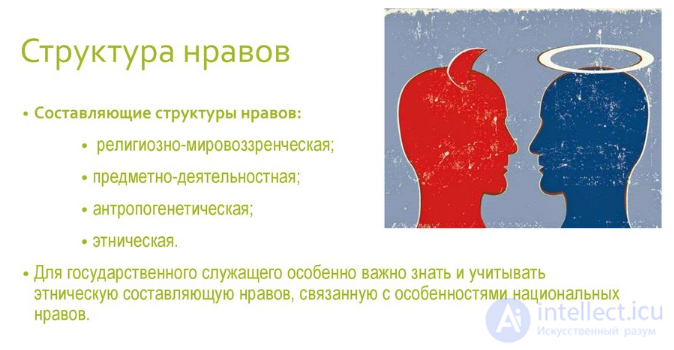
fig. structure of mores
Mores express a specific type of character (ethos) of a society or of a historical period. They determine the style of thinking in all spheres, bringing people back from the world of abstractions into the world of actions. They precede any acts of thought and reflection, and serve as regulators of the political, social and religious behavior of individuals. Only after a person has unconsciously submitted to some custom or other does he realize, upon reflection, exactly what has happened to him. They do not depend on the subjective arbitrariness and desires of the individual person, but at the same time they are not something resembling the action of natural laws.
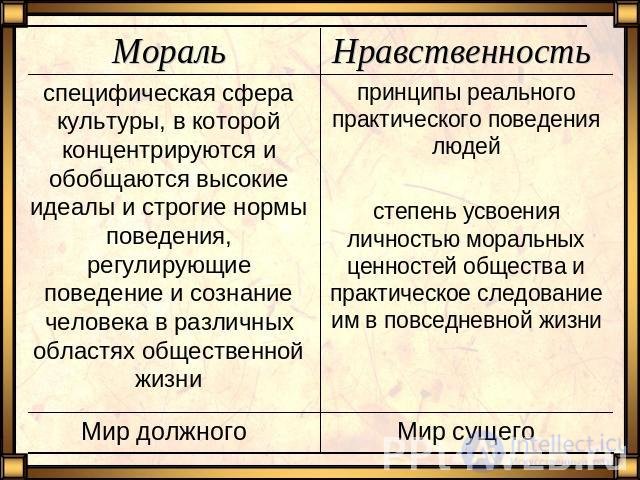
fig. the distinction between morality and morality as lived practice
Mores can be individual and national.
The behavioral stereotypes of Russians naturally depend on which generation a person belongs to.
The most important factor that still determines the behavior of the Russian person (and his attitude toward housing, clothing, food, cleanliness, order, and property) is a long period of living in a totalitarian state.
Among other things, the psyche of the population was very strongly affected both by the post-perestroika crisis and by the „shock therapy“ of the transformations in society in the 1990s.
The rules of everyday life change often and quickly, and no one knows by what laws, and no one explains anything to anyone. In Russia there is a lack of confidence, nothing to rely on.
National character
The main stereotypes about the traits of the Russian national character
„the enigma of the Russian soul“ - the mentality of the Russian people is a mysterious riddle that cannot be solved
„narodnost (national spirit)“ – patriotism, service to the fatherland, love for the homeland, fidelity to traditions
„hope for a bright future“ – the search for truth, justice, freedom, hope for an ideal state, expectation of a „just ruler“
„messianism“ – Russia as an example to other peoples, ready to sacrifice itself for the sake of others („Others are saved, themselves are ruined.“)
„fatalism“ – resignation to the fact that much will happen independently of a person's will and desire, faith that nothing in life is accidental. This trait of the Russian character sometimes leads to passive behavior, the habit of relying not on oneself but on God's will, on a „kind uncle“ (proverbs: „We'll live and see“, „We are used to it...“; „nothing“ – the most frequent reaction to failure)
„sentimentality“, „openness of emotions“, „pathos“ (idioms: „to pour out one's soul“ „soul wide open“ „to have a heart-to-heart talk“)
„polarization“ – dividing the whole diversity of the world into good and evil, truth and falsehood, „one's own“ and „strangers“
„maximalism“, „fanaticism“, „extremism“
an orientation toward observing rites, traditions, customs
Contradictions of the Russian national character
Russians themselves believe that the Russian character consists of extremes and contradictions. The guiding slogan of the Russian person: „All or nothing.“ In the opinion of Russian and foreign observers, Russia is „a country of systematic paradoxes“.
The following contradict one another:
trustfulness, hope for a true ruler - and dreams of freedom
generosity, hospitality, openness in private life - and formalism, strictness, unsmilingness in official communication
great culture (literature, music, theatre), the development of science, the ability to achieve the best results (perfection) in many fields, the presence of modern technologies - and incompleteness, an inability to foresee the consequences of one's actions in advance and plan them, half-heartedness, an inability and unwillingness to bring a started task to completion – everything is decided on the fly, most institutions work at the limit of their capacity (the post office, city transport) (from this stem such positive character traits as „resourcefulness“, „adaptability“, „the ability to create something out of nothing“).
fear of one's superiors - and persistent disregard for prescribed and established rules
Foreigners' opinion of Russians
Russians are a very proud, self-confident people. But on the other hand Russians deceive, pretend, and hide from problems (When German troops entered Kiev, Stalin claimed that not a single German soldier had crossed the Russian border.). When caught in a lie, they merely shrug their shoulders.
The problem of bureaucracy – any matter is processed for a very long and complicated time, the rules change often, and a person seeking something is endlessly sent from one window to another.
Social behavior
Russian collectivism
Russians tolerate solitude poorly; they are a sociable people.
They can strike up conversation even with strangers (conversation on a train), and they like to talk on the phone often.
In the lives of Russians, relations with neighbors are still important - neighborly ties play an almost family-like role.
Russians are characterized by such traits as compassion, warmheartedness, and sympathy (indifference to another person's misfortune is not characteristic of Russians).
On the other hand, many of them have adopted this way of life: live like everyone else, don't stand out.
However, in recent times Russians have also shown a tendency toward individualization (with the fall of the USSR, every Russian citizen ultimately found themselves left to their own devices).
Russians enter their social role more expressively, observe the rules of formal behavior, always try to preserve their „good name“, and are characterized by a constant concern for „what other people will say or think of us“.
A huge difference is observed between a person's behavior in the social (professional) sphere and in private life.
A „servile psychology“ toward superiors is characteristic (the same person may show disdain toward someone dependent on him and, a minute later, become servile and obsequious before his superior); a popular proverb goes: „You're the boss – I'm the fool. I'm the boss – you're the fool“.

Comments