
Lecture
Morality as an attitude of will is the sphere of actions, of a person's practical, active stances.
Morality characterizes a person in terms of his ability to live within human community.
The space of morality is relations between people. When a person is said to be strong and intelligent, these are properties that characterize the individual by himself; to reveal them he has no need of other people. But when a person is said to be kind, generous, courteous, these properties are revealed in dealings with others and describe the very quality of those relations. For example: Robinson Crusoe, once on the island, could display both strength and intelligence, but until Friday appeared, he had no opportunity to be courteous.
Many moral qualities of a person are revealed only in relations between people (honesty, kindness).
Morality is responsible for human community - it is a regulator of relations between people. Human community is sustained not only morally, but also by many other institutions: custom, law, the market, and so on. All human skills, abilities, and forms of activity, not only moral qualities, are connected with the social character of his being.
Morality is not only responsible for human community, it also lends it an inherently intrinsic meaning from the outset.
+Morality can be called the social form that makes possible relations between people in the entire concrete diversity of those relations. It binds people prior to all other ties, and outlines the universal within which alone human existence can unfold. Human relations and the humaneness of relations are very closely related concepts. Morality is precisely that humaneness without which people's relations would never have acquired a human character. The unity of free will and universality constitutes the characteristic feature of morality.
The main historical views on the causes of the emergence of morality.
There are many points of view on the causes of the emergence of morality. One of them is set out in religious conceptions. Morality was given by God, and it is unchanging. People gradually strive to approach the required standard, and how closely they approach it shows their striving toward what is due.
Another point of view on the origin of morality is expressed by authors who hold that morality is a property of man inherited by him as a biological being. In world history these are:
Tylor - a researcher of primitive culture and the founder of the animistic theory.
Peter Kropotkin - an ideologist of anarchism, who expressed biological conceptions on Russian soil.
There is a third point of view: the main factors in the emergence of morality were social - the disintegration of the tribal system, the formation of the slave-holding system, and the stratification of people by occupation and place of residence, which forced them to adapt their behavior to changing conditions of life.
«The social» and «the natural» at different stages of the emergence of morality.
The first moral norms were exclusively prohibitive in character. One must not kill one's own kind (intraspecific regulation). The initial formation of morality took a very long time. This entire period up to early slave-holding society was called pre-morality. The next step at the pre-morality stage was the appearance of permissive norms, which were formulated in the subjunctive mood – «one must not kill a fellow tribesman, but it is shameful not to kill an enemy».
From this moment on, moral norms begin to divide into three groups:
It was unconditionally prohibitive in character. It regulated behavior in situations most important for the individual and the community of primitive people: the prohibition on killing a fellow tribesman, on excessive gathering of plant products, and excessive killing of animals. Of this form only folklore works have come down to us (for example, folk songs of the north). Departure from the norms of this group was followed by severe punishment. Since people possessed an undeveloped mode of thinking and language and could not assess complex abstract punishment through conscience, the higher forces of nature were called upon for help (lightning, thunder, drought, etc.). Thus began the fusion of morality and religion, and thereafter they did not develop apart. In primitive and tribal communities this group of norms in fact played the role of law.
It regulated family and marital relations. Here permissive norms appear, which arise much later.
The regulation of relations between fellow tribesmen who are not in direct blood kinship (mutual aid, friendship, comradeship, etc.).
Morality in our sense begins to take shape during the period of the disintegration of the tribal system and the beginning of the formation of class society. This is connected with a person's gradual awareness of his own «I» and its separation from «we».
The moral choice of the individual is the key act of the whole of a person's moral activity. An act-as-operation is possible only when there are options to choose from; when there are none, it is completely meaningless to speak of virtue, since the person does not exercise a choice between good and evil (Aristotle).
A situation of moral choice arises only when it is a matter of options for a course of action. These options are furnished to a person by objective circumstances. The object of moral choice may be an individual; a collective of people forming norms for the relations among its members; a social group; it may also be a class.
For a choice to take place, the conditions of moral choice must be observed:
The first part of the conditions: the range of objective possibilities for an act, and on the other hand – the subjective ability to choose.
If there is no possibility of comparing the consequences of various behavioral options, of consciously determining a position and translating it into action, then one cannot speak of freedom of choice. A person must know about all possible options. However, the range of choice possibilities is not unlimited; it may be constrained, for example, by a person's physical capacities, the level of prior education received, and so on.
The social conditionality of moral choice is expressed in the possibility of acting one way or another. Ultimately, a person always chooses among things that fall within the circle of his life. The social conditionality of the circumstances that have arisen in a situation of moral choice is inseparably linked with a person's moral and ideological definiteness. However varied the options of choice may be, they always reflect a person's value orientations. Moral choice cannot be exercised outside the bounds of good and evil. Taking into account the moral admissibility of a choice determines a person's choice no less than the awareness of objectively impossible options.
The conditioning of moral choice by external circumstances alone is called moral fatalism – act this way and not otherwise, for that is how circumstances turned out.
If, on the other hand, it is held that choice is conditioned only by a person's will, this point of view is called moral voluntarism.
In a situation of moral choice, the problem arises of the activity of the subject corresponding to particular circumstances – this is the task of finding an act that would correspond to those circumstances.
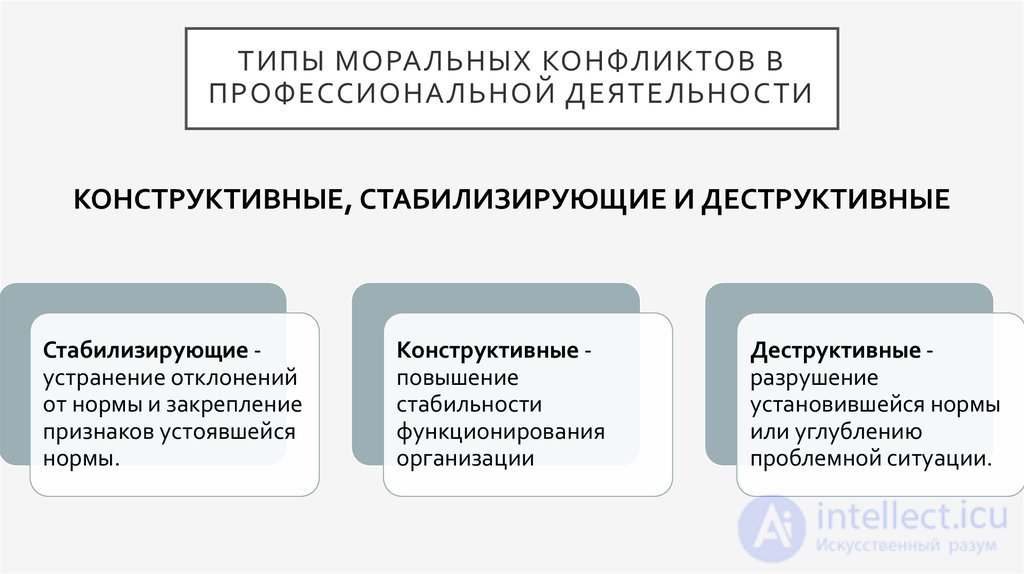
Fig. Types of moral conflicts
Very often a person discovers that carrying out an act according to the laws of good, following one value, leads to that act contradicting the understanding of good found in another value. The situation in which the result of a choice cannot be a direct good, and the choice is made between a greater and a lesser evil, is called: Moral conflict. Choice in a situation of moral conflict depends to the greatest degree on the system of moral values of the very person making the choice.

Comments