
Lecture
Ethics studies the genesis, essence and specific character of morality; it reveals its place and role in the life of society; it identifies the mechanisms of the moral regulation of human activity, the criteria of moral progress. It examines the structure of the moral consciousness of society and of the individual, and analyzes the content and meaning of such categories as the good, good and evil, duty and conscience, honour and dignity, happiness and the meaning of life… Thus ethics functions not only as a theory of morality, studying the essence and specific character of morality, but also as a study of the human being as a moral subject.
According to Aristotle, the aim of ethics is not knowledge in general, but the evaluation of deeds and their content. Aristotle was the first to put forward ethics as an independent science, autonomous from philosophy.
The aim of ethics is the rational analysis of the moral side of human existence in all its complexity, as well as the creation of an optimal model of humane and just relations that ensure a high quality of human interaction and communication.

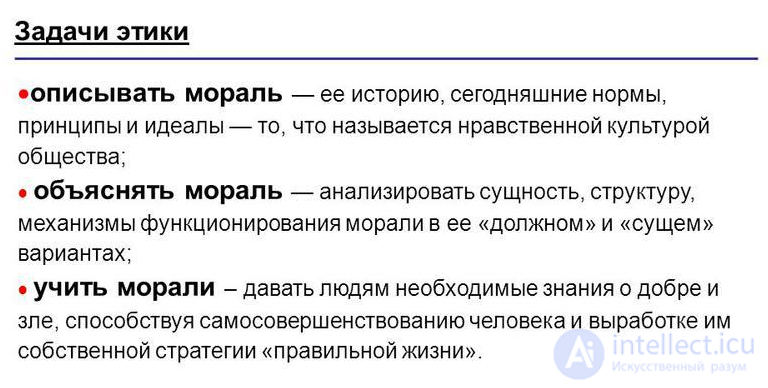
According to Aristotle, the main task of ethics is the study of human relations in their most perfect form. The basic tasks are: the theoretical description and explanation of morality: its history, norms, principles, ideals… To give an analysis of the essence of morality in its "ought" and "is". To teach morality, so that a person may subsequently work out his own strategy of "right living".
The main task of ethics is the study of human relations in their most perfect moral form, as well as of the nature of moral experience, its universality and diversity.
Two kinds of problems have gradually taken shape in ethics:
Any philosophical current must have not only a set of problems, but also aims and tasks that justify its existence. The basic aim of ethics is not hard to define: it must regulate human behaviour, a person's relations with other individuals. It must help a person decide how to act in a situation that is difficult from a moral point of view. Another aim is for the ethical rules that guide a person to prompt his conscience that he has acted wrongly.
Difficulties in determining what is evil and good in certain situations, of course, complicate ethics' fulfillment of its aims. No set of rules can take into account the enormous number of nuances that can fundamentally change one's view of a situation. For example, it is absolutely unethical to interfere in the relations of spouses, especially at the moment when they are having it out. At the same time, if a man is offending a woman, the duty of another real man is to protect her. At what stage one should still be guided by the first rule, and at what stage one should unequivocally intervene on behalf of the weaker woman, cannot be precisely determined.
Since ethics is a philosophical discipline closely bound up with the real life of every member of society, its aims are equally important for every person. Finding the golden mean between how one wants to act and what one's conscience suggests is not always simple. For this, arguments are needed as to why, in a given situation, one should act this way and not another. Which ethical rules to adopt for oneself and consider significant is something each person determines independently. At the same time, the list of ethical norms is not static; as society develops it undergoes changes. For example, as recently as fifty years ago no one even doubted that a man should give up his seat to a woman on public transport (or open doors for her). After the feminist movement gained sufficient popularity, such an act might provoke in a young woman a reaction opposite to the one expected. Which option (to give way or not) a person will consider more ethical depends on the upbringing he has received.
As for the tasks of ethics, they are closely interconnected with the concept of morality. First, what morality is, together with all the questions connected with its origin. And second, what role it plays in a person's life, what it is needed for, and whether it is needed at all by any particular individual.
In the broad sense, morality is understood as the regulator of the interaction between the individual and society, which is why it is so closely bound up with ethics. It is precisely morality that draws the boundaries between the concepts of «good» and «bad», «just» and «unjust», «cruel» and «merciful». But morality is still a far more general, theoretical concept. By itself, without ethics with its subtle explanations and characterizations of every practical deed, it cannot serve as a guide to action. For example, morality tells us that lying is not good. Yet it is beyond doubt that there are many situations in which a lie is not only justified but is even a good. For instance, it is better to lie to a person with a heart condition about some incident that has happened to his relatives, especially if its consequences are reversible. It is even permissible to lie in answer to a direct question, since an honest answer might lead to a negative outcome.
The formation of morality takes place under the influence of upbringing. Most often this occurs in early childhood, and afterward it does not lend itself to serious change. However, strong emotional experiences (for example, compassion) can adjust the moral values even of an already formed personality. Nevertheless, they are practically not amenable to self-analysis and conscious change.
Some thinkers offer an original view of a person's moral principles. In their opinion, these arose exclusively from egoistic motives. Supposedly, a person, guided by them, calculates that they will also be applied toward himself. However, the imperfection of our society suggests that this theory has no real foundation. If the sole reason for the emergence of morality were a calculation on «reciprocity», a person would long ago have realized that this system does not justify itself, and that showing good treatment to someone does not at all mean the same in return from him. On this basis, the striving toward morality and moral life would fairly quickly have exhausted itself. But we see that this does not happen.
Thus, the desire to be treated well by others cannot be called the sole reason why any particular person needs morality. For some people it is part of their religious views. Someone strives to earn, with its help, the good regard of those around him (and self-respect as well). And someone values moral principles simply because he has not been taught to live otherwise.
We see that the aims and tasks of ethics are very interesting in their combination of a theoretical and a practical component. Ethics strives not only to work out a line of behaviour, proving that it is precisely this line that is the most correct and healthy for society, but also to help each particular person put it into practice. And in each particular society, its successes in this endeavour are assessed separately.

Comments