
Lecture 40 min.
Ethics (from ancient Greek ethos - character, habit) is the philosophical study of morality and morals.
The substantive and formal features of ethics are set by three constants: the essence of morality as the object of study; the ways of its theoretical comprehension and description within a socio-cultural context; and the basic paradigms of philosophising (Eastern, Western, Ukrainian).
Ethics is one of the oldest forms of spiritual activity. For many centuries people have striven to understand the nature of moral values, to learn to orient themselves in life situations, and to find stable life goals. Moral values are one of the forms in which the moral relations of society manifest themselves: the social significance, the dignity of the individual and of his actions, or the moral characteristics of social institutions; conceptions belonging to the sphere of moral consciousness - moral norms, principles, ideals. A significant contribution to humanity's spiritual quest along this path is made by religion and art, which have accumulated immense moral experience. However, only ethics strives for a theoretical comprehension of the value-laden, life-meaning problems of the human being: how and for the sake of what one should live, what to orient oneself toward, what to believe in, and what one should strive for.
At first the meaning of the word "ethos" was a common dwelling and the rules generated by common cohabitation, norms uniting society. As society developed, this meaning came to include the study of conscience, compassion, friendship, the meaning of life, self-sacrifice, and so on. Subsequently the term "ethics" was formed from the word "ethos".
The purpose of this work: to trace the development and characteristics of ethical teachings in certain countries of the East. To this end we shall examine ethical norms, problems and concepts in historical and geographical dimensions, together with the related concepts of etiquette, mentality and worldview.
Introduction
1 Ethical Teachings of the Ancient East
1.1 Ethico-Philosophical Systems of Ancient India
1.2 Ethico-Philosophical Teachings of Ancient China
2. Modern Ethics of the Countries of the East
2.1 The Ethics of Modern China
2.2 The Ethics of Modern Japan
2.3 The Ethics of Modern India
2.4 Modern Iranian Ethics
Conclusions
The first ethical teachings arose in Ancient India and Ancient China at the end of the 2nd - beginning of the 1st millennium BCE. Over many centuries various teachings on morality took shape in India: Brahmanism, Jainism, and Lokayata (Charvaka).
According to Brahmanism, at the foundation of everything that exists lies the world spirit - Brahma. The soul of any living being is a particle of the great Brahma, and after death it passes from one body to another until it is united with him. In the world there operates the law of karma, according to which all of a person's deeds bring about certain consequences for the life of his soul in its new state. If during his lifetime a person fulfilled his duty, followed the laws of his caste and the prescriptions of the Brahmins, then after death his soul is reborn in the body of a person of a higher caste; but if he transgressed, he will find himself in the body of a person of a lower caste, or even in an animal, a bird or an insect. Therefore a person must take care of the soul, not of bodily life.
The followers of Jainism held that life is continuous suffering, since it contains falsehood, greed, anger and other vices. A person can free himself from suffering through non-violence, honesty and mercy. He must lead an ascetic way of life, rather than strive for wealth.
The starting point of the ethical views of the followers of Lokayata is the thesis that there is no world beyond this one, and that only sensory objects exist. Therefore a person must take care not of the soul, but of the satisfaction of reasonable needs. His purpose consists in liberation from suffering and in obtaining pleasures.
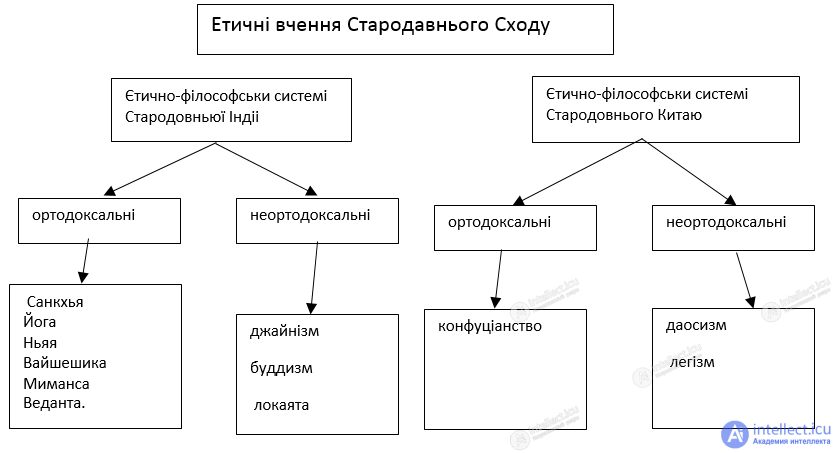
Figure 1. Ethical Teachings of the Ancient East
At the turn of the 6th - 5th centuries BCE, Buddhism arose in Northern India, later spreading to China, Japan and other countries of the East. The essence of the Buddha's teaching consists in the following.
First, everything in the world is transient and therefore full of sorrow. After the death of the bodily shell, every being is reborn in another body - of a human or of an animal. Since existence is suffering, it is evil, while non-existence is the good.
Second, the cause of suffering is the passions and desires of the human being. Any desire gives rise to action, and action, in turn, to new suffering. Since love, compassion and other such qualities give rise to actions, they too must be alien to the human being.
Third, a person can free himself from suffering if he renounces desires.
Fourth, in order to attain salvation it is necessary to step out of the cycle of reincarnations, attaining a bliss conditioned by merging with the spiritual first principle of the universe.
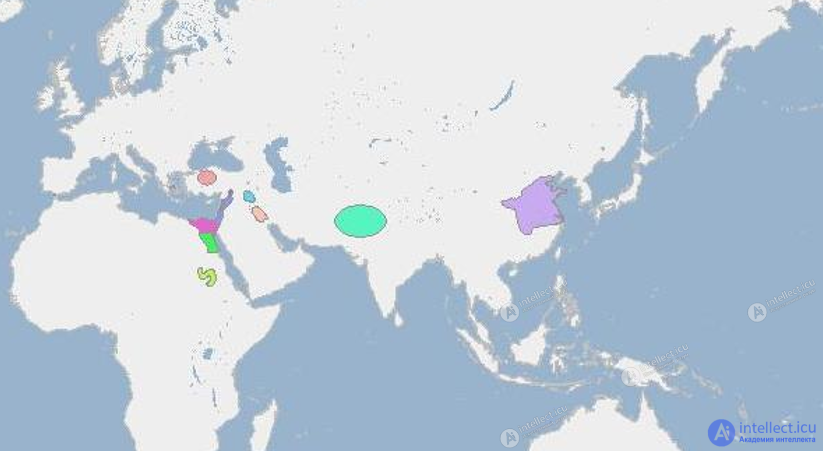
Figure 2 - 1000 years BCE. The map of the world shows settlements in the area of Egypt, India and China.
The defining ethico-philosophical teaching in Ancient China was Confucianism. Its founder was Kong Fuzi, or Confucius (551-479 BCE). In his book "The Analects" attention was drawn to the fact that the proper conduct of people is based on three concepts: "humaneness", the "golden mean" and "reciprocity". It is precisely these that define the path following which a person can live happily. Reciprocity consists in observing the "golden rule" of morality: do not do to others what you would not wish for yourself. Humaneness orients people toward respect for their elders and reverence for history. The "golden mean" is the ability for restraint and caution, which is characteristic of wise rulers. The moral ideal of Confucianism is an educated statesman, who knows the rites and constantly cares for his sub-
-jects. He influences those around him through his own positive personal example, rather than through condemnation.
The first beginnings of ethical knowledge appear in the states of the Ancient East (Egypt, Mesopotamia, China, India), which began to take shape in the 6th-2nd millennia BCE (see Fig. 2). The rhythmicity of natural forces, the need for organised collective effort in the productive sphere, the striving to preserve the natural equilibrium and to ensure the inviolability and effectiveness of state foundations, as well as the deep roots and prevalence of religious cults - all this determined the way of life of the peoples of the Ancient East. A person's life - from birth to death - was subordinated to social norms and prescriptions, and following them was the chief condition of his existence; he had not yet become an individual personality, and he expended his strength on occupying the corresponding cell in the grid of the social order, which gave him a sense of belonging with others and personal security. The development of ethical thought in this region proceeded under particular socio-cultural conditions, among which the following stand out:
- a cult of the past and strict control over the observance of traditions;
- a wary attitude toward everything new, and its acceptance only within the framework of established traditions;
- the subordination of the individual to the social group, its norms and customs;
- the predominance of collectivist ideals, conditioned by the fear of "losing oneself", of not fitting into the social community;
- the levelling of the personality, the subordination of its interests to those of society;
- a complex system of rituals and ceremonies.
An example of the embodiment of these socio-cultural paradigms may be found in the ethical teachings of India and China, countries that preserved their distinctiveness longer than others.
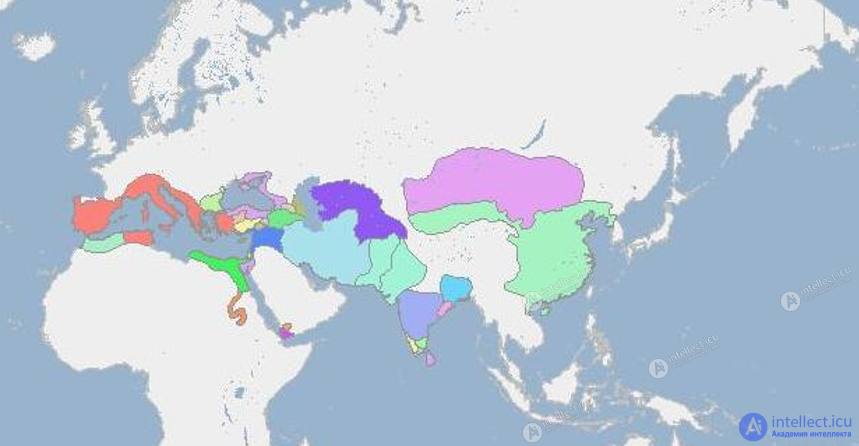
Figure 3. On the world map, 100 years BCE - the westward expansion of China, the appearance of Mongolia (in purple), the Roman Empire - in red.
They finally took shape in the middle of the 1st millennium BCE, although they arose considerably earlier. According to their attitude toward the Vedic canon, they are divided into two groups. The orthodox systems, which rely on the Vedas, are represented by Brahmanism and the philosophical schools (darshanas) that arose on its basis: Vedanta, Mimamsa, Samkhya, Yoga, Nyaya, and Vaisheshika. The heterodox trends include Buddhism, Jainism, and Lokayata-Charvaka. Brahmanism. Closest to Brahma are the gods and demigods - the asuras, followed by the four castes of human society: priests (Brahmins), warriors (Kshatriyas), farmers (Vaishyas), and slaves and servants (Shudras). Lower still are animals, the spirits of the dead, and so on. For each of the castes a set of rules of conduct (dharma) is prescribed, by which the moral worth of any being is determined. The individual soul is immortal; it passes from one body to another (samsara) in accordance with the positive or negative karma accumulated during its lifetime (the principle of posthumous retribution). Any violation of caste norms is judged negatively. The moral ideal is the humble fulfilment of one's social duties, even the most unpleasant ones, and constant professional self-improvement, which gives hope for a higher birth in a future life. The misfortunes that sometimes befall highly moral people are explained as the result of negative karma accumulated by them in a past life. The ethics of Buddhism, which arose in India in the 6th century BCE and later spread to China, Japan and other countries, is built somewhat differently. According to the teaching of the Buddha (Siddhartha Gautama, who lived in 563-483 BCE), any dwelling in an imperfect bodily shell is negative, and therefore the truly enlightened righteous one strives for nirvana - the highest bliss, connected with the complete cessation of the cycle of bodily rebirths and with merging with the spiritual first principle of the universe. Nirvana can be attained already in this life, by mastering the "four noble truths":
1) life in a bodily shell is suffering;
2) the source of suffering is desire;
3) in order to avoid suffering and new physical births, one must rid oneself of desires;
4) the means of ridding oneself of desires is following the "eightfold path of salvation". The essence of the latter consists in the awareness of the four truths and their realisation through complete self-renunciation and detachment from the external world. The eightfold path includes:
1) right understanding;
2) right aspiration;
3) right opinion;
4) right speech;
5) right action;
6) right way of life;
7) right effort;
8) right concentration.
The moral ideal is the sage - the arhat, indifferent to everything, wholly immersed in meditation, as well as the pious monk - the bodhisattva, selflessly preaching the truths of Buddhism among other people. The moral ideal is the sage - the arhat, indifferent to everything, wholly immersed in meditation, as well as the pious monk - the bodhisattva, selflessly preaching the truths of Buddhism among other people. The moral ideal is the sage - the arhat, indifferent to everything, wholly immersed in meditation, as well as the pious monk - the bodhisattva, selflessly preaching the truths of Buddhism among other people.
In a similar way the ethics of Jainism unfolds, based on the principle of "ahimsa" - the non-infliction of harm on living beings. The materialist school of Lokayata-Charvaka developed ideas of extreme hedonism in ethics
, calling for the pursuit of pleasures, but it did not gain wide popularity.
These teachings, too, can conventionally be divided into the most ancient, traditional - orthodox trends, relying on the Pentateuch (Wujing) of the Confucian canon, and the later - heterodox schools (Daoism, Legalism), which arose in the 6th-3rd centuries BCE.
Legalism, or the school of the «jurists» (4th-3rd centuries BCE). Its principal representative was Han Feizi.
The representatives of Legalism - the school of the "jurists", which arose during the period of the final unification of the Chinese empire (Fig. 3), place their main emphasis on the concept of law (fa), which must be put into practice by the harshest means. In their view, the centre of morality is the semi-divine person of the emperor, who through state officials must keep his subjects in constant fear. Only then will all offences disappear, and order and harmony will reign in society. The dominance of Legalist ethics did not last long. Having first come into confrontation with Confucianism, the idea of harsh, immutable laws subsequently dialectically supplemented the principle of humaneness advanced by Confucius, and was absorbed by it.
Legalism regarded morality based on «li» as an unreliable means of governing the state, and preferred law ( «fa») as such a means instead. Observance of the law rests on coercion and punishment. The absolutisation of the role of law in society can be interpreted both as the totalitarian suppression of the individual by the state machine, and as the ideology of a state of law, where all are equal before the law.
The founder of Confucianism, Confucius (551-479 BCE). The main source of Confucian ethics is the book "The Analects" (Lunyu), in which, in the form of philosophical parables and aphorisms, judgements are expressed about the proper conduct of people, based on three concepts - "humaneness", the "golden mean" and "reciprocity". Together they define the "right path", thanks to which a person will live happily, in harmony with himself and with other people. Reciprocity (shu) received the name of the "golden rule" of morality. Confucius defined it thus: "Do not do to others what you would not wish for yourself". Humaneness (ren) orients people toward reverence for the past and respect for their elders. The "golden mean" (zhong yong) is the lot of wise rulers, capable of restraint and caution. The moral ideal is the "noble man" (junzi), a broadly erudite statesman, an educated connoisseur of the rites, who constantly cares for his subjects, influencing ordinary people not through coercion, but exclusively through his own positive example.
Daoism, in the person of Laozi (604 BCE), regards as its moral ideal the hermit-sage, wholly withdrawn from social activity and absorbed in inner spiritual self-perfection. The purpose of human existence consists in comprehending the great path - the Dao, which all that exists follows in its development. With the help of special gymnastic exercises, psychophysical training, and profound meditation, the righteous one learns intuitively to follow the natural course of things, to attain his goals without interfering in the course of events. In this way he realises the principle of "active non-action": «doing nothing - and yet achieving everything», endlessly strengthening his own spiritual potential and ultimately acquiring the qualities of a sorcerer, an immortal wonder-worker. Subsequently Daoism actively interacted with Chinese Buddhism, performing a socio-ethical function similar to it.
The representatives of Legalism - the school of the «jurists», which arose during the period of the final unification of the Chinese empire, place their main emphasis on the concept of law (fa), which must be put into practice by the harshest means. In their view, the centre of morality is the semi-divine person of the emperor, who through state officials must keep his subjects in constant fear. Only then will all offences disappear, and order and harmony will reign in society. The dominance of Legalist ethics did not last long. Having first come into confrontation with Confucianism, the idea of harsh, immutable laws subsequently dialectically supplemented the principle of humaneness advanced by Confucius, and was absorbed by it.
In the Chinese language, the concept of good and evil is expressed by the antonymic pair of characters «shan», closely connected with the pair "i" 義 - «li» ( «duty/justice» - «benefit/gain»), and represents two broader circles of meaning: «happiness, good fortune, beauty, skill, usefulness, mastery, kindness, virtue, approval» (Skt. sadhu, bhadra, ela) and «misfortune, ugliness, disfigurement, harm, corruption, viciousness, excess, hatred» (Skt. agha).

Figure 4. The modern character «shan» (shan) - «goodness»
Etymologically, the primary element of the character "shan» is a depiction of a ram's head (see Fig. 4), which symbolizes the ram as a valuable commodity - a food delicacy and a sacrificial offering. Hence the cognate words «food» (shan) and «sacrifice, good omen» (xiang). The extension of the semantics of «shan» to denote the finest food, sent from on high and offered up to the higher powers, through the inclusion of ever more abstract and immaterial kinds of good, led to the appearance in its graphic form of an additional element (doubled or single) containing the depiction of a mouth and interpreted as «speech» . In
Confucianism, Daoism, Buddhism and folk religion, the term «shan» came close to the notion of grace that flows from above and makes people virtuous. Already in the most ancient canonical literature the terms «shan» and «de» were used as mutually defining: «Virtue is good governance» ( «Shu Jing»);

Figure 5. World map 2019 (Eastern countries at the centre)
The term Eastern countries broadly refers to a range of different cultures or peoples, religions, and philosophical and ethical teachings; depending on the context, it most often includes, at the very least, geographically the countries of Asia and the cultures of eastern Europe and north of Oceania. This term is not generally used by people within the region itself, since the Eastern world is a broad, complex and dynamic region that is difficult to generalize about, and although the peoples and countries living within its territory have much in common that unites them, historically they never needed to define themselves collectively as the opposite of another civilization or nationality.
Originally the term had a literal geographical meaning, referring to the eastern part of the Old World, contrasting the cultures and civilizations of Asia with those that existed in Europe (in the West). Traditionally this includes the whole of Central, North and East Asia (the Far East), West Asia (the Middle East), Southeast Asia and South Asia (the Indian subcontinent) (see Fig. 5)
China's business ethics is quite distinctive. It is based on demonstrating respect for and the inviolability of personal space, both literally and figuratively. For example, tactile contact (physical hugging, kissing and even touching) during communication is considered acceptable only between very close people who are in very personal or even intimate relationships. In all other cases it is not permitted.
Special attention at business meetings is, as a rule, given to two points:
1) gathering the fullest possible information about the subject under discussion and about the negotiating partners;
2) building a «spirit of friendship" toward representatives of the other side.
The spirit of friendship in negotiations is of great importance to the Chinese, and they identify it with ordinary personal relationships between partners. The goodwill that is shown should not mislead you - it has nothing to do with you personally. It relates to the matter at hand and its importance. It by no means signifies that the negotiations will end favourably for you. To succeed you must be prepared to work through the entire matter thoroughly and carefully, to consider it from every angle, and to take into account the influence of various external forces surrounding the negotiation process that may affect it. Bear in mind that a sudden change in the external situation at any stage of the negotiations (even ones that are already almost or entirely complete) can fundamentally affect the outcome of the business interaction.
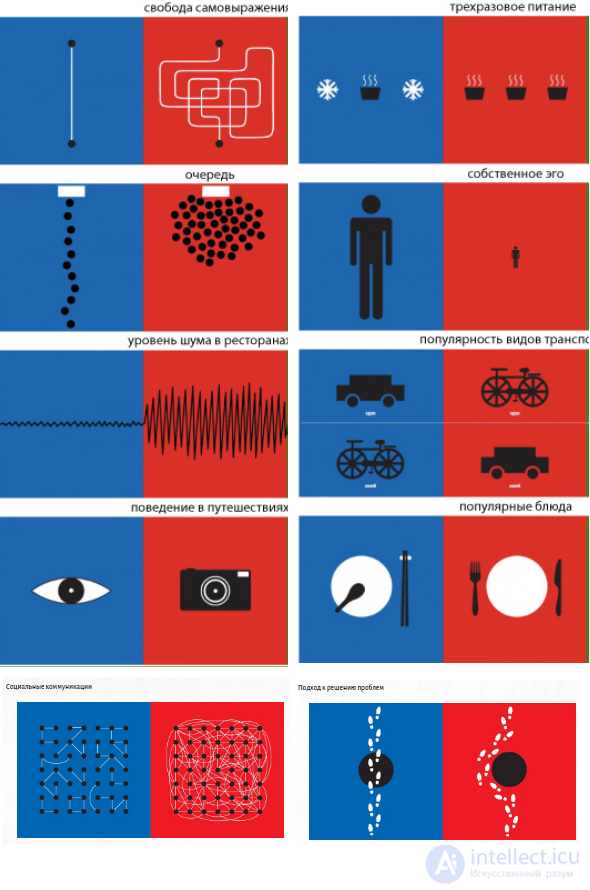
Figure 6. Comparison of the mentality of the average Chinese person and the average European.
The mentality of a people gives rise to ethical norms and traditions. Examples of the features and differences of the Chinese mentality can be seen in Fig. 6.
Japanese culture is historically linked to Chinese culture. This commonality can be seen in the strict hierarchy of relations between elders and juniors, the use of intermediaries in complex and disputed matters, and the giving of gifts in gratitude for a service or help rendered. The latter can even come as something of a shock to a European.
The main features of the Japanese national character are: diligence, discipline, devotion to tradition, deference to authority, a sense of duty, self-control, meticulousness, a deep appreciation of beauty, courtesy, and curiosity. According to Japanese morality, the basis of relationships between people is mutual dependence. Belonging to one group or another is therefore the foundation of the Japanese sense of self.
Hence another famous trait of the Japanese - loyalty to one's group, firm, state and nation, together with the accompanying patriotism and selfless dedication to defending their interests, as well as a high degree of organization. The Japanese judge a person, above all, by their affiliation to one group or another.
When in India, one should try to observe the customs of the people with whom one will be entering into business relations. The fact is that this is a multinational country, with a great many diverse cultural, religious, social and other specific traditions. They are neither bad nor good. They are different, and this should not be forgotten when dealing with them. Within the country one can encounter people who openly advocate aggressive, belligerent behaviour with all the consequences that follow from it, as well as representatives who completely reject violence in all its forms.
Practically all Indians speak English. This is a consequence of the long period of colonial dependence on Great Britain. When greeting one another, men shake hands. One may also use the local greeting, especially when meeting a woman - palms pressed together in front of the chest with a slight bow.
One must constantly bear in mind that India has a strict caste system. It is essential to know which caste people belong to, and what business
connections you have already established with them, as well as to take into account the corresponding restrictions (for example, a ban on contact with representatives of the lower castes), so as not to force your Indian partners to do something that goes against their principles.
Additional points that should be taken into account in business communication are: a high degree of respect for elders; punctuality; food should be passed or accepted only with the right hand; in conversation one should not touch on personal topics, the problem of poverty, military spending, or large volumes of foreign aid; men may not talk to a woman in public places if she is walking alone, or touch her.
Iran is an Islamic republic, the largest state in the Middle Eastern region, and it plays an important role in international and regional relations. Although Iranians have called their country Iran since ancient times, elsewhere in the world the outdated name «Persia» remained in general use until 1935 .The essence of the fundamentalist view of world development lies in the assertion that Islam is a comprehensive world doctrine, the only path to salvation for the whole of humanity. In this context it is worth recalling the words of the well-known Egyptian scholar H. Munis: «Islam is universal for any time and place, Islamic doctrines, laws and ethical norms are a powerful stimulus for development in any age». In their views on world-civilizational processes fundamentalists proceed from the premise that the whole of human history is determined and directed by Allah. people themselves are unable to change history, they can only align their efforts with the will of God. The goal that Allah has set before humanity is to create and maintain an Islamic society on earth. But, despite Allah's power over history, the victory of Islam will not be automatic - its realization depends on the efforts of Muslims.
An integral part of the fundamentalist conception of world-civilizational processes is the notion of a single universal law to which the whole universe is subject - both man and nature. According to this view, nature obeys the laws of the natural sciences, while Allah has given man the shari'a, which is part of the universal law, that is, it exists in harmony with the surrounding world, with the essence of man and his behaviour.
In turn, the strategy and focus of the activity of various Islamist organizations is currently being revised in the direction of consolidation on the basis of Islamic values. They are actively uniting with one another and with society. The idea of the unity of the Muslim Ummah is once again taking hold of public opinion in the countries of the Islamic world.
One striking example of the increasing international significance of the Islamic factor is the Islamic Republic of Iran, whose goals and purposes of existence, as reflected in that state's Constitution, have a global-messianic character, and the type of socio-political structure of modern Iran serves as a model for the future worldwide Islamic Ummah (community) .
As a greeting, Iranians shake each other's hands and then press their own right hand to their heart. It is not customary to shake hands with women, and it is also forbidden to touch women or look them directly in the eye.
When meeting an Iranian it is important to know his full name and title in advance. If there is no title, one should address the Iranian as "doctor", "mister" and so on. One may switch to informal address only once asked to do so.
Most often, business cards in Iran are exchanged only by high-ranking persons. Business cards should be made in both English and Persian.
Family ties are of very great importance in Iran. A family, as a rule, consists not only of husband, wife and children; it represents a group united by kinship ties along the male line. At its head are the husband and wife, their married children, and possibly married grandchildren and great-grandchildren. Family bonds place on Iranians a heavy burden of responsibility and care for one another. On the other hand, they also provide clan support. In getting a job and advancing in one's career, it is not personal merit but family connections that matter. The traditional patriarchal nature of the Iranian family also affects the relationship between parents and children; even today children rarely openly defy their parents' will. The arranging of marriages is still, in most cases, the prerogative of the parents.
Iranians are very hospitable, open and friendly people; they consider courteous treatment of a guest to be their duty. From childhood, every Iranian learns clear rules of politeness, which include, for example, modesty in communication, respectful address to people of different ages and status, refusing to be the first to take something until it has been offered several times, and also the tradition of giving a guest whatever they like, and so on.
In Iran it is customary to invite people to visit upon first acquaintance, and to greet guests with the words: «Peace be with you!», to which one should reply: «May peace, and the mercy of Allah, and His blessing be with you!»
The cleanliness of Iranians is closely connected with their religion. Since many pray five times a day, before prayer one must achieve ritual purity, which means washing.
Women's rights in Iran.
In Iran women live considerably more freely than, for example, in Arab countries. They can walk the streets alone, drive a car, use taxi services, sit at the table together with men, work in various institutions, and even separate from and leave their husbands.
In the metro, carriages are not separated by sex; there are only a couple of carriages specifically for women who wish to travel exclusively in the company of women. On buses one can sometimes see women sitting at the back and men at the front, or the other way round. But this rule is far from always observed. At the airport, women and men undergo inspection and passport control separately.
Iran's business ethics.
Iranian businessmen are very polite, courteous and hospitable people who are accustomed to adhering to traditional protocol. In particular, at the start of a business meeting you will always be shown your place at the negotiating table. Many Iranian businesspeople received their education in the USA. All meetings with representatives of Iranian administration and enterprises should be arranged in advance. Iranians express any gratitude in a markedly polite manner and expect the same from others. An Iranian will let a guest go ahead, giving them the opportunity to always be the first to enter a meeting room, lift, and so on. In business life Iranians tend to follow the European style of dining; in other cases variations are possible, for example a meal eaten seated on the floor on a carpet. Smoking is not customary in Iran. If you are able to, it is better to observe this local tradition. In Iran a bureaucratic style of management with religious features predominates. Your Iranian partners are unlikely to expect representative gifts from you, but they will appreciate it if you present them with a small memorable souvenir. The main thing is that it should not be alcohol or anything else forbidden by Islam.
The ethical thought of the countries of the East is distinguished by its diversity, but common characteristic features can be identified within it:
1) the process of the accumulation of knowledge was NOT intensive but extensive in character, that is, knowledge was accumulated but not developed;
2) schools and currents developed in parallel rather than sequentially, which made the process of continuity more difficult;
3) there is no clearly expressed authorial position, which gave ethical thought a certain "facelessness";
4) the orientation is not toward external reality and objective actuality, but toward self-perfection.
These features were conditioned by the features of the socio-economic and political reality of the countries of the East, which were characterized by the absence of private ownership of land, strong dependence on the state, and the formation of a closed estate-based society with a high level of social inequality.
The achievements of the ethical thought of the countries of the East can be divided into religious and social. The former include the creation of such virtues as respect and reverence for the gods, humility, non-violence, and submissiveness. Among the social-moral values cultivated by the ethical thought of the East, the following should be noted: veneration of ancestors and preservation of customs, respect for elders, hospitality, non-violence, a benevolent attitude toward all living things, truthfulness, piety, generosity, and restraint from anger and the pursuit of pleasure
The countries of the East have their own culture and customs. Eastern ethics is significantly more ceremonious than European ethics, and reaches deeper into the past, into its own traditions and history. Most countries of the Near, Middle and Far East were formed on the basis of ancient civilization and the philosophy of the world religions of the East. In general terms, the basis of the doctrine of ancient Eastern culture of business interaction and communication is that a single individual (or the majority of people, not marked from above with the "seal" of chosenness) cannot influence the course of the universe; they represent a grain of sand in the world ocean. That is why what is important is the "collective" (the country, the family, relatives, society, and so on), and not the "personal" (the individual, the person, personal interests, personal freedom, and so on). At the same time, for the "Eastern" party to the negotiations it is not at all necessary to disregard or forget their own interests in favour of the "Western" party, or, at the very least, they will be taken into account. After all, they are the "chosen one". Therefore, if the negotiations turn out well, then, despite all their goodwill and studied politeness, the "Eastern" negotiator will, with a light heart, "outwit" their Western counterpart. They cannot let down their family, country, relatives, and so on. Therefore there is no question of "deception", it is merely commercial cunning or something of that sort. But if honesty toward a business partner is advantageous to the "Eastern" negotiator themselves, they will be "crystal clear" and exceptionally sincere. The Western tradition of an open, trusting and "mutually agreeable" business process is often perceived by Eastern partners as an inability to conduct business, and sometimes simply as foolishness.
Of course, the world does not stand still. Ethical traditions are evolving, taking into account the realities of the modern process of the development of society, science, art and technological progress.

Comments