
Lecture
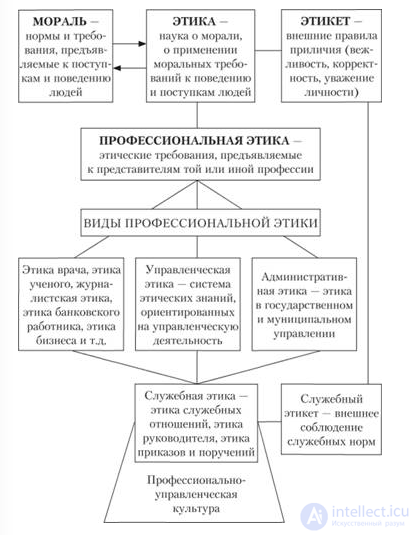
Managerial ethics – a set of rules and forms of business communication with people, making it possible to express respect for them and contributing to the establishment, between a leader and subordinates, of an atmosphere of mutual understanding and goodwill toward one another.
The contemporary level of development of science and technology places high demands on the level of professional competence of a manager specializing in a given field. In addition, any manager, regardless of field of activity - whether production, commerce, finance or show business - must possess skills in working with personnel and must constantly take the human factor into account in solving management tasks:
Administrative ethics – is information, adapted to the practical needs of state and municipal service, about the basic ethical concepts, regularities and trends of official relations, about moral values, and about the moral requirements for the forms, methods and style of official activity.
Official ethics - the broadest concept in the sphere of professional ethics.
By official ethics is meant a set of the most general norms, rules and principles of a person's conduct in the sphere of his professional, production and official activity. These norms must be observed by every person who has begun to work. The number of these norms is small. The overwhelming majority of them are formulated in an extremely general form, so that they can be elaborated in detail with respect to specific kinds of activity. The requirements of official ethics:
Discipline. The concretization of this concept depends on the specifics and content of the work. For example, in animal husbandry the concept of discipline will be determined by the life cycles of the animals being cared for.
The conservation of material resources provided to the employee for carrying out production activity. These resources can be of the most varied kinds. The necessity of replenishing lost resources falls as a heavy burden on profit and cost price, hence the requirement to keep losses to a minimum. This norm includes the conservation of heat, buildings, equipment, materials, etc.
Correctness of interpersonal relations. In the sphere of his labour activity, a person must conduct himself in such a way that interpersonal conflicts arise as little as possible, and so that it is comfortable for other people to work alongside him in direct and indirect interpersonal contact.
All these requirements are divided into two subgroups. The first subgroup: includes the requirements in horizontal interpersonal contacts (subordinate - subordinate, head - head). The second subgroup: includes the requirements in vertical interpersonal contacts (subordinate - head). Here the main requirement for the subordinate is recognition of the very right of the head to issue directives, which includes the functional duties assumed by the person under the employment contract.
+On the basis of these duties, the subordinate must structure his behaviour accordingly, and must not resort to various forms of evasion in carrying out directives. Evasion can be overt, public, with the setting of certain conditions for the head. It can be covert, taking the character of secret (by means of facial expressions, gestures, individual words) provocation of the head into open action against the subordinate. In these situations the subordinate may often appear, to those around him, to be the suffering party, while the head's reaction to him seems inadequate. One of the reasons for such behaviour by subordinates may be a desire to accumulate a certain amount of social capital, to appear persecuted, to acquire the status of an informal leader, to achieve various privileges for oneself, etc.

Comments