
Lecture
Metaethics (analytic ethics) — a field of research whose object is normative ethics. Metaethics carries out a logico-linguistic analysis of normative-ethical, moral reasoning with respect to its consistency, validity, terminological precision, etc.
In metaethical research two lines of analysis intersect: one is directed at developing a certain «reference» image of ethics, at clarifying the criteria and the very possibility of correct, demonstrable ethical reasoning; the other — at critiquing actual ethical constructions (specific doctrines, concepts, arguments)
Ethical studies of the early and mid-twentieth century are associated with metaethics.
The first study in the field of metaethics is considered to be George E. Moore's work «Principia Ethica»

Metaethics does not act as a judge in ethical disputes and does not participate in shaping value positions. It performs an ordering, systematizing function, brings logical discipline to ethical disputes, and removes the «excess complexity» of ethical problems, which arises not so much from the complexity of the subject matter of ethics itself as from the imprecision and ambiguity of its concepts.
According to Richard Garner and Bernard Rosen, there are three kinds of metaethical problems, or three general questions of metaethics:
A question of the first kind, for example, is «what do the concepts „good“, „bad“, „right“, „wrong“ mean?». The second category includes questions about whether moral judgments are universal or relative, unambiguous or pluralistic. Questions of the third kind consist, for example, in asking how we know what is good and what is bad, and whether this can be known at all. Garner and Rosen argue that all three kinds of questions are not independent, and that an answer to one of them implies fairly definite answers to the others
These theories attempt to answer, above all, the first of the general questions of metaethics. For example, value theory is a semantic theory.
These theories attempt to answer questions such as: «what can moral judgments be justified by?» or «why is it necessary to follow the norms of morality?» Most moral epistemologists believe, of course, that judgments in the domain of morality can be justified — unlike moral skeptics.
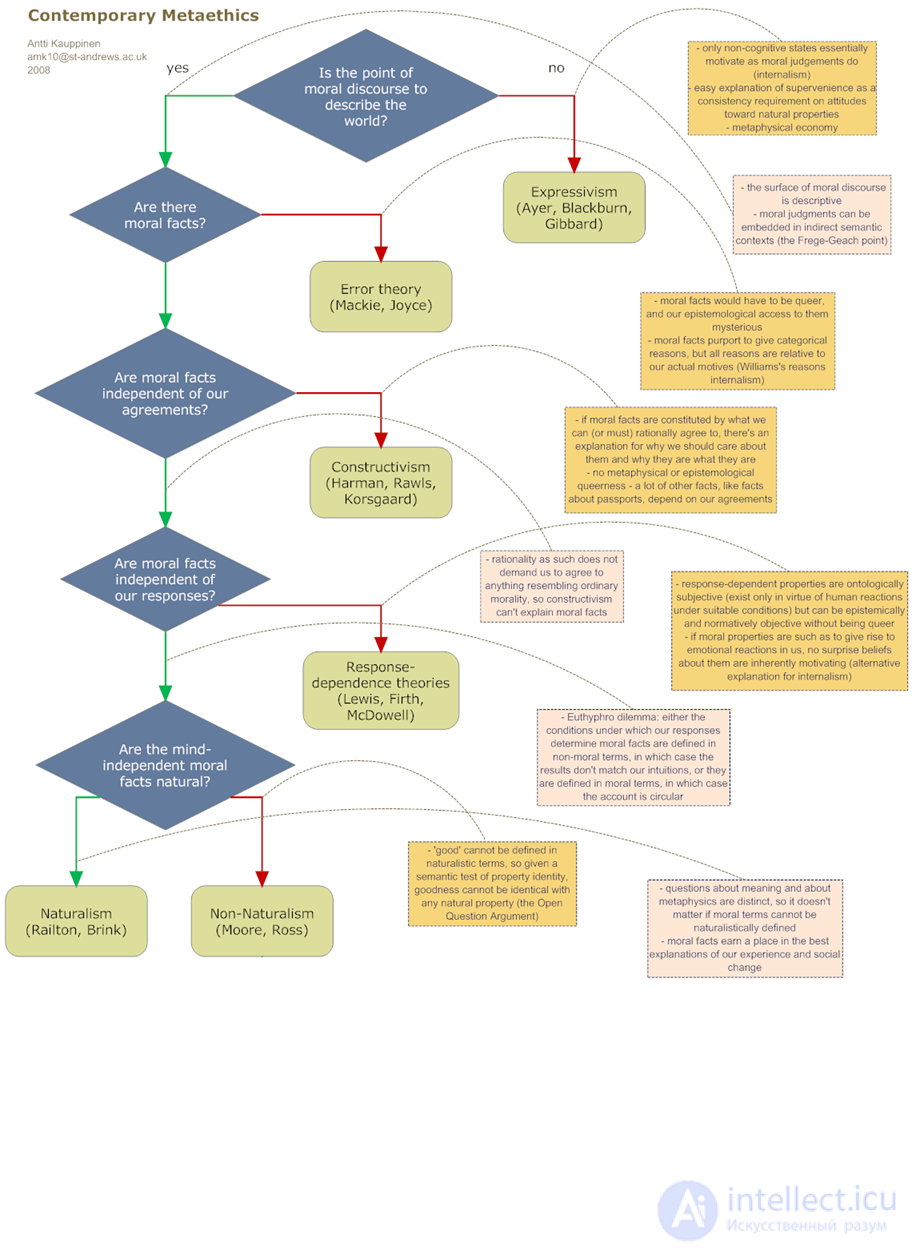
Contemporary metaethics
Intersubjectivism (cultural relativism)

Moral facts depend on place and time.
FOR: Explains cultural differences
AGAINST: The impossibility of cross-cultural criticism and justified disagreement with society, the blurring of cultural boundaries
Emotivism
Ethical statements are not true or false judgments, but exclusively expressions of the speaker's emotions.
«Torturing people – that is bad» means «Torture, ugh».
«Charity – that is good», means «Charity, yaaayyy!».
FOR: Explains the difference between ethical judgments and judgments about facts, and the functioning of morality in terms of evolution.
AGAINST: Discussion? A change of feelings?

Comments