
Lecture
Most modern companies take their image quite seriously. When starting a job at such an organization, one must strictly observe the rules of official (service) ethics. Let's work out what these rules actually involve.
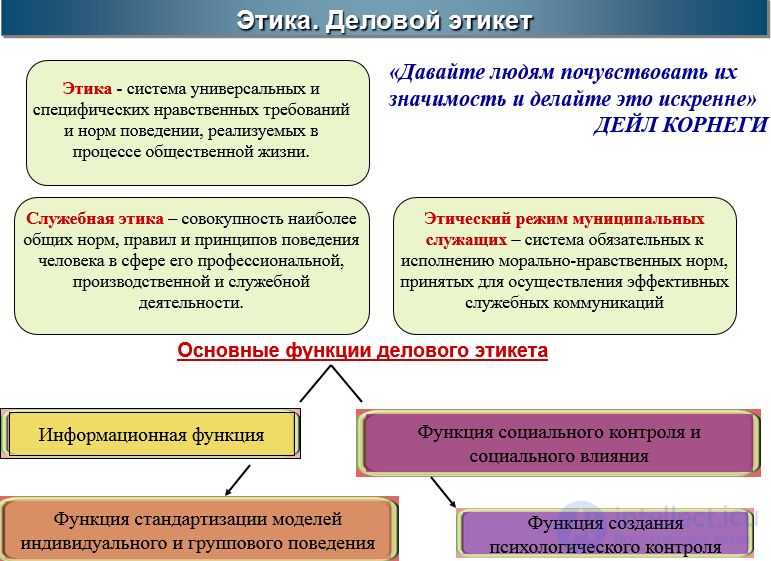
Ethics is the science that studies the specific character of human behaviour in society, including its moral dimension.
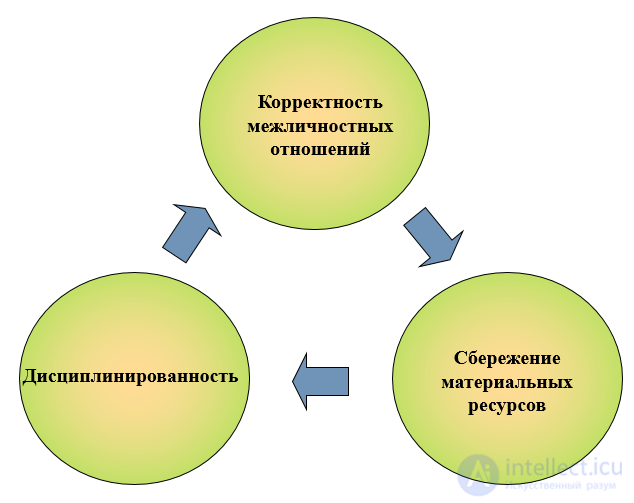
Official ethics - the broadest concept in the field of professional ethics. Official ethics is understood as the set of the most general norms, rules and principles governing a person's conduct in the sphere of their professional, productive and official activity. Every person who starts working must observe these norms. There are not many of them. Most are formulated in extremely general terms, so that they can later be spelled out in detail for specific kinds of activity. Requirements of official ethics:
Discipline. The specific content of this concept depends on the nature and content of the work.
Conservation of the material resources provided to an employee for carrying out productive activity. These resources can be of the most varied kind. The need to replace lost resources weighs heavily on profit and production cost, hence the requirement to keep losses to a minimum. This norm covers the conservation of heat, buildings, equipment, materials, and so on.
Correctness of interpersonal relations. In the sphere of their work activity, a person must behave in such a way as to give rise to as few interpersonal conflicts as possible, and so that it is comfortable for other people to work alongside them in both direct and indirect interpersonal contact.
All these requirements fall into two subgroups. The first subgroup includes requirements for horizontal interpersonal contacts (subordinate – subordinate, manager – manager). The second subgroup includes requirements for vertical interpersonal contacts (subordinate - manager). Here the main requirement of the subordinate is to recognize the manager's very right to issue instructions, which includes the functional duties the person has taken on under the employment contract.
On the basis of these duties, the subordinate must shape their behaviour accordingly, and must not resort to various forms of evading the execution of instructions. Evasion can be overt, public, accompanied by the setting of certain conditions for the manager. It can also be covert, taking the character of secretly (through facial expressions, gestures, individual words) provoking the manager into open action against the subordinate. In such situations the subordinate may often appear to those around as the suffering party, and the manager's reaction to them as inadequate. One of the reasons for such behaviour on the part of subordinates may be the desire to accumulate a certain amount of social capital, to appear persecuted, to acquire the status of an informal leader, to obtain various benefits for themselves, and so on.
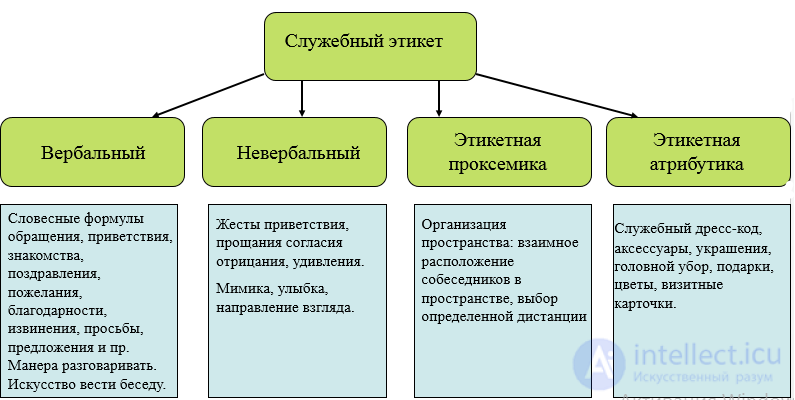
Official etiquette – is the accepted manner of communication within a given company, by which people communicate within the collective and with business partners in order to achieve the best possible results in their work. It is part of business ethics.
The concept of official etiquette includes several components at once:
Principles and values of official ethics
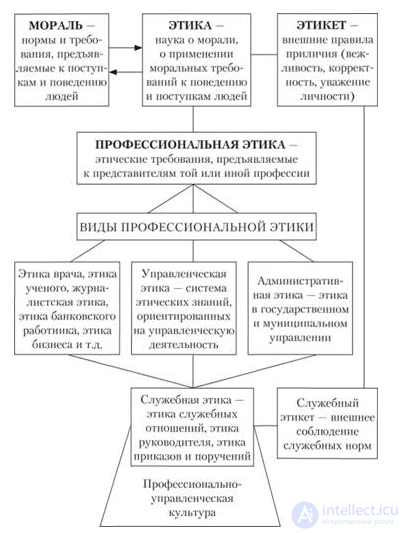
Biomedical ethics (bioethics) is a specific form of contemporary professional medical ethics; it is a system of knowledge about the permissible limits of manipulating human life and death. Such manipulation must be regulated morally. Bioethics is a form of protection of human biological life. The main problems of bioethics are: suicide, euthanasia, the definition of death, transplantology, experimentation on animals and humans, the doctor-patient relationship, attitudes toward the mentally disabled, the organization of hospices, and childbearing (genetic engineering, artificial insemination, «surrogate» motherhood, abortion, contraception).
Professional morality in journalism began to take shape together with journalistic activity. However, the process of its formation stretched
over centuries and reached definiteness only once the journalistic profession became a mass one. It was completed only at the turn of the 19th and 20th centuries, when
the first codes were created and the professional-moral consciousness of the journalistic community acquired a documented form
of existence.
As a journalist absorbs, in the course of professional formation, the postulates of professional morality, they enter into professional-moral relations with colleagues which, unlike moral relations as such, presuppose the possibility of institutionally organized and
direct intervention by the corporation in their behaviour.
The professional ethics of the journalist, like other kinds of professional ethics, began to take shape directly within the course of the work itself. It manifested itself in the codification of those professional-moral notions which had spontaneously taken shape within the mode of journalistic activity and had in one way or another been fixed by the professional consciousness of the journalistic community. The appearance of the first codes
marked the completion of a long process of formation of professional journalistic morality and at the same time opened a new stage in its development. This new stage was based on the purposeful self-knowledge of journalistic activity and the practical application of its results.
Management ethics – is the science examining the acts and behaviour of a person operating in the sphere of management, and the functioning of an organization as a
«collective 18 manager» in relation to its internal and external environment, in the respect in which the actions of the manager and the organization correspond to
universal human ethical requirements.
Economic ethics – is the set of norms of conduct of the entrepreneur, the requirements that a cultured society places on his style of work,
the character of communication among business participants, and their social image. Economic ethics includes business etiquette, which is formed
under the influence of the traditions and certain historical conditions that have taken shape in a given country.
The main postulates of the entrepreneur's code of ethics are the following:
The rules of etiquette-based conduct are the same for men and women (in the business environment we address one another on the basis of status, not gender).
A person should be treated with equal courtesy and respect; maximum goodwill should be observed, emphasizing this with words, a smile, and manners.
One of the leading parts of official ethics is the code of communication between manager and subordinates. And here the requirements for behaviour largely concern not the subordinates, but the superior.
In any situation a manager must «keep himself in hand», must not humiliate employees, and must remember that each of them is a person. Respect within the collective, regardless of rank, is an integral part of communication, since it increases the productivity of subordinates.
Good manners are also very important for a superior. This is because his employees will, over time, pick up the manager's manner of communication and begin to communicate in the same way. That is why the superior must, first and foremost, set an example.
Nor should a superior violate certain conventional norms of etiquette. Thus, on arriving at work, he needs to greet the employees, while the staff should not stand up from their workstations. If the manager is fairly young, he should be the first to greet employees of mature age and women whom he encounters. But at the same time, for example, when a female employee enters the manager's office, the superior is not obliged to stand up.
While talking with subordinates or visitors, a manager should not look through documents unrelated to the matter at hand, allow himself long telephone conversations, or occupy himself with other extraneous business, such as drinking tea without offering some to the other party.
A superior should address employees only using the formal «Vy» (the polite «you»).
The rule «Treat a subordinate the way you would want a superior to treat you» is the fundamental rule in vertical communication among employees.
Communication within the collective is also very important. If there are no conflicts among colleagues at a firm, then the productivity of such a collective is at its highest. Here, first and foremost, the notion of «I» must be absent, and priority must be given to «We», since the collective's main task is joint work toward a result.
But at the same time one must not forget about personal growth and the acquisition of mastery for building one's own career.
In any company one can find employees of various temperaments, including difficult ones who are rather hard to deal with. Here the main thing is not to provoke the person into open conflict, but to strive to smooth over the unpleasantness of communication through polite treatment of such an employee. Remember that the main principle of official etiquette in horizontal communication is respectful treatment of every member of the collective.
FORMS OF ADDRESS. The manager's style of communicating with an employee (i.e., a subordinate) depends on the overall style of relations within the collective. As a rule, a manager should address employees by first name and patronymic. Addressing someone by surname with the addition of the word «Mister» is possible, but is not yet widespread in our country. Nor should one address subordinates by first name, especially in a shortened form. In our country it has been customary since time immemorial to address people respectfully by first name and patronymic. This is our long-standing tradition. One may address one's closest employees by first name if they are young and do not object to such familiar address.
In business conversation one must be able to give an answer to any question. Even to the simplest ones, asked several times a day — "How are things?" — one must always remember a sense of measure. Saying nothing is impolite; muttering "fine" and walking past is also impolite, if not rude; launching into a long account of one's affairs earns one a reputation as a bore. In such cases business etiquette prescribes answering roughly as follows:
"Thank you, fine", "Thank you, no complaints so far", and in turn asking: "I hope things are also going well for you?". Such answers are neutral, they reassure everyone, and follow the norms established in Russia: "Don't jinx it when things are going well".
Among Czechs, Slovaks, Poles and Yugoslavs, however, the rules of business etiquette do not forbid a brief account of one's difficulties in response to the question "How are things?", or a complaint, for example, about the high cost of living. But this is said cheerfully, emphasizing that the businessperson is overcoming difficulties — there are plenty of them in his line of work, but he knows how to deal with them, and takes pride in this. And only an idler lives without difficulties and worries.
THE ABILITY TO LISTEN. The next important stage is the ability to listen to one's employees. To many it seems that nothing could be simpler than being able to listen! But listening does not mean being passive. While listening, one must grasp the meaning not only of what the interlocutor is saying, but also understand why they are saying it, what they want from you, and what brought them to you. What can you do for them? Do not rush to interrupt the interlocutor; let them speak their mind.
But genuine business communication between a manager and his employees often fails to happen for a whole range of reasons, the chief of which is the presence of social, psychological and other barriers. Let us list the most typical of them:
Absence of psychological compatibility between the manager and the employee (certain character traits or manners of behaviour of one are not to the other's liking). At some point, in some situation, the manager (or, conversely, the employee) showed disrespectful treatment. And this estrangement continues to be a barrier in situations of communication.
The manager or the employee had previously been insincere, or worse, one of them committed a dishonest act toward the other. This creates a barrier to communication for a long time, sometimes forever.
The interlocutors do not call each other by first name and patronymic, and address one another in a strictly official manner using the formal «you».
The facial expression of one of the interlocutors is impassive, indifferent, and sometimes even bored, in regard to everything the other person is saying.
One of them (the manager or the employee) considers the other incompetent, professionally unprepared.
One of the interlocutors lacks a sense of humour (one made a joke, and the other either did not understand it or took it as a personal insult).
The manager systematically strives to demonstrate his superiority and thereby suppresses and even humiliates his employee.
The relations are of too formal, official a character.
The manager periodically gets distracted in a communication situation (by phone calls, continues writing something, has a detached look).
The manager does not, and does not even outwardly wish to, put himself in the employee's position, and thereby, as it were, illustrates his indifference toward his employee.
One of the interlocutors behaves arrogantly toward the other, communicating in a moralizing, didactic tone.
The setting is unfavourable for communication (too many outsiders present, or the room is too cold, or, conversely, too hot).
Through clothing, manner of behaviour, or some other signs, one of the interlocutors «illustrates» clear superiority, his «special position».
One of the interlocutors shows that he is in a hurry to get somewhere.
The conversation turns into a polemic, and then into settling scores. The list of barriers could go on. We have cited them not by chance, but so that the manager does not create them himself. And should one of the barriers to communication arise anyway, so that he seeks a way to remove it or at least to reduce it.
Business communication plays a special role in the life of every person. It determines relations between people. Even after changing jobs, former colleagues continue to communicate with one another. The basic principle of effective business communication and of relations among people consists of ethical norms or rules. Everyone has their own idea of the norms of communication, bringing to it their own experience, upbringing, and notions of moral values. That is why business communication is, for some, an effective instrument of career growth and self-realization, while for others it is a source of failures and difficulties in relations with colleagues and superiors.
Underlying the concept of moral norms is a certain notion of an ideal, which serves as a model to be copied and imitated. But this runs counter to a person's need to satisfy his own needs, which is sometimes directly linked to a violation of moral norms. The notion of norms of behaviour comes into conflict with practical calculation, and desired self-improvement with actual necessity.
Business communication is distinguished by the fact that it takes place in connection with a particular activity, for a particular reason, where the people entering into communication are in certain formal relations. In this case communication is not an end in itself, but only an occasion for achieving the ultimate goal of self-realization and socialization of the participants in the communication.
The problems of the ethics of business communication were already being addressed in the distant past. Perhaps the earliest document to have come down to us is the teaching of Confucius, which preaches the basic principle of communication: "do not do to others what you would not wish for yourself".
On this principle he also produced more practical advice and remarks concerning working relations:
When you do not know the rites, you cannot establish yourself.
I listen to people's words and watch their actions.
To lead untrained people into battle is to throw them away.
Treat your work with reverence and deal honestly with others.
The noble man, when he leads people, makes use of each person's talents; the petty man, when he leads people, demands universal ability of them.
Hold both ends, but use the middle.
These are remarkably wise words, giving a precise picture of the general line of conduct within a collective, the optimal way of leading, and the search for compromise, the "golden mean". Also relevant is the thought about the position of each participant in business communication, each occupying his own social rung.
In drawing up provisions on corporate ethics, a manager must proceed from the level of development of the collective's relations. If the collective is new, the formal side of relations predominates in it, and the employees are sizing up both one another and the manager. This is the most suitable moment for the manager to establish his own traditions and rules. If, however, the manager has come into an already established collective, one cannot break everything at once. It is necessary to think through a path of gradual correction of the previous manager's miscalculations and errors, while at the same time drawing on the leaders of that collective.
In contemporary notions of the ethics of business communication, and of corporate ethics as one of its components, lies the principle of controlling and balancing motives and interests.
A manager should not encourage some special position of some employees as against others.
Such a principle of dividing responsibilities should be implemented that makes the assessment of each person's results as clear as possible.
Gossip and rumours must not be encouraged.
It is necessary to develop professional cohesion, pride in the enterprise, in shared results.
Try to look at many things with a sense of humour, and maintain kind and even relations.
Remember that your colleagues and subordinates involuntarily copy you, repeating your words, gestures, and intonation.
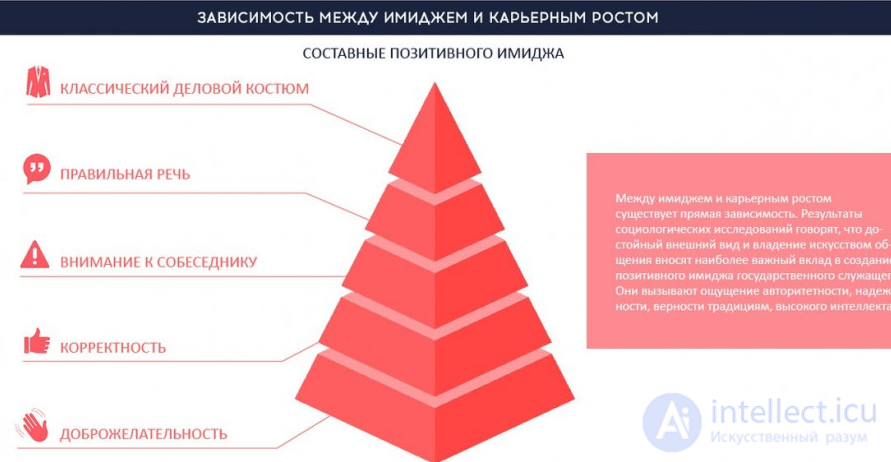
Fig. The relationship between image and career growth
It is well known that among the people with whom fate has connected us are our comrades in service, our co-workers, our colleagues in joint work. The collective in which we have chosen to work is our second home, family and school. The collective unites people – colleagues of different ages, sexes, levels of education and culture, and intelligence. Decency begins with a person keeping his word, and honestly, professionally and competently fulfilling his duties and his service obligation toward other people.
At the same time it is very important not to forget that each co-worker has his own character, habits, convictions, tastes and needs. Virtually all human qualities, both good and bad, fall under the notion of decency and indecency. A colleague at work must, first and foremost, be a decent person
An honest, modest and attentive employee of an institution, first and foremost, respects those around him and helps less experienced colleagues carry out demanding official duties. He will not allow himself to hinder others with idle talk, being late for work, wandering off, drinking, smoking in the workplace, or shifting his responsibility onto others, and he will not allow others to be idle either.
An intelligent, decent person will never allow himself, will never permit himself, to spread gossip about colleagues, will not indulge conflicts within the collective; he is ready to stand in for a sick colleague, to stand up for a colleague who has been treated unfairly. He will not fawn slavishly around his superior, will not address elders too familiarly, or deliberately look down with arrogance on those below him or equal to him. A fair-minded employee of an institution can tactfully point out a colleague's mistakes, and if he does criticize him, he does so kindly and objectively, without exaggerating or blowing out of proportion the errors and mistakes the colleague has made.
And indeed, other people's mistakes are always in plain sight. And it is good that we criticize them. But it would be even better if we treated our own carelessness and negligence with the same intolerance, so that everyone knew how to value his professional honour. So that everyone remembered that he works not for himself alone, but for other people. And that by his work people judge not only him, but the entire collective of the institution, enterprise, and so on. That is why it is fitting in such cases to recall the advice of L.N. Tolstoy: «If you are doing something, do it well. If you either cannot or do not want to do it well, it is better not to do it at all».
We spend the best part of our lives at work, in service. It is good and pleasant to work in a collective where mutual respect reigns among co-workers and colleagues, and this is a guarantee of a good mood.
That is why it is very important for co-workers to be restrained, considerate and tactful in disputes and conflict situations that arise at work. Such situations arise because, out of our own kindness, we often forgive rude, tactless people, naively thinking that their unwillingness to restrain themselves comes from their fiery nature or an upset nervous system. In reality, though, nature has nothing to do with it; such a co-worker is simply poorly brought up, or not brought up at all, is selfish, or even consciously unwilling to control his emotions.
To our great regret, «masters» of spoiling the mood have not yet died out. There are still, among co-workers, people who are malicious, selfish, envious and ill-disposed. And often they mask incompetence at work with this malice, which, as a rule, poisons the psychological climate within the collective.
In relations among employees one observes not a little that gives cause for concern. People do not always keep their word, forget their duties, fail to cope with assignments, and are late for work. Employees who respect their own work also respect that of others.
In every profession, sooner or later, a period arrives when an employee must make every effort toward self-affirmation as a master of his craft. Only someone who has the will and the interest in achieving the goal overcomes this stage. The rest remain amateurs, capable of showing their abilities only occasionally.
Mutual respect among colleagues at work – that is the guarantee of the normal functioning of any institution. That is why it is said that the simplest way to understand a person's motives – is to put yourself in his place.
Different people work alongside you in any institution: well-mannered and ill-mannered, tactful and tactless, modest and rude, shy and domineering, people with character, as they say. Some will turn to you for advice and help and will ask you for it. Others, on the contrary, look at you as a subordinate and, in a tone that brooks no objection, demand an immediate solution to their problem. And, naturally, not everyone arouses our sympathy. But we are at work, and we must be equally polite and tactful with everyone, and take care of the good reputation of our institution.
Colleagues at work must be especially correct during visitor reception hours. Unfortunately, there are still employees who pretend to listen to a visitor while feverishly thinking about which colleague to palm him off on or which other institution to send him to.
The etiquette of official relations requires an employee to be equally respectful to all visitors and ready to take part in their affairs and requests. It is absolutely unacceptable to show pointed courtesy to one visitor while behaving proudly and haughtily towards another.
A cultured employee will kindly settle a visitor's matter, courteously explain what needs to be done and how, clarify the applicable legislation on the visitor's issue, and help complete the necessary documents, regardless of whether the person in front of him is an acquaintance or not.
Business etiquette also makes equally serious demands on the conduct of visitors. A person who has come to an institution usually behaves like a guest in the home of a host he barely knows: he does not enter an office without the employees' permission, does not slam doors, politely greets those he addresses, patiently waits if they are occupied with urgent business, and does not make a scene in the event of a refusal.
The courtesy of colleagues is expressed in this: if you have set a time for someone to come, or have promised to do something – keep your word. These are elementary principles of official etiquette, obligatory for everyone.
In relations between colleagues, it would do everyone good to remember: say what you know, do what you can.
The rules of official etiquette state that:
It is better not to touch on matters of a personal nature, and not to talk about yourself, when dealing with business matters;
Discussion – is an art. You must defend your position using only objective facts. A raised, ironic tone is not an argument. Generalisations must be avoided in any discussion;
The question sometimes arises of how to react to the impoliteness or tactlessness of a colleague. Nothing works as well as a pause in the conversation that follows a tactless remark.
Listening to an interlocutor – does not simply mean keeping silent. It is unacceptable to look at the speaker with «empty» eyes reflecting your own concerns. While someone is speaking, it is unacceptable to rummage in your bag, search your own pockets, or look at your watch... While taking part in a conversation, you need to look at your interlocutor with interest and, from time to time, insert words or phrases as evidence that you understand what is being said. If you have already heard the information under discussion, it is better to tell your interlocutor so at once, rather than interrupting him mid-sentence. A grateful listener rarely interrupts an interlocutor, even if he has already heard it several times.
Conflicts of interest often arise in work collectives. In terms of official ethics, these are situations that affect the interests of employees which contradict one another. Several variants of such disagreements are distinguished:
Conflict of interest — is a situation in which a person's personal interest may affect the decision-making process and thereby cause harm to the interests of society or of the company that employs the person.
The problem of conflict of interest is relevant both for private business and for government employees. National legislation and corporate regulatory documents require conflicts of interest to be resolved. Of the greatest significance to society is the problem of conflicts of interest arising among officials, state and municipal employees, and other persons. Federal Law of the Russian Federation — Russia No. 273 «On Combating Corruption», of 25 December 2008, defines a conflict of interest as a situation in which the personal interest (direct or indirect) of a state or municipal employee affects, or may affect, the proper performance of his official (service) duties, and in which a contradiction arises, or may arise, between the personal interest of the state or municipal employee and the rights and legitimate interests of citizens, organisations, society or the state, capable of causing harm to the rights and legitimate interests of citizens, organisations, society or the state. Personal interest is understood as the possibility for a state civil servant, in the performance of his official duties, of receiving income in monetary or in-kind form, or income in the form of material benefit, directly for himself or for persons closely related to him by blood or by marriage, as well as for citizens or organisations with which the state civil servant is connected by financial or other obligations.
An organisational conflict of interest arises when an organisation provides services to a client and, owing to other kinds of activity or relationships, that organisation is unable to provide services impartially, its objectivity in performing its assigned functions is impaired or may be impaired, or the organisation gains excessively large competitive advantages.
A personal conflict of interest — is a situation in which a person's private interests — such as professional ties outside the organisation or personal financial assets — come into real or apparent conflict with the performance of existing official duties.
There are two standard solutions to a conflict of interest:
Applying these principles in practice is, however, quite difficult, and the simple method of «subtraction» is hardly likely to be appropriate in a work collective.
Nowadays, in most cases, conflicts of interest are resolved by setting priorities. When making any decisions, one has to take into account not only personal interests but also political, economic and ethical aspects. Although many modern managers believe that ethical norms are not needed in resolving conflicts, this is far from true. But nor should the moral component be placed above everything else.
All requirements need to be assessed from different angles; only in this way will you make the right decision and resolve the conflict of interest with minimal harm to all its participants.
Preventing the emergence of a conflict of interest — is the most effective way of combating this manifestation of corruption. An example of such a method is a state employee's refusal, upon receiving an appointment, of a share in a company's capital.
State employees are required to regularly declare their property and income. This makes it possible to identify and prevent the emergence of a conflict of interest. In many countries, doctors working in state healthcare must disclose information about funds received from pharmaceutical companies . In France, information on the funding of patient organisations by the medical industry is subject to disclosure. The introduction of a similar measure is currently being discussed in the USA .
Voluntary withdrawal from participation in a decision-making process associated with the emergence of conflicts of interest. Such action may be prompted by general ethical considerations, professional ethics, or a prescribed legislative act (charter).
Within the system of state service there exists a Commission on Compliance with Requirements for the Official Conduct of State Civil Servants and the Settlement of Conflicts of Interest. In parallel, there exist independent anti-corruption organisations representing the interests of society and monitoring the emergence of conflicts of interest.
Most often a conflict of interest arises when a person making a decision on the use of state funds in the form of subsidies, state contracts, grants, etc. has some relationship with a company or organisation that is one of the applicants for these funds, in cases where state funds are distributed on a competitive basis. The likelihood of a conflict of interest arising is especially high if the members or heads of the tender commission making the decision on the distribution of funds are simultaneously heads of companies or public organisations applying for funding. In Russian practice, a conflict of interest is most often not declared and not properly regulated. In the spring of 2012, the Prosecutor's Office of Novgorod Region uncovered a violation of the law by the chairman of the tender commission for reviewing applications from socially oriented non-profit organisations, I. M. Neofitov, who was simultaneously a member of the Board of Directors of the public organisation "Search Expedition «Dolina», which won this tender. I. M. Neofitov did not inform the employer's representative of this in writing and took no other measures to settle the conflict of interest . In late February, the deputy prime minister of Kaliningrad Region, Yevgeny Morozov, was removed from his post. Before that he had held the post of Minister of Construction and Housing and Communal Services and was, at the same time, a founder and owner of 100% of the shares in a number of enterprises engaged in construction activity. Morozov subsequently transferred the shares of authorised capital that belonged to him to his relatives, but continued to make decisions in favour of companies he had founded, including decisions on the conclusion of state contracts . Punishments for undeclared conflicts of interest in Russia are extremely rare. The first case occurred at the end of 2012, when the justice of the peace of judicial district No. 88 of Samara Region found the police department of Tolyatti guilty of committing an administrative offence under Article 19.29 of the Code of Administrative Offences of the Russian Federation (unlawful engagement, for labour activity or for the performance of work or the provision of services, of a state or municipal employee or a former state or municipal employee), imposing on it a fine of 100 thousand roubles. The conflict of interest arose because the police department had concluded an employment contract with a former employee of the Interdistrict Inspectorate of the Federal Tax Service of Russia No. 2 for Samara Region and, in violation of the requirements of federal legislation, failed to notify the new employee's former employer of the conclusion of the employment contract within the established 10-day period.
Conflicts of interest (COI) often arise in scientific publications. Such conflicts can lead to misconduct and increase its likelihood. Ethical standards exist in scientific publications in order to avoid conflicts of interest and resolve them, and this field continues to develop new standards. Standards vary between journals and are applied unevenly. According to the International Committee of Medical Journal Editors, «[authors] are responsible for assessing the integrity, history, practices and reputation of the journals to which they submit manuscripts».
Conflict of interest increases the likelihood of bias; it can harm the quality of research and the public good (even if disclosed). Conflicts of interest can concern research sponsors, authors, journals, journal staff, publishers and reviewers.
There is evidence that industry funding of research into medical devices and drugs causes such research to reach more positive conclusions regarding efficacy (funding bias). A similar relationship has been found in clinical trials of surgical interventions, where industry funding leads researchers to overstate the positive nature of their findings. Not all studies have found a statistically significant relationship between industry funding and research outcomes.
Chronically ill participants in medical research report that they expect to be told about COI, and some report that they would not have taken part if the researcher had had any COI. With some exceptions, several ethical principles prohibit researchers who are financially interested in the outcome from taking part in research on human subjects.
Consent agreements concluded with research participants may be legally binding on the scientists, but not on the sponsor, unless the sponsor has contractual obligations stating otherwise.
Ethical rules, including the Declaration of Helsinki, require the publication of results from trials on human subjects. [61] whose participants are often motivated by a desire to improve medical knowledge. Patients may be harmed if safety data and such risks to patients are kept secret. [57] The duties of human research participants may therefore come into conflict with interests in non-publication [57], such as gag clauses
Official etiquette — is the most important aspect of the morality of a business person's professional conduct. Knowledge of it — is a necessary professional quality that must be acquired and constantly improved.
Thus, as early as 1936, Dale Carnegie wrote: "A person's success in his financial affairs depends about 15 percent on his professional knowledge and about 85 percent — on his ability to get along with people". Many careers are ruined and much money is lost because of improper conduct or a lack of manners. Knowing this, the Japanese spend hundreds of millions of dollars a year on training in good manners and consultations on matters of etiquette and culture of conduct. They know well that the success of any firm largely depends on the ability of its employees, on their ability to work together harmoniously towards a common goal. Knowledge of etiquette and a culture of conduct — these are the key conditions for successful work in any organisation — such is the opinion of leading specialists at firms.

Comments