
Lecture
Business etiquette reflects the accumulated experience, moral attitudes and tastes of particular social groups. The foundation of business etiquette is made up of such notions as common sense, freedom, ethicality, convenience, expediency, economy, conservatism, ease, universalism and effectiveness.
Business etiquette — is a set of rules and norms generally accepted in the business sphere and in international economic cooperation, which regulate the norms of business communication (the procedure for meeting and seeing off delegations, the signing of documents, business correspondence, the conduct of events). One of the components of business etiquette is business protocol. Business protocol is based on diplomatic protocol and is a set of rules, traditions and conventions observed by officials and representatives of the business sphere.
Modern business etiquette has absorbed norms that have been selected and tested by time. There is nothing superfluous in business etiquette. It is an instrument that increases the effectiveness of communication. Knowledge of business etiquette – is a necessary professional quality that must be acquired and constantly improved. Knowledge of the rules of business etiquette allows a person to feel confident and at ease, to avoid embarrassment from incorrect actions, and to avoid mockery from those around him. Violation of etiquette norms can lead to an undesirable outcome in the process of communication and put a person in an awkward position. Almost 70% of favourable deals that fell through for domestic entrepreneurs did not take place because Russian entrepreneurs do not know the rules of business communication and do not possess a culture of behaviour. The well-known expert in the field of communication Dale Carnegie wrote back in 1936: «A person's success in his financial affairs depends about 15 percent on his professional knowledge and about 85 percent – on his ability to get along with people».
To strengthen business relations with foreign business partners, knowledge of the business etiquette of foreign countries is essential. One might recall how trade relations were established with Japan, which until the Meiji era (until 1868) was almost hermetically closed to the rest of the world. To establish business relations, a foreign merchant arriving in Japan would be presented to the emperor. The procedure of presentation was so humiliating that it was beyond the strength of not every foreign guest. The foreigner had to crawl on the floor of the reception hall from the door to the place assigned to him, and afterward, in the same way, backing away like a crab, had to leave his place and disappear through the door.
But, as in those distant times, so now, the rules of business etiquette help bring together the economic and financial interests of business people, and contribute to the establishment of business relations with partners.
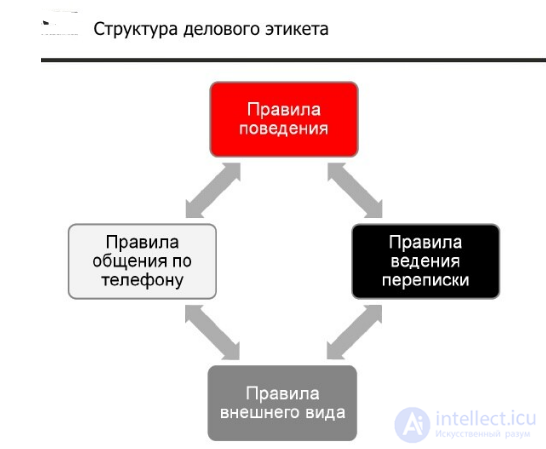
The components of business etiquette are:
behaviour during conversation, negotiations, at an official reception, at the table;
speech etiquette, which includes the rules of acquaintance, introduction, address, greeting, farewell, expressions of request, apology and gratitude;
the drafting of business documents and the conduct of business correspondence;
appearance, clothing, the exchange of business cards;
the ability to manage negative and positive emotions.
The sources of etiquette are usually considered to be the norms of morality (ethics), mythology and religion, cultural traditions, as well as social hierarchy . Business etiquette combines certain rules of military, secular and diplomatic etiquette . It is notable that, unlike the rules of secular etiquette, in business etiquette privileges are not granted on the basis of a person's age and sex. Business etiquette gives first place to the priority of subordination. Among other things, business etiquette may involve such points as: non-disclosure of confidential information, punctuality and precision in fulfilling one's duties, observance of subordination, and benevolence in communication .
Geoffrey Leech derived a principle of politeness that contributes to success in the process of communication. This principle can be used as a standard for relations between interlocutors. The theory of the politeness principle, as a guiding principle of communication, consists of six maxims:
A distinction is made between personal (business), corporate and name-only business cards. A personal (business) card personally represents its holder – it states his surname, first name, position, company name, office telephone numbers, an official or personal website, as well as an email address. A corporate business card represents the company, product or service. For this reason, the card owner's personal data is not indicated on it. All additional information is written on the back at the moment of the acquaintance. A name-only business card contains only the surname, first name and patronymic. It may also contain information about a title or academic degree. A family business card is a variety of the name-only card. It is used when making acquaintances, when sending greetings to family friends, and is enclosed with gifts. On such a card the wife's name is placed before the husband's .
Standard characteristics :
Abbreviations on business cards . There are abbreviations accepted throughout the world that are placed on cards that are sent out – they are written in pencil, not pen, in the lower left-hand corner. These abbreviations are borrowed from French, and each of them has its own meaning. The most common of them are :
In his work, I.R. Galperin notes that complex subordinate constructions predominate over compound ones. This tendency in the drafting of business documentation has developed historically, since one of the main aims of a business letter is the striving to convey a variety of meanings and variable conditions within the framework of a single sentence .
The basic formula of address in documents is: «Dear Mr. (Dear Ms.) + surname» For example: «Dear Mr. Ivanov!», «Dear Ms. Petrova!». In some cases, for example in letters of complaint, the word «dear» may be omitted from the address: «Mr. Tikhonov!». When addressing a group of persons, for example the management of an organization or the entire staff of an organization, the address «Dear Sirs!» or «Gentlemen!» is used. The same address is used when the names and positions of the letter's recipients are unknown[10]. When addressing officials of government bodies, deputies, presidents (chairmen) of societies, companies, firms, as well as clergy of various faiths, it is customary to address them by position without a surname. In letters of congratulation, invitations, and notices, it is permitted to address by first name and patronymic: «Dear Evgeny Alexandrovich!». When addressing someone, either an exclamation mark or a comma may be used, but it is recommended to keep to one style. If the address is followed by a comma, the text of the letter begins with a lowercase letter; if by an exclamation mark, with a capital[11].
Abroad, an address is an obligatory element of an official letter. The absence of an address is considered a violation of the norms of business etiquette. In correspondence with foreign correspondents, the address is formulated in accordance with the traditions of the destination country, the status and the level of the relationship between the officials. In personal forms of address, the addressee's first name (or initial) is usually omitted, leaving only the surname[12].
The following phrases can be used as a closing: «Respectfully», «With deep respect», «Best wishes».[13]
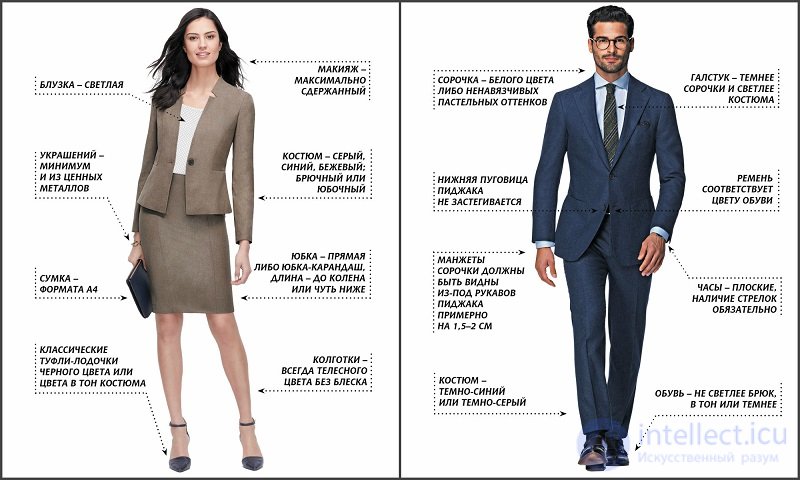
Business etiquette imposes special requirements on appearance. In many large corporations, especially Western ones, the contract specifies in detail how an employee is to be dressed. According to the British social anthropologist Kate Fox, clothing performs several functions: it warms and protects from atmospheric effects; it serves as an indicator of sex differences; it shows belonging to a particular category of society [14].
The classic of the business genre – the traditional business suit. The classic suit has undergone some changes, acquiring new details and fashionable lines, but on the whole it has remained unchanged for almost two hundred years. The optimal base tone for a business suit is gray and the whole gray range (gray-blue, gray-brown, gray-coffee, gray-burgundy, gray-olive, gray-beige, gray-green). [15].
Accessories in the business style are quite restrained and functional. It is precisely classic pieces of jewelry that allow one to place the accents in one's image correctly. An essential item – a watch. If a business person has no watch, or it does not match the business style (too small, too large, electronic, overloaded with decoration), this may signal that he has a difficult relationship with time. It is worth remembering that time is one of the most valuable resources in business[16].
The basic principle in a businesswoman's makeup is moderation. A clear accent – on the eyes or the lips – will help emphasize the expressiveness of the face and the facial expressions. A professional haircut and quality styling are also preferable, for women and men alike. Men should bear in mind that a beard and mustache create an ambiguous impression. Researchers in the psychology of perception and stylists maintain that only a smoothly shaved face and skin free of blemishes make the best impression. When choosing a fragrance, a sense of moderation is important. The perception of scents is a strictly individual process[17].
On invitations to various formal and informal events one may find an indication of the dress code, that is, the form of dress. Usually, the dress code is formulated in one or two words at the very end of the invitation to the event. The most frequently used dress codes:
White tie («White Tie») — a black tailcoat with a white bow tie. This dress code is set for the most solemn occasions, on VIP-class invitations. Guests are required to appear in a tailcoat with a white waistcoat and a white bow tie. The front of the white dress shirt must be stiffly starched. Black patent-leather shoes and a pocket watch complete this outfit. The tailcoat is not used in all countries, but in a number of states (Sweden, the United Kingdom, France, Austria) the tailcoat is recognized as official attire for attending a reception. Ladies at a formal reception should appear in long evening gowns, invariably in stockings, in long gloves reaching to the elbow, and with genuine jewelry. Dresses open at the top, often with a train, are complemented with a stole of expensive fur.
Black tie («Black Tie»), Tuxedo («Tuxedo»), Dinner jacket. Into Russian all of these expressions are translated as «men – in tuxedos, ladies – in evening wear». In different countries this dress code is called differently, but it always means one and the same thing: you must wear a tuxedo. In Russia, the tuxedo is considered precisely the form of formal attire. Trousers worn under a tuxedo, regardless of its color, are always chosen either black or dark blue. The tuxedo is accompanied by a black bow tie and a cummerbund, the pleats of which must be folded upward (a white cummerbund with a white tuxedo, black with black). Shoes should be black, but under no circumstances patent leather. Under the shoes one should wear black knee-length socks, preferably silk. The lady must without fail be in an evening gown.
Formal — this dress code is used in invitations to weddings, anniversaries, and national holidays: men wear an ordinary classic suit – dark blue in a barely noticeable stripe, dark gray, more rarely – black. A formal suit may only be a single color. At events beginning before 7 p.m., a light-colored suit is permissible. Today a handkerchief in the breast pocket of the jacket is often used as an accessory. The handkerchief should be of the same quality as the tie, and match it in color. It is recommended to wear black classic laced oxfords. Socks – only black, knee-high.
After 5 (A5) («After 5 p.m.»). In some countries this dress code prescribes even the number of buttons on the waistcoat, the shape and material of the shoes. At prestigious racecourses, for example, people wear a poplin shirt, a pearl-gray five-button waistcoat, a solid-colored tie, a woolen flannel jacket, and trousers with a crease.
Casual dress (Cd) («Casual clothing»). If the invitation carries this code, it is implied that you may come in any clothing, but at the same time you should take into account exactly which event you are attending. If you are invited to relax at an informal party, such a dress code most likely means that you need not worry about the form of dress[18].
It is important to understand that modern etiquette inherits the customs of practically all peoples. At their core, these rules of behavior are universal, since they are observed by representatives of the most varied socio-political systems existing in the modern world. Each country introduces into etiquette its own amendments and additions, conditioned by the specifics of its historical development, its social system, and its national traditions and customs. Without observing these norms, political, economic, and cultural relations are impossible. Knowledge of the rules of business etiquette accepted in other countries helps avoid mistakes and unpleasant situations when establishing business contacts, whereas disregard for national norms and traditions can lead to the breakdown of business relations after the very first handshake[19].

Comments